Accessoires IBC 1000 litres
 Couvertures Chauffantes
 Raccords Plomberie
 Bidons / Futs et raccords
 Semences
 Produits Phyto

 Jardin
 Espaces Verts
 Barbecue - Braséro - Cheminée
 Entretien
 Fluides & Climatisation
 Arrosage
How do you permanently eliminate an ant nest? Guide and solutions
- Understanding the Enemy: Why Do Ants Invade Your Space?
- The Failure of Traditional Methods: The Spray Trap
- The Science of Trophallaxis: How Frost ACTO Destroys the Nest
- Diagnosis: Identify strategic crossing points
- Application Guide: The 4 Steps to Successful Treatment
- Specific issues: "Resistant" ants and relapses
- Safety and the Environment: Protecting Homes
- Interactive Calculator: How much for your invasion?
- Diagnostic Ants Express
- Conclusion: A healthy home starts with a smart treatment
The Complete Guide to Eradicating Anthills: From Understanding to Action
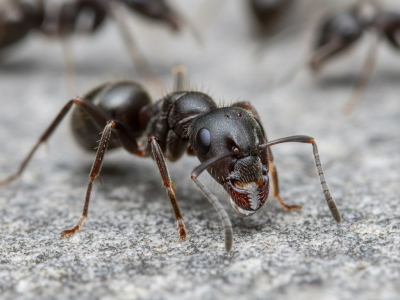
The appearance of a column of ants crossing the kitchen tiles or along the terrace tiles is often the first sign of a much larger problem. For many, the immediate reflex is to take out an aerosol and spray the visible insects. However, this approach is one of the least effective in the long term.
To permanently free a habitat from these invaders, we must stop seeing the ant as an isolated individual and start considering it as the cell of a super-organism: the colony. This guide tells you how to move from a surface fight to deep eradication using the science of insect social behavior.
Understanding the Enemy: Why Do Ants Invade Your Space?
Before treating, you need to understand what attracts these insects to your home. Ants do not settle by chance. They are in perpetual search for three resources: food (mainly sugars and proteins), water, and stable shelter.
The problem of the Girl Scouts
An anthill sends "scouts" to reconnoitre. If one of them finds a cake crumb or a drop of syrup, it returns to the nest by depositing pheromones on the ground. It is this chemical marking that creates the famous "highway" that you observe in your home.
Preventive solutions
The first solution is mechanical: remove the sources of attraction.
Store your dry goods in airtight boxes.
Clean up traces of sugary liquids immediately.
Don't let dirty dishes stagnate in the sink.
The Failure of Traditional Methods: The Spray Trap
The most common mistake is the massive use of contact insecticides (sprays).
The problem of the alarm signal
When a spray instantly kills worker ants, it sends a stress signal to the rest of the colony. The queen, feeling threatened by the decline in the number of workers, can then increase her laying rate to compensate for the losses. In some cases, it can even cause a "split" of the colony, creating two anthills instead of one.
The solution: Slow "Chemical Warfare"
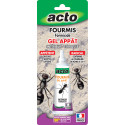
To win, you have to be discreet. The solution lies in the use of bait gels, such as Gel ACTO Ants. Instead of killing the insect instantly, its social nature is used against it.
The Science of Trophallaxis: How Frost ACTO Destroys the Nest
Trophallaxis is the way ants are fed: they regurgitate part of what they have eaten to feed the other members of the colony.
The "Trojan horse" effect
The gel ACTO contains sodium cacodylate precisely dosed so that it does not kill the ant immediately. The worker consumes the gel, attracted by its palatability, and returns to the heart of the anthill. There, she feeds the larvae and, above all, the queen.
Systemic destruction
24 hours after ingestion, the poison begins to work. In a few days, the entire social structure collapsed. Without a queen to lay eggs and without workers to maintain the larvae, the anthill is definitively extinct.
Diagnosis: Identify strategic crossing points
For the gel to be effective, it must be placed where it will be consumed. Poor placement is the No. 1 cause of treatment failure.
Indoors: Heat and humidity zones
Kitchen: Behind the refrigerator (motor heat), under the sink (humidity), and along baseboards.
Bathroom: Around water inlets and shower ducts.
Outdoors: Cracks and thresholds
Terrace: In expansion joints and under flower pots.
Walls: At the level of cracks in the plaster or door frames.
Application Guide: The 4 Steps to Successful Treatment
Identification: Observe the ants' path without disturbing them.
Partial cleaning: Clean the area but do not remove the pheromone trail (do not use bleach or vinegar before treatment), as it is what guides the ants to your bait.
Gel deposit: Place a few drops of ACTO gel (about the size of a pinhead) directly on the path or at the entrance of the cracks.
Patience: Don't kill the ants that come to eat the frost! Let them go back to the nest.
Specific issues: "Resistant" ants and relapses
Why do they come back?If ants come back after a month, it's usually not because the product didn't work, but because a new colony has taken the vacant place. Suitable areas (cracks, humidity) remain attractive.
Maintain constant monitoring. The 30g ACTO tube can be used for several applications. A preventive freezing point in spring at the doorsteps can block the establishment of a new colony.
Safety and the Environment: Protecting Homes
The use of biocidal products indoors legitimately raises safety issues for children and pets.
The bitterner: A safety barrierThe gel ACTO incorporates a bittering agent (Bitrex). Its taste is so repulsive to humans and mammals that it causes an immediate rejection reflex in the event of an attempt to swallow it, while remaining undetectable to ants.
Interactive Calculator: How much for your invasion?
To help you calibrate your purchase and treatment, we have developed an interactive script. This tool estimates the amount of gel needed based on the extent of your problem.
Diagnostic Ants Express
Where do you see ants?
How intense is the invasion?
Well-formed columns
Massive Invasion (Multiple Pieces)
Conclusion: A healthy home starts with a smart treatment
Fighting ants is not a question of strength, but of strategy. By switching from spray to gel, you are acting like a professional pest control professional. You are no longer treating the symptom (the visible ants), but the disease (the anthill).
With precise application, compliance with contamination times (24 hours) and maintenance of hygiene, you guarantee your home a serene summer. The Ant ACTO Gel Tube is the precision tool you need to transform your terrace and interior into an invader-free zone.
Share this content