



 Accessoires IBC 1000 litres
 Couvertures Chauffantes
 Raccords Plomberie
 Bidons / Futs et raccords
 Semences




 Produits Phyto

 Jardin


 Espaces Verts
 Barbecue - Braséro - Cheminée
 Entretien
 Fluides & Climatisation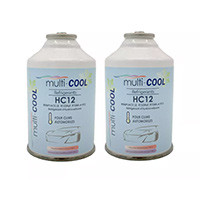
 Arrosage
Recharging your air-conditioning with a Duracool 12a can
Recharging an AC system with Duracool 12a takes a quarter of an hour, engine running, with a can, a hose fitted with a gauge and the right low-pressure coupler. This page gives the full procedure as we have recommended it for fifteen years, the pressures to respect and the mistakes that cost a compressor. If you do not yet know which Duracool or how much you need, start with the Duracool 12a guide.
The equipment
- The can: Duracool 12a 170 g for an R12 or R134a system, Duracool 12a-yf for a 1234yf system. One can is enough for a small car, two for a saloon (the calculation is in the guide).
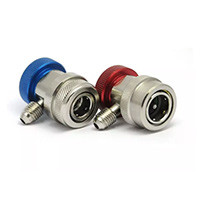
- The recharge hose: the DC402 kit — piercing valve on one end, gauge, and both R12 (screw-on) and R134a (quick) couplers on the other. For a 1234yf vehicle, the DC402 version with 1234yf coupler.
- A scale accurate to the gram (optional but recommended) to weigh the can before and after.
- A thermometer placed in the centre vent: a correctly charged AC blows at 7-8 °C.
- Gloves and goggles.
The cans + hose pack brings the essentials together. Avoid cheap unbranded hoses: their valve damages the can thread, and the cans become unusable or leak.
Before you start: find the low-pressure port
The circuit has two service valves. You always recharge on the low-pressure side: it is the larger-diameter pipe, and its valve has a cap marked L (usually blue or black). The high-pressure valve (cap H, red, thin pipe) does not accept the R134a low-pressure quick coupler — that is a safety feature. Some Renault models have only one valve, high pressure: you then need the DC402 kit with high-pressure coupler. If you cannot find it, our article where is the low-pressure valve of my AC? locates it brand by brand.
The procedure, step by step
- Prepare the valve. Before screwing on the can, turn the piercing valve fully anticlockwise: the pin must be fully retracted, otherwise it pierces the can while screwing on and the gas escapes.
- Screw on the can by hand, without forcing. The assembly is sealed as long as the pin is retracted.
- Fit the right coupler to the other end of the hose: R134a quick, R12 screw-on, or 1234yf depending on the vehicle.
- Start the engine, AC at maximum, fan at maximum, windows open. The compressor must run (if it has cut out for lack of gas, it will start with the first grams injected).
- Remove the L cap and connect the coupler to the low-pressure valve: pull back the collar, push, release — the collar returns into place when the connection is good. Read the static pressure on the gauge.
- Pierce the can by turning the valve fully clockwise, then reopen it the other way to release the gas.
- Turn the can upside down for the whole charge: Duracool must enter as a liquid.
- Charge in stages: open for a few seconds, close, let it run 30 seconds so pressures equalise, repeat. Watch the gauge: the ideal charging zone is the blue zone, between 30 and 45 PSI (2 to 3 bar). Never exceed 45 PSI on the low-pressure side.
- Know when to stop. Three concordant signs: the needle in the blue zone and stable, the compressor no longer cycling every 45-60 seconds, and air blowing at 7-8 °C on the thermometer. If the cabin is not yet cold, add in small doses, letting it run a few minutes in between — overcharging cools worse than undercharging.
- Close and disconnect. Valve closed fully clockwise, then pull back the coupler collar: it releases by itself. Put the L cap back.
- Label. Stick the supplied "charged with Duracool 12a" label near the service port: the next technician must know the circuit contains a hydrocarbon.
Gas left in the can? Leave it screwed onto the closed valve, away from heat and flames, in a ventilated place: it stays sealed for several months and will serve another vehicle. To fit a second can, close the valve before unscrewing the first, otherwise the gas in the circuit escapes.
The mistakes that cost money
- Connecting to the high-pressure side: the can may burst. Low pressure only, cap L.
- Exceeding 45 PSI: overcharge, degraded cooling, compressor at risk. When the AC does not cool despite a correct pressure, the problem lies elsewhere (expansion valve, condenser, fan), not in the amount of gas.
- Charging with the engine off: without the compressor nothing circulates and the low-side pressure shoots up.
- Injecting additives after the gas: Duradry, stop-leak and oil go before the Duracool, in the order given in the guide.
- Mixing gases in a circuit full of another refrigerant: empty it or have it vacuumed first, then charge the calculated quantity.
- Looking for a leak with a flame: electronic hydrocarbon detector, soapy water or UV dye, nothing else.
- A hose that damages the thread: the can leaks at the valve and the recharge is lost.
Still not cooling?
A normal pressure and a lukewarm cabin point to a mechanical or electrical fault, not a lack of gas: car AC not blowing cold: the diagnosis and the checks to make before recharging go through compressor, clutch, fan, expansion valve and cabin filter. An AC that empties every season has a leak: Duracool SystemSeal seals micro-leaks at seals, evaporator and condenser, to be injected before recharging. And if the air is cold but smells bad, it is the evaporator: why does my AC smell bad.
For professionals: charging from a cylinder
With a 5.4 kg cylinder or 9 kg cylinder and a station: recover the existing charge into a suitable container (never mix refrigerants), pull a vacuum to −69 kPa (−10 psi), then with the compressor off charge Duracool 12a as a liquid on the low-pressure side; once the minimum charge is reached, start the compressor and top up. Do not exceed 414 kPa (60 psi) on the low-pressure side. Check pressures and temperatures, fit the Duracool 12a label on the circuit. After an overcharge or a repaired leak, empty completely and recharge from zero: the quantity is calculated with the guide's ratio, never by the sight glass.
Frequently asked questions
Do I need to pull a vacuum before recharging with Duracool?
Ideally yes: air and moisture in the circuit degrade performance. Without a station, two cases: the AC still works a little → top up in stages; it has been empty for a long time → first inject a can of Duradry to capture moisture, then the gas.
Can I recharge with the engine running?
You must: the compressor has to draw the gas in. Engine running, AC on, fan at maximum.
How long does a recharge take?
Ten to fifteen minutes, stages included. The longest part is finding the low-pressure valve the first time.
What if the can does not empty?
Check that the pin has pierced properly (valve screwed fully in then reopened), that the can is upside down, and that the compressor is running. A cold can empties more slowly: stand it in lukewarm water for a few minutes, never hot.
Can I use an R134a hose from a shop?
The R134a low-pressure coupler is standard; the problem is the piercing valve on low-end hoses, which damages the can thread. Our DC402 hoses are tested with our cans.