



 IBC 1000 L accessories
 Heating jackets
 Fittings
 Drums, jerrycans & fittings
 Seeds

 Plant protection & biocides


 Garden

 Green spaces & municipal
 Barbecue, fire pit & fireplace
 Cleaning & care
 Refrigerants & air conditioning
 Watering
Duracool 12a: everything about the hydrocarbon refrigerant
Duracool 12a is a hydrocarbon-based refrigerant (propane and isobutane) that replaces R12 and R134a in car air-conditioning and refrigeration systems. It is not fluorinated: it escapes the quotas and restrictions of the F-gas Regulation, can be bought freely, and one 170 g can is enough for most cars. This guide explains which one to choose, how much to charge, what equipment you need and what the regulations say. Already holding the can? Go straight to the step-by-step recharge procedure.
What exactly is Duracool?
A blend of purified hydrocarbons (propane R290 and isobutane R600a) formulated to replace fluorinated gases in cooling systems. It works in circuits designed for R12 or R134a without changing the compressor, oil or seals, and at a lower discharge pressure — the compressor works less. The range has three references:
| Reference | Replaces | Typical use |
|---|---|---|
| Duracool 12a | R12 and R134a | Car air-conditioning up to 2016-2017 models, refrigerators, motorhomes, cold rooms |
| Duracool 12a-yf | HFO R1234yf | Recent vehicles (after 2017) running on 1234yf |
| Duracool 22a | R22 | Older fixed air-conditioning and heat pumps |
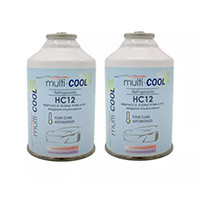
Multitanks has distributed Duracool since 2010 and also offers two equivalent 12a brands, Multicool 12a and Climapure 12a: same hydrocarbon composition, same uses, same can thread compatible with our recharge hoses.
Which Duracool for my car?
It all depends on the original gas, shown on the label under the bonnet (usually near the radiator or on the wheel arch) and on the service port.
| Original gas | Vehicles concerned | Product to use |
|---|---|---|
| R12 | Before about 1994, classic cars | Duracool 12a — with the screw-on R12 fitting from the DC402 kit |
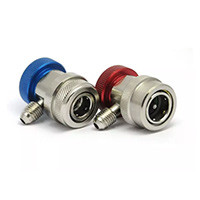
| R134a | From 1994 to 2016-2017, the vast majority of cars on the road | Duracool 12a — R134a low-pressure quick coupler |
| R1234yf | New vehicles since 2017 | Duracool 12a-yf — dedicated 1234yf quick coupler |
| R22 | Fixed air-conditioning, older mono-splits | Duracool 22a |
1234yf is expensive and its coupler is different: our article 1234yf AC too expensive: the Duracool 12a-yf alternative covers recent vehicles. For a full comparison of the three gases, see Duracool 12a, R134a, R1234yf: the comparison.
How much Duracool should I charge?
The charge of a system is always given in grams on the vehicle label (for example "R134a 550 g"). Hydrocarbon molecules are lighter, so you need noticeably less Duracool than the original gas. The ratio to apply:
| Original gas | Calculation | Example |
|---|---|---|
| R134a | stated charge ÷ 2.7 | 650 g of R134a → 650 ÷ 2.7 ≈ 240 g of Duracool 12a |
| R12 | stated charge ÷ 3 | 1,200 g of R12 → 1,200 ÷ 3 = 400 g of Duracool 12a |
| R1234yf | stated charge ÷ 2 | 500 g of 1234yf → 500 ÷ 2 = 250 g of Duracool 12a-yf |
A can holds 170 g. In the R134a example, 240 g means two cans, the second only partly used — provided the system is empty. If gas remains, top up in stages while watching the pressure: that is what the recharge procedure explains. A kitchen scale accurate to the gram is the best tool to avoid overcharging.
Which format to buy?
| Format | For whom | Indicative price |
|---|---|---|
| Duracool 12a 170 g can | One car, one recharge. Screws onto the piercing valve of the hose. | €14.63 |
| Duracool 12a self-sealing can | Same content, self-sealing valve: the can closes when unscrewed, the remainder keeps. | €14.63 |
| Multicool 12a 420 g | Large systems (vans, motorhomes) or several vehicles. 1/2" ACME thread. | €26.25 |
| Pack of 4 Climapure 12a | The best price per can for a workshop or a fleet. | €52.50 |
| 5.4 kg cylinder and 9 kg cylinder | Professionals with a charging station: liquid charge through the manifold. | €650 / €850 |
To charge a can you need a hose with a piercing valve and a low-pressure coupler: the DC402 kit (€29.90) includes the R12 and R134a fittings and a gauge; it also exists in a 1234yf version and with a high-pressure coupler for vehicles that have only one valve. The cans + hose packs cost less than buying separately. We advise against cheap hoses of Asian origin: their valves damage the can threads and cause leaks — the number one reason for returns we see.
Duracool additives: which ones, in which order
The range includes treatment cans, to be injected before the gas, each containing a little Duracool 12a to restart a compressor that has cut out on low pressure:
- Duradry — removes moisture from the circuit (do this first: moisture corrodes and blocks the expansion valve).
- Kwykdie — tracer dye to locate a leak.
- Sealquick — stop-leak for micro-leaks at seals; or SystemSeal, more complete, which also treats the evaporator and condenser.
- AC Oil Chill — R12/R134a-compatible oil, if the circuit has lost oil.
- Then the Duracool 12a gas.
Use only what the circuit needs; if you use several, keep this order. An AC system that loses its gas every season has a leak: sealing it before recharging saves you a second can.
What the regulations say
Duracool is a hydrocarbon, not a fluorinated gas. The EU F-gas Regulation 2024/573, in force since March 2024, cuts HFC quotas and pushes the price of R134a up year after year; it does not cover hydrocarbons. National rules on who may buy and handle refrigerants vary: in France, the certification required for fluorinated refrigerants (R134a, R1234yf, R22) does not apply to hydrocarbons, which is why a private individual may buy Duracool and recharge his own air-conditioning — something not possible with R134a. From 1 January 2027, the new French certification scheme brings hydrocarbon handling into scope for professionals: a workshop will need to be certified, which changes nothing for a private individual working on his own vehicle. Check the rules that apply in your own country.
Two obligations remain in every case: Duracool is flammable (class A3) — work outdoors or in a ventilated space, away from flames, no smoking — and the system must carry the "charged with hydrocarbon" label supplied with the product, near the service port, to warn the next technician. Also check the manufacturer's warranty on a recent vehicle: some exclude it after a change of refrigerant. For the full context, see the 2024 F-gas regulation and its consequences.
Safety
- Gloves and goggles: liquefied gas causes cold burns.
- No flame, spark or heat source nearby; never expose the can to more than 55 °C (a car in the summer sun is enough).
- Recharge outdoors or in a ventilated space, never in a closed garage.
- Leak testing only with an electronic hydrocarbon detector, soapy water or UV dye — never with a flame.
- Read the instructions printed on the can before starting.
Frequently asked questions
Is Duracool 12a compatible with an R134a AC system?
Yes: that is its main use. Same compressor, same oil, same expansion valve; only the recharge coupler differs (quick coupler on R134a, screw-on for R12).
Do I have to remove the old gas before adding Duracool?
Ideally the circuit is vacuumed: residual air degrades performance. In practice, if the AC still works a little, you can top up with Duracool in stages while watching the pressure; if it is completely empty, charge the calculated quantity directly. Never mix two different gases in a full circuit.
How many cans for a car?
A small car (R134a charge of 400 to 500 g) needs 150 to 185 g of Duracool: one 170 g can, sometimes a little more. A saloon or SUV (600 to 800 g) needs two cans. A van or motorhome may need three, or one 420 g Multicool can.
Is Duracool dangerous?
It is flammable, like lighter gas, and is handled with the precautions above. It is neither toxic nor corrosive, does not deplete the ozone layer, and its greenhouse effect is negligible (GWP of about 3 versus 1,430 for R134a).
Duracool or Deepcool?
Deepcool was the trade name of the same product in Europe; some references in our catalogue still carry it. Duracool, Deepcool, Multicool and Climapure are 12a gases of the same nature, interchangeable.
Where can I buy Duracool in Europe?
From Multitanks, distributor since 2010: cans, cylinders, hoses and fittings in stock, shipped within 24 to 48 hours across Europe. See the 12a refrigerant gases category.