



 IBC 1000 L accessories
 Heating jackets
 Fittings

 Drums, jerrycans & fittings
 Seeds
Seeds 
 Plant protection & biocides

 Garden


 Green spaces & municipal


 Barbecue, fire pit & fireplace
 Cleaning & care
 Refrigerants & air conditioning
 Watering

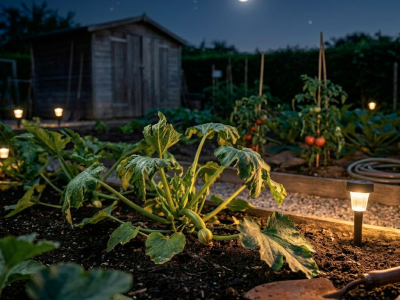
Sweltering nights: why your plants can no longer recover
Everyone knows that midday heat puts plants under strain. But another phenomenon, far less well known, is taking hold in our gardens: nights that no longer cool down enough to allow recovery. On the night of 8 to 9 July 2026, Météo-France recorded 30.0 °C at Cap Béar in the Pyrénées-Orientales, an all-time nocturnal record across all months, as well as 27.0 °C in Nîmes and 26.6 °C in Avignon. These figures are not mere statistical anomalies: they reflect a climatic shift whose consequences for your garden are as real as they are poorly understood.
🌙 AT NIGHT, PLANTS DON'T REST: THEY BREATHE
Night is not a period of inactivity for plants: on the contrary, it is the moment when their mitochondrial respiration, which is active twenty-four hours a day, becomes the only major metabolic process under way, without photosynthesis to compensate. During the day, thanks to sunlight, plants produce sugars through photosynthesis by absorbing CO2. At night, this sugar factory shuts down completely, but respiration continues to consume a portion of the reserves accumulated during the day.
This mechanism is perfectly normal and necessary. Nocturnal respiration allows the plant to maintain its vital functions, fuel cell growth and finance the repair of tissues damaged by the stresses of the day. According to the Encyclopédie de l'Environnement, the intensity of this nocturnal respiration accounts for between 10 and 15 % of gross photosynthesis. In other words, the plant "spends" each night a significant fraction of what it produced during the day — a fraction that must remain moderate for the overall energy balance to stay positive.
The challenge is therefore simple to understand: if nocturnal respiration runs out of control, the plant spends more sugars than it can reasonably produce the following day, and its energy reserves dwindle night after night. This is precisely what happens when the night-time temperature remains abnormally high.
🌡️ WHY NIGHT-TIME TEMPERATURE IS THE KEY FACTOR
A cool night is the essential condition for moderate nocturnal respiration: it is what slows the plant's metabolism and allows it to retain most of the sugars produced during the day for growth and fruiting. The link between temperature and respiratory rate is direct and well documented: the higher the temperature, the faster the respiration, regardless of the species in question.
A comparison drawn from the world of sport helps to make this phenomenon intuitive. A runner who picks up the pace sees both their breathing rate and body temperature rise simultaneously: their body burns more energy per unit of time. For a plant exposed to a warm night, the scenario is the same: the outdoor thermometer does not drop low enough, the cellular "engine" runs at too high a speed, and reserves melt away faster than expected. With 30.0 °C recorded at Cap Béar in the middle of a July 2026 night, it was as though the plants in that region had spent the night "running" without ever being able to stop.
The condition for normal recovery is that the night-time temperature should be significantly lower than the daytime temperature. This difference is the sign that the plant can finally slow its metabolism and devote most of its reserves to repair and growth. When that gap disappears — as during the nights recorded in Nîmes (27.0 °C) or Avignon (26.6 °C) in July 2026 — the plant never benefits from that recovery window, and stress accumulates day after day.
🌿 CONCRETE CONSEQUENCES THE GARDENER CAN OBSERVE
A plant deprived of truly cool nights displays very real symptoms, documented by agronomic research: damage to flowers, slowing of growth, and accelerated depletion of sugar reserves. What makes these signs puzzling for the gardener is that they resemble those of water stress, even when watering is perfectly regular.
A plant that seems permanently "tired", whose flowers abort or whose fruits develop less well than expected, is not necessarily short of water. It may simply be short of energy, its sugar reserves having been squandered night after night by overly intense nocturnal respiration. This diagnosis is often overlooked because it is less visible and less immediate than a leaf wilting from drought.
The most vulnerable crops are those whose energy balance is most heavily taxed: tomatoes, peppers, courgettes, and fruit trees during the fruit-set period. For these plants, every warm night represents an additional energy deficit that accumulates over the weeks. To optimise watering in your garden during periods of heat and limit thermal stress, well-planned irrigation remains an essential first lever.
During overly warm nights, the energy available for flowering and fruit set decreases. Flowers may abort, fruits remain small or develop irregularly — a symptom too often attributed to poor watering, when the real cause is thermal and nocturnal in origin.
The sugars produced during the day normally serve cell growth. If nocturnal respiration consumes too large a share of them, the plant lacks the "raw materials" it needs to develop. Vegetation appears to stagnate even in the height of summer, the very period when it should be most dynamic.
Unlike water stress, which manifests quickly through wilting, nocturnal thermal stress sets in slowly and silently. The plant weakens week by week, becoming more vulnerable to diseases and pests, without the root cause being obvious at first glance.
🌱 HOW TO HELP YOUR PLANTS GET THROUGH HOT NIGHTS BETTER
Faced with nights that no longer cool down sufficiently, several gardening measures can help limit the build-up of heat around plants and preserve their recovery capacity as much as possible. None of these measures is spectacular in isolation, but their combination can make a noticeable difference to the overall condition of the garden after a prolonged heat wave.
These four levers are complementary and target different stages of the same problem: reducing the heat input during the day, limiting the storage of that heat by the soil, and actively lowering the temperature at the start of the night. Together, they create the conditions for a slightly cooler micro-environment, in which the plant can resume more moderate nocturnal respiration.
🔍 A STRESS FACTOR DISTINCT FROM WATER SHORTAGE, AND ONE THAT IS HERE TO STAY
Nocturnal heat constitutes a plant stress factor in its own right, independent of water stress and often little known to the general public as well as to experienced gardeners. This point is fundamental: a correctly watered garden can still experience significant yield losses during a summer marked by repeated warm nights. Watering, however well done, does not compensate for the absence of nocturnal coolness.
The values recorded on the night of 8 to 9 July 2026 by Météo-France are not a simple isolated peak: they are part of a climatic trend observed over several decades, according to which minimum night-time temperatures are rising at a rate comparable to, or even slightly faster than, maximum daytime temperatures. In other words, the recovery window that the night traditionally offered to plants is shrinking year after year. Adapting one's gardening practices accordingly is therefore not a one-off precaution, but a structural necessity for the years ahead. Also consult our resources on watering adapted to summer conditions and on gardening during periods of intense heat.
💡 Multitanks Expert Tip — The thermometer as a diagnostic tool
A simple outdoor thermometer, read twice a day — at sunset and then at sunrise — is enough to assess how difficult the night has been for your plants. If the minimum night-time temperature remains above 20 °C, your plants' respiration remains elevated. Above 25 °C, nocturnal thermal stress is significant, even for Mediterranean species. The smaller the difference between the daytime and night-time temperature, the more useful nocturnal cooling measures — mulching, shading, late watering — become, even in the absence of any visible sign of drought. Do not let a garden that appears correctly hydrated cause you to overlook this invisible but very real factor.
Share this content