Accessoires IBC 1000 litres
 Couvertures Chauffantes
 Raccords Plomberie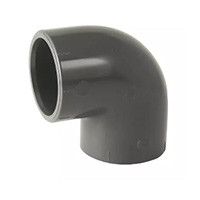
 Bidons / Futs et raccords
 Semences

 Produits Phyto
 Jardin
 Espaces Verts
 Barbecue - Braséro - Cheminée
 Entretien

 Fluides & Climatisation
 Arrosage
Screwing or gluing PVC pressure: which method to choose?
- The technical fundamentals of PVC assembly: understanding gluing and screwing
- Why choose bonding for your fixed high-pressure installations
- The strategic advantage of screwdriving for maintenance and winterization
- Successfully sealing your screw fittings: the expert tutorial
- Building a mixed network: the ideal compromise to last
- Help with the choice: Fitting & Sealing
The technical fundamentals of PVC assembly: understanding gluing and screwing
Before diving into the comparison, it is essential to understand what is physically involved in the assembly of a PVC-U PN16 fitting. In plastic plumbing, we are not talking about a simple fixing, but a real structural integration that must withstand the pressure.
Gluing, which professionals call "cold welding", uses a specific solvent glue. This product will temporarily soften the surface skin of the tube and fitting. As it dries, the two parts fuse together to form a single piece of polymer.
It is the preferred solution for:
Fixed installations subject to strong vibrations.
Constant high-pressure systems where no movement is tolerated.
Buried areas where a leak would be catastrophic to repair.
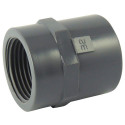
On the other hand, the screwing is based on a removable mechanical connection. Here, the seal is not ensured by a fusion of the material, but by the compression of a sealing agent (PTFE tape, wire or gasket) between two threads: the male and the female.
This method requires impeccable thread accuracy. This is where the choice of PVC-U PN16 makes sense: its walls are thick enough to withstand the mechanical tension of the screwing without splitting, unlike low-end fittings that crack at the slightest tightening.
Choosing between these two methods is not just a matter of preference. It is an analysis of the lifespan of your installation. A fully bonded network is a fortress against leaks, but it is frozen. A screwed network offers incomparable maintenance flexibility.
Why choose bonding for your fixed high-pressure installations
Bonding remains the absolute standard for underground networks or complex filtration circuits. The major advantage of cold welding is its rock-solid reliability over the long term.
Unlike a threaded connection which can, under the effect of thermal cycles (hot/cold water) or water hammer, end up taking on a micro-play, the bonding is definitive. We recommend this method for:
The pipes under a terrace slab.
Watering networks buried more than 40 cm.
Risers under high pressure.
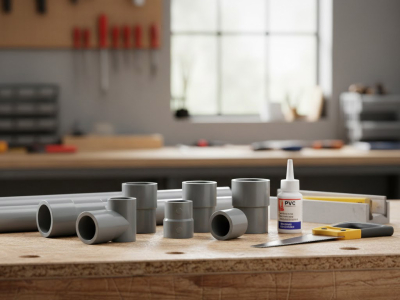
The tutorial for a professional collage: To succeed in your assembly, the procedure does not tolerate any shortcuts. It all starts with surface preparation:
Deburring: Clean the end of the tube.
Chamfering: Create a slight slope on the outside of the tube to prevent it from "pushing" the glue to the bottom of the fitting.
Stripping: Use a PVC stripper (Cleaner). This is a crucial step to open the pores of the plastic and ensure chemical fusion.
Application: Spread the glue evenly and snap together in a straightforward, twist-free motion.
The golden rule is to respect the drying time. Although the setting is fast, it is necessary to wait about an hour per bar of pressure before putting on water. For a classic 1.5 bar pool system, wait at least two hours. For a PN16 full-capacity test, a 24-hour wait is the only guarantee of real safety.
The strategic advantage of screwdriving for maintenance and winterization
If gluing is the rule for the structure, screwing is the king of modularity. Imagine your pool technical room or your pumping station: this equipment has a limited lifespan compared to fixed pipes.
A pump can fail, a filter can scale or a valve can freeze. In a 100% glued system, the slightest replacement requires taking out the saw, cutting the tubes and attempting complex sleeves.
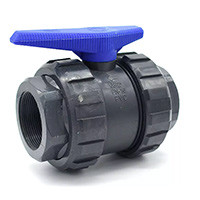
Tapped PVC-U is a game-changer: By integrating 3-piece union fittings or screw-on valves, you can provide your system with controlled "breaking points". The screwing allows disassembly in seconds without any destructive tools.
This is the number one asset for wintering:
You unscrew the pump fittings.
You empty it of its residual water.
You store it in a dry place to prevent frost from bursting the pump housing.
For automatic watering systems, the use of screw-on manifolds makes it possible to replace a defective solenoid valve without having to redo the entire distribution clarinet. However, screwing on plastic requires skill.
The most common mistake is to squeeze too tightly at the end of the day. This may stretch the female thread to the crack. A good screw-in assembly is often finished by hand, completed by a quarter turn with the strap wrench. It's the sealing provided by the tape or gasket that does the job, not brute force.
Successfully sealing your screw fittings: the expert tutorial
Successful threaded connection on PN16 PVC requires more care than on metal. Plastic is sensitive to temperature variations and has a smooth surface, which can cause the sealant to slide.
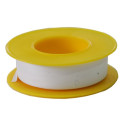
Choosing the right sealant: For small diameters, PTFE (Teflon) tape remains the reference. But be careful with the installation:
The meaning: Wrap the tape clockwise (looking at the end of the tube). Upside down, it will peel off when screwed.
Quantity: Don't hesitate, 10 to 15 turns are often necessary to ensure real compression.
For larger diameters, you can opt for:
Plastic filasse: Excellent certified alternative to PVC.
The O-ring: It is the most reliable system. It is found on professional union fittings.
Careful: Never use classic hemp filasse with metal joint paste. Hemp swells with moisture and can cause the plastic female fittings to burst by too much internal pressure.
If your fitting has a built-in O-ring, no PTFE tape is required. Waterproofing is ensured by the compression of the rubber. A simple silicone lubricant is enough to prevent it from being crushed crookedly. This system is much more resistant to vibrations than Teflon.
Building a mixed network: the ideal compromise to last
The winning strategy, which we recommend at Multitanks, is to design functional "blocks". Use PN16 rigid PVC pipe and glue-down elbows for your water transport lines, as this is the most economical and robust solution.
These lines must then lead to transition fittings: the famous composite fittings (one side to be glued, one side to be screwed). Let's take the example of a pump installation:
The water supply: It is made of rigid glued tube for maximum stability.
The pump connection: A 3-piece union fitting is used. One side is glued to the tube, the other is screwed onto the pump inlet.
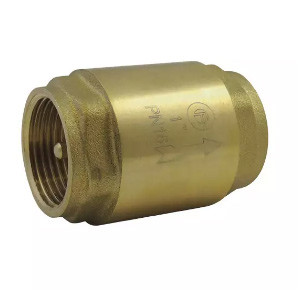
Safety: A non-return valve to be screwed in at the outlet is installed. This makes it easy to clean if an impurity is blocking it.
This approach makes it possible to "freeze" the immobile parts while maintaining total freedom over the mechanical parts. It is also a lifesaver in the event of an assembly error. If you get the wrong angle on a glued fitting, you need to cut. If you have screw points, you can adjust the orientation without destroying anything.
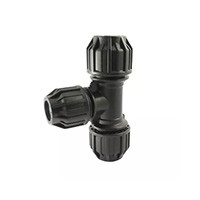
For irrigation networks, screw-in tees for sprinkler feeders allow the model of the sprinkler to be changed over the years without touching the underground pipe. By combining the strength of bonding and the flexibility of BSP tapping, you build a durable, scalable and above all, professional installation.
Help with the choice: Fitting & Sealing
Share this content