IBC 1000 L accessories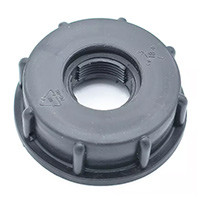
 Heating jackets
 Fittings
 Drums, jerrycans & fittings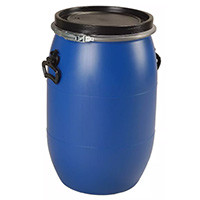
 Seeds
Seeds 
 Plant protection & biocides

 Garden
 Green spaces & municipal

 Barbecue, fire pit & fireplace
 Cleaning & care
 Refrigerants & air conditioning
 Watering
5 Genius Ideas for Reusing a Full Opening Keg
When we think of blue plastic drums, our collective imagination immediately conjures up images of factories, industrial logistics and shipping. Yet these ultra-sturdy containers made from High Density Polyethylene (HDPE) conceal extraordinary potential. Thanks to their ergonomic design, perfect watertightness and impact resistance, open-top drums have become a favorite playground for DIYers, gardeners and upcycling enthusiasts. At Multitanks, we see our customers transforming these simple drums into veritable treasures of ingenuity. Discover the unsuspected uses of open-top drums and give free rein to your creativity!
The great classic revisited: the made-to-measure water recovery station
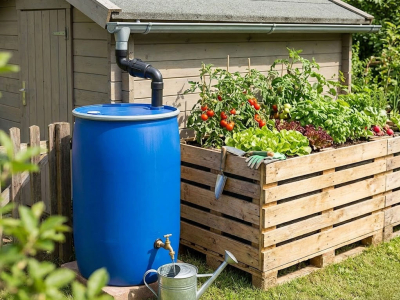
This is the queen of uses, the one that combines ecology and savings. But why settle for a simple trough under a gutter when you can design a real pumping and filtration station? The barrel's removable, fully-opening lid allows full access, which makes all the difference when it comes to annual cleaning of the sediment or algae that inevitably forms at the bottom of stagnant water.
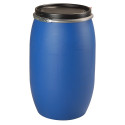
For a large-scale reclamation project, the blue 220-liter full-opening drum is the perfect candidate. Its large capacity can store the equivalent of dozens of watering cans. The DIY (Do It Yourself) trick is to couple several 220L drums together to multiply your storage capacity ad infinitum. Using the principle of communicating vessels, all you have to do is pierce the bottom of the drums and connect them.
To make these watertight connections without risk of leakage, you'll need special fittings. HDPE is easy to drill with a standard hole saw. Once the hole has been drilled, all you need to do is install a grommet. You'll find all the professional hardware you need in our dedicated overflow and grommet department. Add a brass tap to the front, and you've got a water tank worthy of a professional installation at a fraction of the price.
Rotary or fixed composters: the gardener's black gold
Composting is the key to a thriving garden. But wooden composters rot over time, and commercial plastic models are often fragile or difficult to stir. A plastic barrel with a full opening offers an indestructible alternative for transforming your green waste into fertile compost.
The simplest version consists in taking a barrel, drilling a multitude of 10 mm ventilation holes on the sides and bottom with a drill, and placing it on the ground. The perfectly airtight lever lid will prevent rodents (rats, mice) from gaining access to your peelings, while retaining the heat needed for bacterial fermentation.
For more advanced do-it-yourselfers, the "rotary composter" is the Holy Grail. By passing a metal axle (a simple galvanized steel tube) through a 220L or 120L barrel on wooden trestles, you create a cylinder that you can manually rotate every week. Stirring becomes child's play, oxygenation is maximized, and your compost will be ready twice as fast! Combined with our superb pallet-raised vegetable patches (for which we've written a complete assembly guide), your garden will be perfectly self-sufficient.
Bivouacs, boating and road-trips: the ultimate watertight housing
Let's get out of the garden and go on an adventure. Enthusiasts of canoeing, kayaking, rafting or 4x4 raids know the secret: small, fully-opening drums are the best watertight containers in the world. Forget expensive waterproof bags that end up piercing a rock. A small HDPE drum floats, absorbs violent impacts against rocks, and protects your belongings from mud, total immersion and dust.
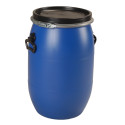
For this nomadic use, the compact format is preferred. Our 30-liter full-opening blue drum is the star of expeditions. Its small size allows it to fit in the back of a pick-up truck or in the boat. It can be used to store food away from wild animals, to protect electronic equipment (cameras, drones), or even to isolate wet clothes from the rest of the camp.
Maceration, fermentation and home brewing
Do It Yourself also applies to gastronomy! Craft beer brewing, preparing nettle purin for the garden, macerating large quantities of cabbage for sauerkraut, or storing brine for olives all require special containers. It must be food-grade, chemically inert so as not to alter flavors, and feature a large opening for stirring.
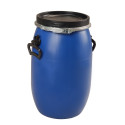
The 60-liter full-opening blue barrel is the absolute compromise for these preparations. Easy to clean thanks to its large diameter, its lid can be pierced to fit a bubbler (which lets fermentation gases escape without letting in outside air). For gardeners, macerating comfrey or nettles in the pot will produce a powerful natural fertilizer, while keeping odors (often dreaded) in check thanks to the metal hoop seal.
Anti-odour tip: When macerating liquid manure, gas pressure can cause the lid to pop off if it's tightly closed. Always leave the strapping slightly loose during active fermentation, or install a small degassing valve on top!
Industrial furniture, upcycling and decoration
Who said industrial plastic lacked charm? In keeping with the trend towards upcycling (the art of recycling from the top down by creating valuable objects), the blue barrel has been diverted from its primary function to equip our exteriors in a clever and indestructible way.
There's no shortage of ideas for do-it-yourselfers. Cut in half lengthways, a 220L barrel becomes a huge raised planter (very popular in permaculture), or an excellent hay rack for horses and sheep, with no risk of cutting the animals thanks to the flexibility of the plastic.
Some daring do-it-yourselfers even use upturned 60L drums as legs for small outdoor tables, or turn them into large, watertight sandboxes for the kids (simply close the lid at night to keep the sand dry and cat-proof). The advantage of HDPE is that it can easily be spray-painted (by first applying a plastic primer), allowing you to hide the industrial blue under a color in harmony with your garden.
Safety and precautions for your DIY projects
While anyone can handle Multitanks drums, there are a few common-sense rules to follow before getting out the jigsaw:
1. Never modify a drum intended for the transport of hazardous materials: If you've bought a new drum for a regulated chemical or gasoline storage project (UN standard), the slightest drilling will invalidate its approval and jeopardize your safety. DIY is reserved for water, solids, gardening or decoration.
2. Deburr your cuts: Cut HDPE creates sharp edges. After using a hole saw or jigsaw, always use sandpaper or a file to smooth the edges, especially if the barrel is intended to interact with animals or children.
3. Pre-cleaning: Our Multitanks kegs are sold new, clean and ready to use. If you recover old drums by other means, make sure you know their history. A barrel that has contained motor oil or toxic plant protection products should never, ever, be turned into a composter or water reclaimer for the vegetable garden.
Conclusion: Imagination is the only limit
Simplicity is often the ultimate form of sophistication. The full-opening barrel, with its basic but formidably effective design, perfectly embodies this adage. Whether it becomes a watertight sanctuary for your camping gear, a super-fast composter for your vegetable garden, a brewing tank for your beer or a simple rainwater collector, its durability will see you through decades of use.
The strength of DIY lies in its modularity. With the right containers (from 30 to 220 liters) and the right connecting accessories, you have the power to design systems perfectly suited to your space and budget constraints. Explore our Multitanks catalog, choose your capacity, get out your tools, and give an unexpected second life to this industrial storage classic!
Answer this question to find out Multitanks!
Share this content