IBC 1000 L accessories
 Heating jackets
 Fittings
 Drums, jerrycans & fittings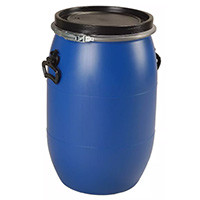
 Seeds
Seeds 
 Plant protection & biocides
 Garden
 Green spaces & municipal
 Barbecue, fire pit & fireplace
 Cleaning & care
 Refrigerants & air conditioning
 Watering
Optimising its conservation: Why does opening the barrel change everything?
Storing a product, whether food, chemical or natural, is more than just hiding it in a closed container. Storage is a veritable science of preservation. Every day, thousands of liters of fluids evaporate, kilos of foodstuffs oxidize and water reserves stagnate because of an unsuitable container. At Multitanks, we know that the choice of your drum opening (total or bunghole) is your merchandise's first line of defence. Find out how to optimize your storage and extend the life of your products.
The great enemies of long-life storage
Before tackling material solutions, it's crucial to understand what we're up against. A stored product, whether liquid or solid, is constantly under attack from its environment. To ignore these factors is to condemn your goods to accelerated degradation.
The first of these enemies isoxygen. Ambient air is responsible for oxidation. It turns oils rancid, alters the taste of food and changes the properties of certain fine chemicals. The more air your container lets through, the faster the degradation process. Next comesambient humidity, capable of turning a perfectly dry powder into an unusable block of concrete, or promoting the appearance of mould in your grains.
Finally, thermal variations and light (UV) play a catalytic role. Ultraviolet rays destroy vitamins in food products and degrade polymers. This is why the vast majority of our industrial HDPE drums are dyed opaque blue, an ideal color for blocking light penetration while repelling some of the summer heat.
Food processing and dry goods: the challenge of watertightness and access
When it comes to storing products intended for animal or human consumption (kibbles, seeds, honeys, or spices in bulk), the requirements are twofold: a hermetic barrier against rodents and humidity, while maintaining ergonomics for daily picking.
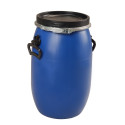
In this scenario, the bung barrel is automatically disqualified. This is where the total opening reveals its full potential. The large lid, secured by a lever-operated strap, compresses a thick gasket that completely isolates the inside of the barrel from the outside atmosphere. This system traps dry air inside and blocks out moisture, guaranteeing crispy kibbles or viable seeds for months to come.
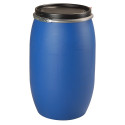
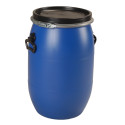
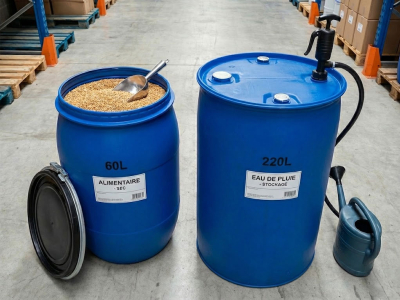
For this very purpose, our favorite and best-seller is the blue 60-liter full-opening drum. Why 60L? Because it's the perfect size to hold the contents of one or two large bags of industrial foodstuffs, while remaining easy to move around thanks to its integrated handles. It's just as at home in a domestic cellar as in a beekeeper's laboratory or an equestrian center's storeroom. Integral cleaning between two storage cycles guarantees absolute hygiene, with no inaccessible nooks and crannies.
Water control: avoid putrefaction and algae
Collecting and storing rainwater is a very different matter. Water is a living element. When it stagnates in an opaque container, micro-organisms, pollen and organic matter carried by the wind or washed off your roof end up settling there.
If you use a closed container (such as an old bung tank) to store raw water, you're exposing yourself to a major problem: the formation of a slimy biofilm on the walls and a thick layer of silt at the bottom. If you can't reach in with your arm or a high-pressure cleaner, this sludge will ferment, giving off nauseating odours of hydrogen sulphide (rotten egg smell) and making the water unsuitable even for watering delicate plants.
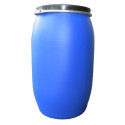
For this reason, rainwater must be completely open. For a generous but space-saving gardening supply, we recommend the blue 120-liter full-opening barrel. This volume can cope with heavy spring rainfall, while making annual maintenance much easier. At the end of the summer season, simply open the large lid to empty the residue, sponge-wipe the walls and start again on a healthy footing for the following year. What's more, its flat lid allows you to cleanly drill a hole for your roof gutter.
Did you know? Even mains water (tap water) deteriorates if stored for too long. The chlorine added by treatment plants evaporates naturally within a few days. To store drinking water for the long term (resilience, survival), it's essential to use a perfectly cleaned food-grade barrel (virgin HDPE), placed in complete darkness and in a cool place, and to add specific purifying treatment drops.
Securing chemicals and volatile liquids: structural sealing
If the total opening shines by its accessibility, it finds its limits when handling fine chemicals, solvents, fuels or very fluid oils. Here, the lid's large seal, however effective, represents a potential leakage perimeter too vast to cope with the pressure of the gases generated by the evaporation of a hydrocarbon.
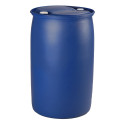
For these sensitive fluids, conservation means "absolute containment". This is the exclusive mission of the bung barrel. Molded in a single monoblock piece with no welds or large lids, the bung barrel eliminates 99% of the risk of evaporation or oxidation. The only two points of contact with the outside world are the ultra-precise 2" and 3/4" bung threads, sealed by high-performance O-rings.
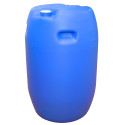
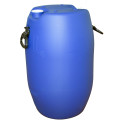
If you need to store solvent-based paints, emergency fuel, industrial cleaning products or reactive chemicals, we'd point you straight to the 60-liter blue bung drum. Its intermediate size makes it easy to handle in the workshop, while offering an industrial-grade protective barrier. What's more, it allows you to screw a manual dosing pump directly onto the large bung, thus avoiding exposing all the liquid to the open air (and your lungs to fumes) every time you need to draw off a liter of product.
The golden rules Multitanks to maximize the life of your products
Whatever keg you choose, the quality of its opening won't do everything if the storage environment is neglected. Here's our expert advice on how to optimize your storage logistics:
1. Headspace management: In a half-empty container, the amount of air (and therefore oxygen and moisture) trapped with your product is significant. For products that are highly sensitive to oxidation, always try to store in a drum whose capacity corresponds exactly to the volume of your goods. A 60L drum full will protect your oil better than a 220L drum a quarter full.
2. Tightening "just right": On a fully-open drum, there's no point in forcing the lever-operated hoop beyond its natural stop, or adding weight to the lid. This would only crush and irreversibly deform the profiled rubber seal, destroying its elasticity and thus its watertightness for future use.
3. Thermal shock: HDPE is a robust plastic, but the liquids inside are subject to thermal expansion. A barrel of liquid filled to the brim, hermetically sealed (without a vent plug) and left in the August sun will build up pressure until the walls are deformed, or the container may even blow up. Always remember to leave an air gap of 5 to 10% when filling liquids, to absorb this natural expansion.
Conclusion
When it comes to logistics, "who can do more can do less" is a false proverb. Optimizing storage requires a perfect match between the nature of the product and the engineering of its container. Total opening drums excel in protecting solids, powders and foodstuffs, while offering the best solution for maintaining a water supply. Conversely, as soon as the product is volatile, hazardous or sensitive to the slightest evaporation, the hermetic structure of the bung barrel becomes non-negotiable.
Good management of your container logistics will save you precious handling time, while securing your investment in merchandise. If you still have questions about the volume or type of closure best suited to your specific activity, our experts at Multitanks are on hand to analyze your needs and guide you towards the ideal container.
Discover the ideal container to protect your goods over the long term.
Share this content