IBC 1000 L accessories
 Heating jackets

 Fittings
 Drums, jerrycans & fittings
 Seeds
Seeds 

 Plant protection & biocides

 Garden


 Green spaces & municipal

 Barbecue, fire pit & fireplace
 Cleaning & care
 Refrigerants & air conditioning
 Watering
Full Opening Keg or Bungs: The Expert Choice Guide
The choice of an industrial or domestic container is far from being a detail. Anyone who has ever struggled to extract a viscous product from a too-narrow orifice, or witnessed with horror the evaporation of an expensive solvent, knows that the engineering of a drum dictates its use. At Multitanks, we guide you through the technical intricacies of storage. Full-opening drum or bung barrel? Dive into the heart of a strategic choice that will impact your logistics and your costs.
The anatomy and philosophy of the full-opening drum
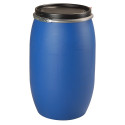
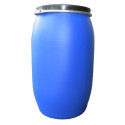
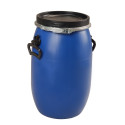
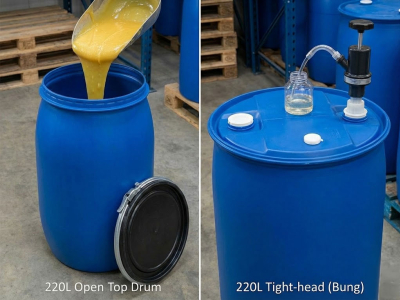
The total-opening keg, often referred to as the lidded keg, is designed for absolute freedom of access. Visually, it features a cylindrical body with a completely unobstructed top. The opening is equal to the container's internal diameter, fundamentally altering the way we interact with the stored material.
To ensure that this huge opening is watertight, manufacturers use an independent lid, usually fitted with a gasket made of natural rubber, EPDM or polyurethane, depending on the chemical compatibility required. This lid is then sealed to the body of the keg by means of a lever-operated metal hoop (or sometimes a screw-on lid for small quantities). The lever lock compresses the seal, ensuring a robust closure.
This architecture makes this container the undisputed champion of ergonomics. It allows complete visual inspection, full high-pressure cleaning without the slightest shadow, and allows the insertion of bulky tools or lifting pumps directly into the product. Feel free to explore our extensive range of total opening drums to discover the models best suited to your needs.
The one-piece fortress: the bung barrel
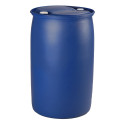
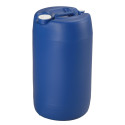
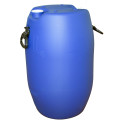
At the opposite end of the accessibility spectrum is the bung barrel (also known as the plastic L-Ring barrel). Here, safety takes precedence over accessibility. The bung barrel is a closed structure, blown or molded in one piece (or welded for metal). The "roof" of the barrel is immovable and an integral part of the body.
Communication with the interior is via two standardized openings called bungs. The worldwide standard configuration includes a 2" main bung (S56x4 or G2 thread) for filling and pumping, and a 3/4" secondary bung (G3/4). Why two openings? Fluid physics demands it. When emptying through the large bung, air must be able to enter through the small one to avoid the vacuum effect, the famous "glugglish" phenomenon that causes potentially dangerous splashes.
Each bung is fitted with its own tamper-proof seal and an ultra-precise O-ring. This design guarantees a structural tightness that cannot be matched by total opening. When it comes to transporting sensitive liquids or chemicals, our selection of bunghole drums is the safest choice on the market.
From 30 to 220 liters: the right container size
Choosing the right opening is not enough: you must also choose the right volume. An error in sizing can make it impossible to handle your drums on a daily basis. Bear in mind that a drum filled with water weighs 1 kg per liter. While the 220-liter full-opening drum remains a global logistics standard optimized for pallets, it is not the most suitable for manual handling without the aid of a forklift truck.
That's why, at Multitanks, our real bestsellers are in intermediate volumes, offering the perfect balance between storage capacity and ergonomics. The undisputed star of our catalog is the blue 60-liter full-opening drum. Often fitted with integrated carrying handles, they can be handled by just one person, even when full, greatly reducing the risk of musculoskeletal disorders (MSD). They are massively popular with private individuals for the storage of animal kibbles and seeds, and with craftsmen for maceration and small-scale chemistry.
Our second best-seller is the blue 120-liter full-opening keg. Highly prized in the catering, farming and gardening sectors, it offers generous volume (ideal for brine, composting or a nice water reserve) while retaining a very reasonable footprint. Finally, for very small quantities or laboratory sampling, the 30-liter formats round off this ultra-versatile range.
Viscous, solid and bulk products: The reign of total openness
The rheological nature (viscosity and flow) of your product is the first judge of peace. As soon as you leave the realm of water or fluid oil, the bung barrel becomes a logistical nightmare.
Take the agri-food or heavy chemicals industry, for example. Storing honey, fruit puree, mechanical grease, glue or resin involves a major problem: total product recovery. In a bung barrel, a viscous product will line the walls and refuse to drain. You risk losing up to 10% of your product at the bottom of the drum, generating huge financial losses.
With a full-opening drum, the problem is eradicated. The operator can use a follower plate (which scrapes the walls as it goes down), a spatula or a submerged pump to extract every last gram of product. Similarly, for powders, plastic granules or agricultural seeds, the total opening allows straightforward pouring and unrestricted use of shovels.
Fluid liquids and volatile chemicals: the bastion of the bung barrel
If handling solids requires space, managing volatile liquids demands rigor. The number one enemy of solvents, fuels, alcohol and certain fine chemicals is evaporation, often coupled with oxidation.
The large joint of a full-opening drum represents a microscopic but real point of weakness over a perimeter of almost two meters. In contrast, bungs offer a minimal leakage surface, sealed by precision-machined screw threads. The bung barrel integrates perfectly into automated industrial processes. It becomes a truly airtight dispenser, protecting the operator from inhaling toxic vapors during the transfer of heavy chemicals.
Multitanks tip for rainwater: Although the water is free-flowing, we recommend the full-opening barrel for rainwater harvesting in the garden. Why would we do this? Because algae, leaves and sediment will inevitably accumulate at the bottom. Only a fully-open barrel will enable you to clean your tank with a sponge or hose at the end of the season to prevent putrefaction.
Accessories and connectivity: Optimizing your installation
A barrel on its own is just a dead container. What turns it into an efficient workstation are its peripherals. At Multitanks, we know that filling ergonomics are vital.
For bung barrels, the standardization of threads (Tri-Sure 2" and 3/4") allows for a professional level of equipment. To open the seals without damaging the screw threads, it's essential to have a bung wrench (in metal or spark-proof plastic). Next, you can directly screw on brass or HDPE filling valves, ideal for drip dispensing or filling smaller cans.
For full-opening drums, accessorizing often involves custom drilling. You can add watertight grommets at the bottom of the tank to connect a garden hose, or fit the lid with bubblers for fermentation processes. Whatever your project, you'll find everything you need (valves, S60x6 fittings, wrenches) in our dedicated drum and tank accessories department.
UN regulations and transport of dangerous goods (ADR)
The choice of opening becomes a legal requirement when transporting goods classified as hazardous by road, sea or air. UN (United Nations) approval defines drastic resistance standards subject to severe crash-testing.
The general rule is: the presence of a removable lid mechanically weakens the whole unit in the event of a violent impact. Consequently, drums with bungs (UN 1A1 or 1H1 marking) are mandatory for transporting the vast majority of hazardous, toxic or flammable liquids.
Full-open drums (UN 1A2 or 1H2 marking) are generally UN-certified only for the transport of solid hazardous materials. Please note that a UN-certified drum for solids must never be used to transport a hazardous liquid on public roads. In the event of an accident, you could be held criminally liable.
The duel of materials: HDPE versus steel
The type of opening is intrinsically linked to the material chosen for the drum. High-density polyethylene (HDPE) is the undisputed king of versatility. It is unalterable, shock-resistant thanks to its shape memory, and never rusts. Ideal for the food industry, chemical acids and bases, it can be stored outdoors in the rain without deterioration.
Steel (metal drums) comes into play when the limits of plastic are reached. Steel offers ultimate mechanical strength and incomparable fire resistance. Above all, it is totally impervious to gas permeation. Certain aggressive solvents can slowly permeate through plastic walls, which is impossible with metal. If the metal drum is intended for food use, its interior is coated with a special epoxy-phenolic varnish.
Comparative summary for an informed decision
To help you make the right decision, here's a simplified overview of our expertise Multitanks, based on the most common scenarios encountered by our customers.
| Type of use or product | Total opening keg | Bung Barrel |
|---|---|---|
| Powders, granules, seeds | Ideal | Unsuitable |
| Honeys, glues, resins, greases | Ideal (scraping possible) | Unsuitable (heavy losses) |
| Solvents, essences, volatile products | Not recommended (evaporation) | Ideal (hermetic) |
| Water recovery and gardening | Ideal (algae cleaning) | Possible but complex cleaning |
| Road transport of liquids ADR | Limited by approval | Mandatory (Standard 1A1/1H1) |
Frequently asked questions on drum use and maintenance
How can I prolong the life of the seal on my open-end drum?
The seal is the only part of your container that wears out. To preserve it, avoid storing the keg in direct sunlight for long periods (UV rays dry out the rubber). Always clean the seal after pouring chemicals or sugary syrups, which could cause it to stick to the rim. Finally, if the barrel remains empty, close the strapping without forcing it to the maximum, so as not to crush the profile of the seal unnecessarily.
Can I change the bung system on my keg?
On a keg with one-piece bungs, the threads are molded in the mass and cannot be changed. However, the wide range of adapters and reducers in our accessories section make it possible to overcome this problem and connect the majority of conventional pipes without any hazardous DIY.
Conclusion and final advice from our experts
The match between the full-opening and the bung barrel is not a question of one model's superiority over the other, but a strict question of compatibility with your workflow. The full-opening barrel is the all-rounder par excellence, offering the freedom of action and ease of maintenance that appeal to market gardeners and food manufacturers alike, especially in the ultra-practical 60 and 120-liter sizes.
The bung barrel, meanwhile, is the high-security keeper, designed to confine hazardous liquids, prevent evaporation and integrate into precise, standardized distribution circuits.
Take the time to analyze not only the nature of your product, but also the way in which you are going to fill, empty and clean the container. If you have any doubts about chemical compatibility or the standard required for your transport, the experts on the Multitanks team will be happy to guide you towards the perfect reference.
Take the 2-click test to find your ideal Multitanks container.
Share this content