IBC 1000 L accessories
 Heating jackets
 Fittings
 Drums, jerrycans & fittings
 Seeds
Seeds 
 Plant protection & biocides
 Garden
 Green spaces & municipal
 Barbecue, fire pit & fireplace
 Cleaning & care
 Refrigerants & air conditioning
 Watering
Diatomaceous Earth vs Chemical Insecticide: Which One Should You Choose?
- 1. Diatomaceous Earth: The invisible (and fearsome) shield
- 2. Liquid insecticides: the heavy artillery
- 3. The Duel: Point-by-Point Comparison
- 4. Real-life examples: What to do in your case?
- 5. My "pro" tips for a successful application
- 6. The Hybrid Approach: The Key to Peace of Mind
- In summary: What is your side?
Diatomaceous Earth vs. Chemical Insecticides: The Match for a Healthy Home
Have you spotted a few ants in single file in the kitchen? Or worse, do you suspect the presence of bed bugs after a trip? We all know this feeling: an immediate desire to declare war on intruders. But before running to the drugstore aisle and emptying the first spray that comes along, a question arises: should we favor the lightning efficiency of chemistry or the strategic patience of natural?
Between diatomaceous earth, the miracle powder that everyone is talking about, and conventional liquid insecticides, the heart is swinging. On the one hand, the promise of ecology; on the other, strike force.
In this complete guide, we unpack everything. No complex jargon, just concrete, real-life examples and an unfiltered comparison to help you choose the most suitable weapon for your situation.
1. Diatomaceous Earth: The invisible (and fearsome) shield
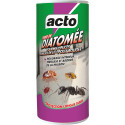
If you've never heard of it, diatomaceous earth is not a laboratory invention. It is a mineral powder derived from the fossils of microscopic algae (diatoms).
The principle of the "crystal sword"
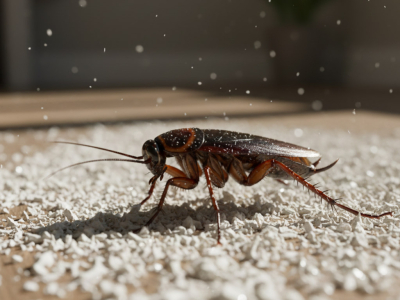
Contrary to what one might think, diatomaceous earth does not poison the insect. It acts mechanically. For us, it's a flour-fine powder. For an insect, it's a field of razor blades.
Abrasion : When stepping on it, the insect suffers micro-cuts on its shell.
Absorption : The powder sucks lipids out of the insect's cuticle.
The result : The insect becomes dehydrated and dies within a few days.
Why do we love it?
The biggest advantage is durability. As long as the powder remains dry and is not sucked in, it works. One year, two years, ten years... it never "expires". In addition, no insect can become resistant to a physical cut. It is the anti-evolution weapon par excellence.
2. Liquid insecticides: the heavy artillery
Here, we are talking about chemical molecules (often pyrethroids) designed to attack the nervous system of pests. This is the "One Shot" solution.
A neurotoxic action
When you spray a liquid insecticide, you aim for the "knock-down" effect. The insect is paralyzed almost instantly. It's radical, it's visual, and it immediately relieves the stress of the infestation.
Why do they remain useful?
In some emergency situations, you can't wait for the insects to dehydrate quietly. If you have a wasp nest inside or a massive proliferation of bed bugs, the liquid can treat large areas and reach the nooks and crannies by capillary action.
3. The Duel: Point-by-Point Comparison
| Criterion | Diatomaceous Earth | Liquid Insecticides |
| Speed | Slow (2 to 7 days) | Fast (immediate) |
| Security | Excellent (if food grade) | Vigilance (toxic to cats/fish) |
| Pricing | Very economical | More expensive in the long run |
| Application | Dusty | Wet / Invisible |
The question of toxicity: a crucial point
Let's be honest: "natural" does not mean "without precautions".
Diatomaceous earth is safe if ingested by your dog (it's even used as a dewormer!). On the other hand, it is very irritating to the respiratory tract. When you apply it, wear a mask!
Chemical liquids, on the other hand, leave residues. If you have a baby crawling on the floor or a cat licking its paws after stepping on the treated area, the risk of poisoning is real.
4. Real-life examples: What to do in your case?
To help you decide, here are three classic scenarios encountered by our customers.
Case n°1: The ant colony in the kitchen
The classic reflex : The chemical spray. The result? You kill all 50 visible ants, but the queen continues to lay eggs in the wall.
The "Help & Advice" solution : Sprinkle diatomaceous earth behind your baseboards and in the path of the ants.
What for? It's clean, economical, and it creates a permanent barrier that ants will never cross again.
Case n°2: The invasion of bed bugs
It's an absolute nightmare. Here, diatomaceous earth alone may not be enough because it does not act fast enough to stop nocturnal bites.
The winning strategy : Use a liquid insecticide (or steam treatment) to clean the mattress and bed frames. Then, apply diatomaceous earth in the footboard cups and in the cracks in the walls.
The trick : Chemistry kills the current invasion, diatomaceous earth kills the stragglers who come out of their hiding places three weeks later.
Case n°3: Parquet fleas (with animals)
If you're treating your salon with harsh chemicals, you'll need to evacuate the room for several hours, ventilate, and worry about your cat.
The alternative : Sprinkle your carpet and parquet floor generously with diatomaceous earth. Leave on for 48 hours, then vacuum. This is radical to pierce the shell of fleas without poisoning the air in your home.
5. My "pro" tips for a successful application
If you choose diatomaceous earth :
Choose the "Food Grade" : It is the only uncharred version, safe for vertebrates.
Have a light hand : No need to make piles 2 cm high. Insects are clever: if they see a "mountain", they go around it. You need a light, almost invisible veil, like icing sugar on a cake.
The magic tool : Use a bellows or brush to work the powder into the slots.
If you choose liquid insecticide :
Read the label : We can never say it enough. Some products are fatal for cats (permethrin).
Target the areas : Don't spray in the middle of the room, it's useless. Target door frames, windows and under sinks.
Ventilate : Minimum 2 hours after application.
6. The Hybrid Approach: The Key to Peace of Mind
In our country, we believe very much in integrated pest management. Why choose only one side?
The best method is often to treat the immediate problem with a targeted action (physical or light chemical) and then secure your home in the long term with diatomaceous earth. It's the difference between putting on a bandage and strengthening your immune system.
By using diatomaceous earth at the "bottom of the tank" (behind kitchen furniture, in roller shutter boxes, under household appliances), you create a house hostile to pests in a natural and permanent way.
In summary: What is your side?
Do you want an ecological, zero risk of resistance and ultra-economical solution? Dash into Diatomaceous Earth. It is the Swiss Army knife of the healthy home.
Are you facing a health emergency, a massive or localized invasion that prevents you from sleeping? The Liquid Insecticide will be your best ally to regain control quickly.
One last piece of advice : Whatever the method, cleanliness remains your first line of defense. A regular vacuum cleaner and food stored in airtight boxes is worth all the insecticides in the world!
Share this content