IBC 1000 L accessories
 Heating jackets
 Fittings
 Drums, jerrycans & fittings
 Seeds
Seeds 
 Plant protection & biocides

 Garden
 Green spaces & municipal
 Barbecue, fire pit & fireplace
 Cleaning & care
 Refrigerants & air conditioning
 Watering
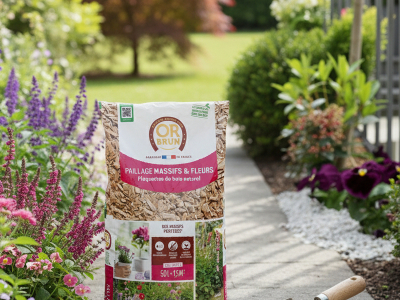
The Art of Natural Mulching: Complete Guide, Calculation & Advice | Multitanks
- Why choose poplar: a species with unique properties
- The Calculation Method: how many bags for my project?
- Concrete example for your beds:
- Longevity comparison: a sustainable investment
- The heat shield and water saving
- Installation Guide: The 3 Golden Rules
- Conclusion: the commitment to a living garden
- Take action: Estimate your needs in one click!
- Mulching Calculator?
The Art of Natural Mulching: The Complete Guide to a Sustainable and Economical Garden
Modern gardening is no longer just about planting and watering. In the face of climate challenges — scorching summers, unpredictable winters and scarcity of water resources — our practices must evolve. Mulching, once a simple grandfather's trick, has become the centerpiece of sustainable green space management.
Among the solutions available, natural poplar wood chips are an excellent choice. Aesthetic, light and incredibly effective, they make garden maintenance a real pleasure.
Why choose poplar: a species with unique properties
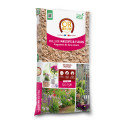
The choice of wood species for mulch is never trivial. For its range of natural wood chips, Or Brun has favoured poplar for its technical and ecological qualities. Poplar is a species of wood called "soft", which gives it a remarkable lightness.
For you, the gardener, this means that a 50-litre bag is still easy to handle, usually weighing between 12 and 15 kg depending on its moisture content. From an agronomic point of view, poplar has a balanced pH (around 8), respecting the balance of the majority of ornamental plants and the vegetable garden. Its 10-40 mm gauge allows for dense coverage while allowing the floor to breathe.
The Calculation Method: how many bags for my project?
This is the crucial question before placing an order. Insufficient thickness will allow light (and therefore herbs) to pass through, while an unnecessary excess will weigh on your budget. Here is the universal mathematical formula to memorize:
Area to be covered (m²) × Desired thickness (cm) × 10 = Total volume in litres.
Concrete example for your beds:
If you have a 15 m² bed and are aiming for the recommended thickness of 4 cm :
15 m² x 4 cm x 10 = 600 Liters
By using 50 Litre bags, you will therefore need: 600 / 50 = 12 bags.
Correspondence table (Thickness 4 cm):
| Mulching Area | Volume Needed | Number of 50L Bags |
| :--- | :--- | :--- |
| 2 m² | 80 Liters | 2 bags |
| 5 m² | 200 Liters | 4 bags |
| 10 m² | 400 Liters | 8 bags |
| 20 m² | 800 Liters | 16 bags |
Longevity comparison: a sustainable investment
Why prefer wood chips to other mulches? It's all a question of structure and decomposition.
Straw and flax/hemp flakes : Very light, they decompose in just 6 to 12 months. They are ideal for the fast-moving vegetable garden, but require frequent renewal.
Pine bark : Durable, but it acidifies the soil, which can harm plants that don't like acidity.
Poplar wood chips : They offer the best compromise. Thanks to their caliber (10-40 mm), they have a lifespan of 2 to 3 years. They remain stable against the wind and do not fly away at the first sweep. This is the "long-lasting" solution that enriches the soil with humus very gradually.
The heat shield and water saving
Think of your plant roots as the engine of your garden. They need stability. In summer, bare soil can reach extreme temperatures, causing intense water stress. Mulch acts as a natural umbrella, keeping the soil cool.
This protection reduces watering requirements by 30% to 50%. The water no longer runs off the surface during storms; It gently seeps in to benefit the roots directly. In winter, this same mulch plays the role of an insulating duvet against frost.
Installation Guide: The 3 Golden Rules
Pre-cleaning : Carefully weed the area by hand. Mulching is preventive, it does not eliminate plants that are already rooted.
The collar rule : Never glue the plates against the trunk or main stem. Leave a small 2cm gap to avoid any risk of rot due to excessive moisture against the bark.
Strategic storage : If you don't use your bags immediately, store them away from the rain. The pads are porous: if they become waterlogged, the bag will be much heavier to handle!
Conclusion: the commitment to a living garden
Mulching with poplar wood chips is a strategic investment. You save time on weeding and you save a precious resource: water.
It is a clean, elegant solution that can be used in organic farming. By protecting your beds today, you feed the micro-organisms that will make your soil fertile tomorrow. Offer this protective mantle to your garden, it will return it to you with a radiant vigor.
Take action: Estimate your needs in one click!
You now have all the keys in hand to transform your garden with natural mulching. But one question remains: how much exactly should you order for your beds? Don't leave any more room for chance! To make your life easier, we have developed an interactive Mulching Calculator. Simply indicate the surface area of your area to be protected and the desired thickness: our tool instantly calculates for you the number of 50L bags needed. Take the test below and prepare your project with peace of mind:
Mulching Calculator?
Calculate the number of 50L bags needed
Technical precision: This calculation is based on standard spreading. If your land is very sloping, do not hesitate to opt for the thickness of 5 cm (Maximum Protection) to ensure better stability of your wood chips against runoff.
Share this content