Accessoires IBC 1000 litres
 Couvertures Chauffantes
 Raccords Plomberie
 Bidons / Futs et raccords
 Semences
 Produits Phyto

 Jardin



 Espaces Verts
 Barbecue - Braséro - Cheminée
 Entretien
 Fluides & Climatisation
 Arrosage

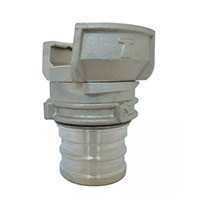
Guillemin Fitting: DN Sizes and How to Measure Correctly
Ordering a Guillemin fitting based solely on the DN shown on the product sheet is, by far, the most common source of error in professional settings. Not through negligence, but because DN is not a physical measurement — it is a compatibility designation between fittings of the same family, and on its own it says nothing about the actual diameter of the socket designed to receive a flexible hose. This article provides the complete correspondence table, concrete proof that DN40 alone can refer to six different socket diameters, and an unambiguous measurement method so you never order by guesswork again.
🔧 DN: A DESIGNATION, NOT A MEASUREMENT
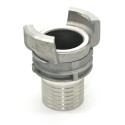
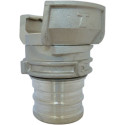
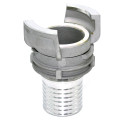
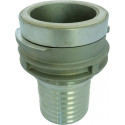
Nominal diameter — abbreviated DN — is a series identifier. It guarantees that a male Guillemin DN40 fitting will correctly assemble with a female Guillemin DN40 fitting, regardless of brand or material. That is its role, and it fulfils it perfectly. But what DN does not tell you is the actual physical diameter of the socket — that is, the barbed end onto which the flexible hose is fitted — of the specific reference you have ordered. This distinction is fundamental, and it is all too often overlooked.
In practice, a single DN can group several references whose sockets have different outer diameters, depending on whether the fitting is designed with or without a flange, depending on the manufacturer, and depending on the intended application (thin flexible hose, reinforced hose, industrial flexible). In other words, two fittings bearing exactly the same DN may be physically incompatible with the same hose. This is precisely the point that explains the majority of returns and ordering errors observed with this type of product.
🔧 PROOF BY DN40: SIX DIAMETERS FOR A SINGLE IDENTIFIER
DN40 is the most illuminating — and most risky — example. According to the Pathel Industrie manufacturer catalogue, a Guillemin DN40 fitting can have a socket of 25 mm, 30 mm, 35 mm, 38 mm, 40 mm or 45 mm depending on the exact reference. Six different diameters for one and the same DN: this is the DN that concentrates the most variants across the entire Guillemin range, and therefore the greatest risk of ordering error. A discrepancy of a few millimetres between the socket and the inner diameter of the hose is enough to make fitting impossible or, conversely, too loose to be leak-tight.
This is not an isolated case. Other DN sizes also have multiple variants: DN25 exists with a socket of 25 or 30 mm, DN32 with 32 or 35 mm, DN80 with 76, 81 or 90 mm depending on whether or not a flange is present. The table below summarises all known correspondences as they appear in the manufacturer catalogue. It should be read as a guide, not as an absolute truth: only the product sheet for the exact reference ordered is authoritative.
🔧 DN / SOCKET DIAMETER CORRESPONDENCE TABLE
The following table lists the socket diameters observed for each DN in the Guillemin range, based on the Pathel Industrie catalogue. DN sizes with multiple variants are highlighted: these are the ones that require maximum vigilance before any order is placed.
| DN | Observed socket diameter(s) | Note |
|---|---|---|
| DN25 | 25 mm or 30 mm | 2 variants — check the reference |
| DN32 | 32 mm or 35 mm | 2 variants — check the reference |
| DN40 | 25, 30, 35, 38, 40 or 45 mm | ⚠️ 6 variants — highest-risk DN |
| DN50 | 50 mm (without flange) or 55 mm (with flange) | 2 variants depending on flange |
| DN65 | 64 mm (without flange) or 70 mm (with flange) | 2 variants depending on flange |
| DN80 | 76 mm or 81 mm (without flange) or 90 mm (with flange) | 3 variants — caution |
| DN100 | 100, 102 or 105 mm (without flange) or 110 mm (with flange) | 4 variants — caution |
| DN125 | 125 mm | 1 known variant only |
| DN150 | 152 mm | 1 known variant only |
| DN200 | 200 mm | 1 known variant only |
Reading this table prompts an immediate observation: the higher DN sizes (DN125 and above) have only one known socket value, while the DN25 to DN100 range concentrates the bulk of the variants and therefore the bulk of the risk — without any regular progression: DN40 peaks at six variants, and both DN80 and DN100 still have three to four. It is within this mid-range that verifying the exact socket diameter of the specific reference ordered is absolutely essential.
🔧 SOCKET OR THREAD: TWO COMPLETELY DIFFERENT MEASUREMENT APPROACHES
Before getting into the measurement method, it is essential to distinguish between the two types of end connection a Guillemin fitting can have on the connection side — because the verification approach is not the same in each case.
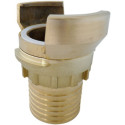
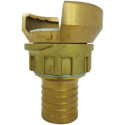
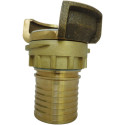
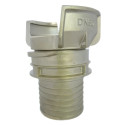
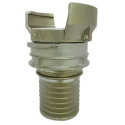
The socket is the barbed end onto which the flexible hose is fitted, generally held in place by a hose clamp or a crimped sleeve. What determines compatibility is the match between the inner diameter of the hose and the outer diameter of the socket. The hose must slide onto the socket with a tight but achievable fit — neither too loose (risk of leakage) nor impossible to fit. It is this outer socket diameter that varies depending on the reference, and that DN alone cannot reliably determine.
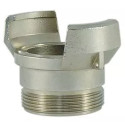
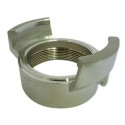
When the Guillemin fitting is intended to connect to fixed pipework, a valve or a IBC tank outlet, the end connection is a thread. In this case, the question of socket diameter no longer applies: what matters is the thread compatibility between the fitting and the equipment to be connected, in accordance with EN ISO 228-1. You must identify the existing thread on the equipment — not start from the DN on the Guillemin side — and ensure that the fitting ordered has the corresponding thread.
This distinction is decisive because it entirely defines the approach to follow before ordering. A professional who confuses the two approaches — for example, trying to match the Guillemin DN with an existing BSP thread — risks a selection error that neither the correspondence table nor the product sheet can correct after the fact. The first question to ask is therefore always: what type of end connection do I need on the connection side?
🔧 STEP-BY-STEP MEASUREMENT METHOD: THE UNAMBIGUOUS PROCEDURE
Once the type of end connection has been identified, the measurement can be carried out. The procedure below applies to both scenarios and also covers the case of replacing an existing fitting. It is based on a simple principle: measure the actual item before consulting the catalogue, not the other way around.
This procedure may seem rigorous for a routine purchase, but it becomes essential when working with multi-variant DN sizes — and in particular with DN40, which alone concentrates six different socket diameters. On the fittings available at Multitanks, each product sheet indicates the socket diameter of the relevant reference: this is the value to compare against the measurement taken on the actual hose.
🔧 Multitanks Expert Tip
If you are hesitating between two close socket diameters for the same DN — for example 38 mm and 40 mm on a DN40 — it is better to measure twice with a calliper than to order by guesswork. A discrepancy of a few millimetres is enough to make a fitting unusable on a given hose: too large and the hose will not hold; too small and it will not fit on at all. Accurate measurement before ordering is the only reliable way to avoid a return and additional delays on site. If you have an existing fitting to replace, bring it with you or measure it directly: it is the most reliable reference there is.
🔧 SUMMARY: THE PROFESSIONAL REFLEX BEFORE EVERY ORDER
The DN of a Guillemin fitting is a compatibility designation between fittings of the same family — it is not, and has never been, a universal physical measurement of socket diameter. This nuance, often overlooked in quick orders, is nevertheless the key to avoiding the most common error with this type of product. The correspondence table provided in this article is a reference tool, not a substitute for checking the product sheet of the exact reference ordered.
The safest professional reflex remains invariably the same: measure the actual hose or equipment before ordering, identify the type of end connection required (socket or thread), then verify that the exact socket diameter of the chosen reference matches the measurement obtained. For DN sizes with multiple variants — DN25, DN32, DN40, DN80, DN100 in particular — this verification is not an extra precaution: it is an essential step in the selection process.
To go further in selecting your fittings, Multitanks also offers a range of fittings and connection accessories suitable for industrial and agricultural applications, as well as fittings and valves for IBC tanks for bulk storage installations.
Interactive measurement guide
Select your connection type to display the appropriate method and the socket diameters to check.
Share this content