IBC 1000 L accessories
 Heating jackets
 Fittings
 Drums, jerrycans & fittings
 Seeds
 Plant protection & biocides


 Garden
 Green spaces & municipal
 Barbecue, fire pit & fireplace
 Cleaning & care
 Refrigerants & air conditioning
 Watering
Which lawn to choose? A complete guide to the 9 types
Choosing your grass is the step that determines everything else. The wrong mixture cannot be corrected by maintenance: an ornamental lawn laid on a play area will thin out whatever you do, and a full-sun grass will stay sparse under trees. Here are the nine types available, what genuinely separates them, and how to decide.
The 9 types of lawn compared
Let us start with the overview. This table answers the question in the order it actually arises: what is the ground used for, and what are its constraints?
| Type of lawn | For what use | Its strength | Its limit |
|---|---|---|---|
| Hardy | Ordinary family garden | The best all-round compromise | Nothing exceptional anywhere |
| Hard-wearing | Sports ground, play area | Takes heavy foot traffic | Needs water, copes poorly with shade |
| High resistance | Paths, heavily used areas | Tall fescue: deep roots | Less fine in appearance |
| Dry ground | Poor soil, warm region | Holds without frequent watering | Lower density |
| Overseeding | Repairing an existing lawn | Fast germination | Not a mixture for a new lawn |
| 7-day | A visible result very quickly | Germinates in a week | Very thirsty |
| Universal meadow | Large area, heavy soil | Economical per square metre | Meadow look, not a fine lawn |
| Shade | Under trees, north-facing | Tolerates low light | Will not take foot traffic |
| Kikuyu and tropicals | Mild region, drought | No watering at maturity | Frost-sensitive, invasive |
Four questions to ask before buying
The choice comes down to four criteria, in this order of importance. Taking them the other way round is the most common cause of a poor purchase.
Soil type comes next, and is easier to correct than people think: sandy ground suits cynodon, heavy clay suits meadow mixtures, but an amendment resolves many situations.
Hard-wearing grass
This is the grass for gardens that get used: sports grounds, play areas, parks, family gardens, corporate grounds. It generally combines perennial ryegrass, tall fescues, meadow grasses and sometimes brome.
Sow it preferably in spring, or in early autumn. On heavily used ground, plan an annual overseeding to maintain density: that is what separates a lawn that lasts from one that wears out.
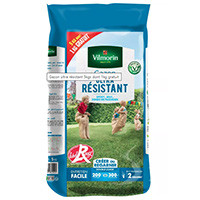
BHS High Resistance grass meets this need: 50 % perennial ryegrass for fast establishment, 40 % tall fescue for resilience, plus meadow grass, with an organic NPK fertiliser that feeds from sowing onwards. A 5 kg bag covers 200 sqm. Hard-wearing grass 5 kg is the alternative.
Hardy grass
This is the default choice, and that is no criticism: hardy grass is the best compromise for an ordinary garden. It combines perennial ryegrass for fast germination, creeping red fescue for density and partial-shade tolerance, and meadow grass for longevity.
It tolerates moderate drought, accepts a partially shaded aspect, takes normal family use and asks for no particular attention. It excels nowhere, but it fails nowhere either - which, for a lawn, is exactly what you want.
Sow at 25 g per square metre, in crossing passes. The first cut comes at 8 to 10 cm, set to 5 cm minimum. After that, keep 4 to 5 cm: this encourages deep rooting, and so better resistance to summer.
BHS Hardy grass contains 45 % perennial ryegrass, 50 % creeping red fescue and 5 % meadow grass, enriched with an organic NPK 5-3-6 fertiliser to the French NF standard. The 5 kg bag, with 1 kg free, covers 200 sqm. For a Mediterranean garden, BHS Rustic SUD is the variant adapted to water stress.
Dry ground grass
Designed for poor, sandy or stony soils, and for regions where watering is limited. Its composition favours deep-rooting species, notably fescues, which reach water further down than ryegrass.
Sow in spring or early autumn, avoiding high heat. Mow high, at 5 cm or more: that is precisely what preserves soil moisture and lets the mixture deliver on its promise.
Dry ground grass 5 kg answers this need. And if your region has marked droughts with mild winters, consider a tropical grass instead: our comparison of cynodon, dichondra and kikuyu covers that option, which removes watering altogether at maturity.
The other six types, in brief
The following mixtures answer more specific needs. A single criterion is usually enough to tell whether they concern you.
In practice: BHS Overseeding GRE5 germinates in 5 to 8 days over 250 sqm, 7-day grass for an immediate result, universal meadow 5 kg for 500 sqm, shade grass for poorly lit areas. Our article on the Japanese lawn covers flowering lawns.
The most common choice mistakes
They come up again and again, and cost a whole season.
| The mistake | What happens | The right approach |
|---|---|---|
| Choosing a fine grass for a play area | It thins out within a season | A mixture high in perennial ryegrass |
| Sowing a full-sun grass under trees | It stays sparse regardless | A shade mixture, or give up on grass there |
| Choosing kikuyu north of the Loire | The first hard winter gets it | A hardy or dry ground mixture |
| Sowing too thickly to increase density | Seedlings compete and the result is worse | Follow the rate given on the bag |
| Mowing short to mow less often | The lawn weakens and yellows sooner | Mow high, never more than a third of the height |
Going further
This article covers the choice. Our other guides set out sowing, maintenance and the special cases.
In short
Start from how your ground is actually used, not from the look you want. An ordinary family garden calls for hardy grass; ground that gets used, a high-resistance mixture; poor soil in a warm region, dry ground grass; a shaded area, a shade mixture. Overseeding is not a mixture for creating a lawn but the tool that maintains all the others.
The full range is in the turf seeds category, each with its coverage and recommended rate. Dispatched within 24 hours.
Share this content