



 IBC 1000 L accessories
 Heating jackets
 Fittings
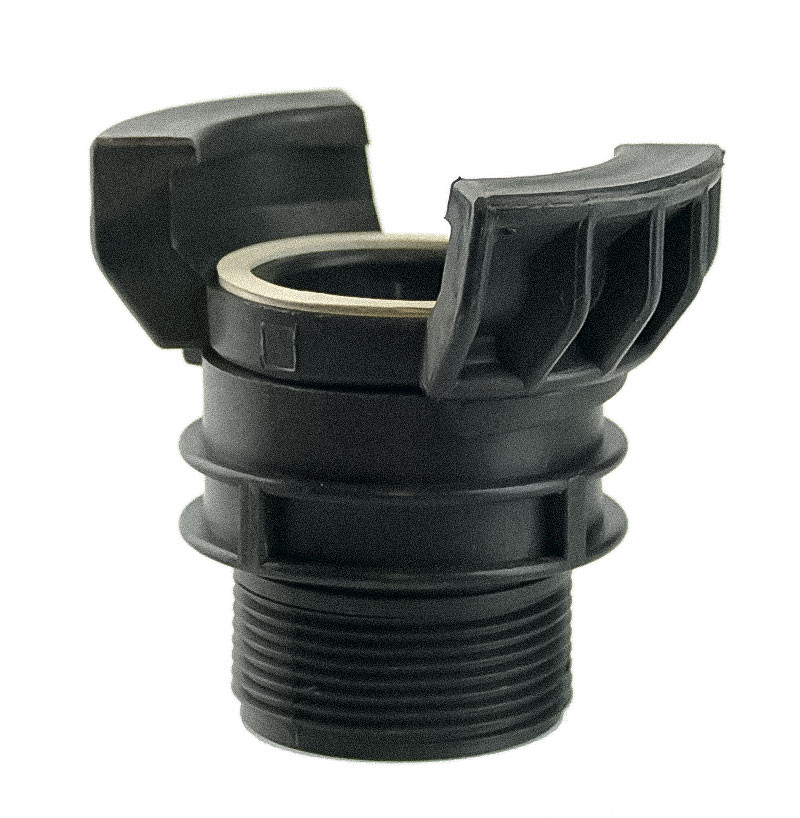
 Drums, jerrycans & fittings
 Seeds
Seeds 

 Plant protection & biocides

 Garden


 Green spaces & municipal
 Barbecue, fire pit & fireplace
 Cleaning & care
 Refrigerants & air conditioning
 Watering
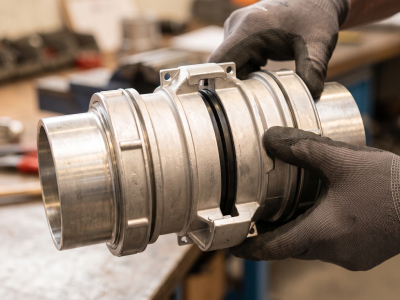
Guillemin Coupling: How the Firefighter Coupling Works
The Guillemin coupling is a symmetric quick coupling: its two halves are strictly identical, there is no distinct male and female part. This founding property — and not its nickname of "firefighter coupling" — defines its principle and determines all its practical advantages. Browse our full range in the Multitanks Couplings category.
Our tool finds the fitting that goes with it — IBC tank, plumbing, garden — in 3 clicks, with live prices and stock.
🔧 DEFINITION AND ORIGIN OF THE GUILLEMIN COUPLING
The Guillemin coupling is a symmetric quick coupling whose two half-couplings are strictly identical: no male/female distinction, no orientation imposed by the geometry of the parts. This symmetry is not a design detail: it is the founding characteristic that differentiates the Guillemin from virtually all other quick couplings on the market, and explains why it assembles just as quickly in one direction as the other, with no risk of orientation error.
Its nickname of "firefighter coupling" is not coincidental: this type of coupling has been used in firefighting since the end of the 19th century, a longevity that attests to its operational reliability under demanding conditions. Emergency services adopted it precisely because its symmetry eliminates connection errors under time pressure, and because its mechanical robustness withstands field conditions.
Beyond firefighting, the Guillemin has established itself in many other sectors: agriculture and irrigation, chemical and petrochemical industries (transfer of liquids or powdered products), food processing, general fluid transport, dust suppression, and tank trucks. Its versatility stems from both its symmetry and its sealing principle, which we will detail below.
🔧 FLAT GASKET, SUCTION AND DISCHARGE: THE KEY TECHNICAL POINT
The Guillemin coupling achieves its seal through a flat gasket compressed between the two faces of the half-couplings during assembly. This principle is insensitive to the direction of pressure inside the hose: whether positive (discharge) or negative (suction), the flat gasket remains mechanically compressed by the locking of the lugs, independently of the fluid pressure. The Guillemin can therefore be used interchangeably for both suction and discharge.
This property fundamentally distinguishes it from the DSP coupling, which looks visually similar but works on a radically different principle. The DSP uses a lip seal: when pressure increases inside the hose, it pushes the lip of the seal outward and presses it against the face of the opposite coupling, which reinforces the seal. This mechanism is effective — but only in the direction of discharge. In suction, the negative pressure acts in the opposite direction and lifts the lip away from its seat: the DSP is not designed for this use and must never be employed in this way.
Regarding the origin of the DSP name, sources differ: according to some, it derives from the company "Dubois Special Paris", which is said to have commercialised it after a patent filed around 1931 — but the exact attribution remains disputed and this technical history point should be taken with appropriate caution. What is certain, however, is the difference in principle between the two couplings, summarised in the table below.
| Criterion | Guillemin Coupling | DSP Coupling |
|---|---|---|
| Gasket type | Flat gasket | Lip seal |
| Sealing principle | Mechanical compression by locking | Reinforcement by fluid pressure |
| Suction | ✅ Yes | ❌ No |
| Discharge | ✅ Yes | ✅ Yes |
| Part symmetry | Two identical half-couplings | Two identical half-couplings |
| Risk of confusion | Low (universal use) | Real if used in suction |
🔧 APPLICABLE STANDARDS: NF E29-572, NF EN 14420-8 AND NF S61-701
Guillemin couplings are governed by two distinct normative references, which do not cover the same scope. The standard NF E29-572 and its European equivalent NF EN 14420-8 define the general characteristics of the Guillemin coupling: dimensions, materials, pressures. These are the reference standards for all industrial, agricultural or fluid transport applications.
The standard NF S61-701 falls within a different register: it is specific to firefighting and defines which types of symmetric couplings — DSP, AR, Guillemin — equip which emergency service equipment. It does not replace the dimensional standards; it complements them by specifying the requirements specific to the firefighting domain. A professional equipping an emergency vehicle or a fixed firefighting installation must therefore verify compliance at both normative levels.
🔧 DN SIZING AND COMPATIBILITY BETWEEN COUPLINGS
The size of a Guillemin coupling is expressed in nominal diameter (DN), from DN20 to DN150, i.e. a connection diameter of 20 to 150 mm. The DN is the only parameter that determines compatibility between two couplings: two Guillemin couplings of the same DN fit together regardless of their brand, material or manufacturer. This is a direct consequence of the dimensional standardisation established by NF E29-572 and NF EN 14420-8.
In practice, this means that a DN80 aluminium Guillemin coupling from manufacturer A couples without difficulty with a DN80 stainless steel coupling from manufacturer B. This interoperability is particularly valuable in contexts where multiple parties — firefighters, farmers, carriers — need to connect their equipment in the field without having to check brand-by-brand compatibility. The DN is the common language of the Guillemin coupling.
The two half-couplings are strictly identical. No male/female distinction, no risk of orientation error during connection. A decisive advantage in rapid interventions or under operational pressure.
The flat gasket ensures mechanical sealing independent of the direction of pressure. The Guillemin is the only symmetric quick coupling usable interchangeably in suction and discharge, where the DSP is limited to discharge only.
Two couplings of the same DN fit together regardless of brand or material. The NF E29-572 / NF EN 14420-8 standardisation guarantees this universal compatibility, essential in multi-operator environments.
🔧 ASSEMBLY, LOCKING AND ORIENTATION CONVENTION
The assembly of a Guillemin coupling is based on a system of lugs (ears) carried by each half-coupling. The lugs of the two half-couplings interlock with each other by rotation, then a locking ring or lock is tightened by hand or using a specific key — called a Guillemin key or tricoise key — to achieve a leak-tight connection. An additional quarter turn with the key can be used to perfect the tightening if necessary.
In the firefighting field, an orientation convention applies: the lugs are positioned horizontally on the side where water enters the half-coupling (water intake, supply point), and vertically on the side where water exits (vehicle outlet). This convention is not imposed by the geometry of the coupling itself — which remains symmetric — but by the operational practices of emergency services, to standardise connections and avoid any confusion during interventions.
When connecting two hoses to each other (as opposed to connecting to a fixed point), it is recommended to have a lock on each side of the coupling rather than just one. This arrangement reinforces the mechanical security of the connection and reduces the risk of accidental disconnection under pressure or during handling.
🔧 MATERIALS AND SERVICE PRESSURES
The Guillemin coupling is available in several materials: aluminium, stainless steel, brass/bronze and polypropylene. Each material corresponds to specific uses and chemical constraints, a subject that will be covered in a dedicated article in this series. What should be noted here: for metal versions (aluminium, stainless steel, bronze), the service pressure is 16 bar and the test pressure is 32 bar, in accordance with standards NF E29-572 and NF EN 14420-8.
Polypropylene, on the other hand, is reserved for specific applications where the lightness or chemical resistance of plastic takes priority over pressure resistance. The admissible pressures for polypropylene versions differ from metal versions and must be verified according to the product. Browse all available couplings in the Multitanks Couplings category, as well as stainless steel butterfly valves to complete your fluid transport installations.
🔧 Multitanks Expert Advice — Guillemin or DSP: a choice that commits you
The suction/discharge versatility of the Guillemin coupling often makes it the safest default choice when you do not yet know with certainty all the future uses of an installation. The DSP, visually very similar, definitively commits the direction of use: once an installation is designed around the DSP, using it in suction is not an option. If your installation is likely to be used in suction — even occasionally, even exceptionally — the Guillemin is the only technically correct choice. When in doubt, it is therefore the one to turn to first.
Share this content