IBC 1000 L accessories
 Heating jackets

 Fittings
 Drums, jerrycans & fittings
 Seeds
Seeds 
 Plant protection & biocides

 Garden



 Green spaces & municipal


 Barbecue, fire pit & fireplace
 Cleaning & care

 Refrigerants & air conditioning
 Watering
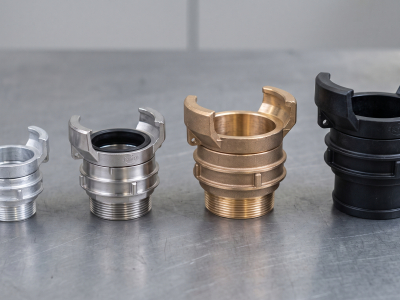
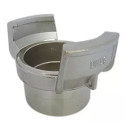
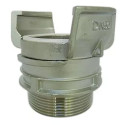
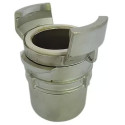
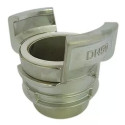
Which material for your Guillemin fitting based on usage?
The material of a Guillemin fitting is not a catalogue detail: it is a technical criterion that determines the durability of the connection, the safety of the installation and, in certain sectors, regulatory compliance. An aluminium fitting exposed to a corrosive fluid, a polypropylene fitting used where stainless steel is required by food-grade standards, or brass where acetylene flows: every material selection error has concrete consequences. This article does not revisit how the Guillemin fitting works — already covered in our fitting guide — but goes straight to the point: which material to choose based on your sector and the fluid being conveyed?
Our tool finds the fitting that goes with it — IBC tank, plumbing, garden — in 3 clicks, with live prices and stock.
🔧 ALUMINIUM: LIGHTWEIGHT AND VERSATILITY ACROSS THE MAJORITY OF SECTORS
Aluminium is the most widely used material in the Guillemin fitting range, and for good reason. Its lightness makes it the natural choice in all contexts where the weight of the equipment carried has a direct impact on working conditions. Firefighting is the most obvious example: an operator deploying hose lines under pressure, sometimes over long distances and in degraded conditions, directly benefits from the lightness of each fitting. Aluminium is also recommended for general industry, construction, petrochemicals, the oil industry and bulk transport in tankers.
Its presence across virtually all sectors should not lead to it being treated as a default choice. Aluminium is absent from recommendations for the food industry and for the chemical or pharmaceutical industry, sectors in which stainless steel is mandatory. Starting from the industry sector and the fluid being conveyed remains the only reliable method to avoid a selection error.
🔧 STAINLESS STEEL: THE REFERENCE MATERIAL FOR SENSITIVE FLUIDS
Stainless steel holds a special position in the hierarchy of Guillemin materials: it is the only material recommended for the food industry. This exclusivity is not trivial. As soon as the fluid being conveyed is intended for human consumption or enters a food production chain, no other material can substitute for stainless steel without risking contamination or non-compliance with applicable standards. The same logic applies to the pharmaceutical industry, where fluid purity and the neutrality of the contact material are non-negotiable requirements.
Beyond these two sectors, stainless steel also features among the recommended materials for the chemical industry, petrochemicals, the oil industry, maintenance and bulk transport. Its corrosion resistance makes it the reference material whenever the fluid is aggressive, the environment is humid, or the service life of the installation is a determining criterion. Browse the full range of industrial fittings available on Multitanks.
🔧 BRONZE AND BRASS: A TARGETED POSITIONING
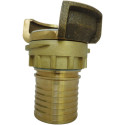
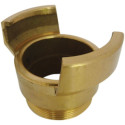
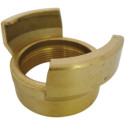
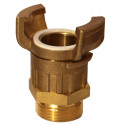
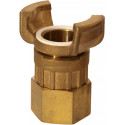
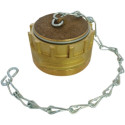
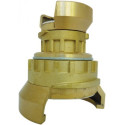
Bronze — often referred to as brass in fitting catalogues — is not a universal material in the Guillemin range. Its positioning is more targeted: it is specifically recommended for firefighting, the oil industry and construction, alongside aluminium. Its mechanical robustness and good performance in demanding environments make it a relevant choice for these applications, even though aluminium is often preferred for weight reasons in firefighting.
Bronze also features in recommendations for general industry, maintenance and bulk transport in tankers. Outside these contexts, it does not appear in sector-by-sector recommendations — which means it should not be considered a default alternative in sectors where stainless steel or polypropylene are recommended.
🔧 POLYPROPYLENE: THE TECHNICAL ALTERNATIVE FOR CORROSIVE FLUIDS
Polypropylene sometimes suffers from an image as an "economy" material compared to metals, which leads some buyers to underestimate it. This is a misjudgement that can prove costly. In the chemical, pharmaceutical and petrochemical industries, polypropylene is explicitly recommended on a par with stainless steel — not because it is cheaper, but because its chemical resistance makes it the most suitable choice for many aqueous or corrosive fluids.
The most concrete example of this use comes from agriculture: the polypropylene Guillemin fitting is particularly used for the transfer of liquid fertilisers and crop protection products, fluids that would rapidly attack an unsuitable metal fitting. It is also found in water treatment plants, light chemical industry, swimming pool maintenance and storage tanks. In all these cases, polypropylene is not a fallback option: it is the most technically sound choice. Its pressure and temperature limits are real and must be verified in the manufacturer's datasheet before any demanding application, but for common uses in light chemistry and agriculture, it outperforms metals in terms of durability when exposed to aggressive fluids.
🔧 GALVANISED STEEL: A SPECIAL CASE FOR AGRICULTURE AND STEELWORKS
Galvanised steel occupies a distinct place in the Guillemin material selection. It does not appear as an alternative to the four previous materials in conventional industrial sectors: it is specifically recommended for agriculture, irrigation and steelworks. This positioning meets specific needs: galvanised steel fittings are suited to inert or corrosive liquids and gases, resistant to water at ambient temperature, steam and compressed air.
It would be incorrect to consider it a general-purpose material or a replacement option for aluminium or stainless steel in other contexts. Its field of application is defined, and it is precisely within that field that it performs best.
🔧 TABLE OF RECOMMENDED MATERIALS BY SECTOR
The table below summarises the recommendations by industry sector, as established by specialist manufacturers. It is the starting point for any material selection for a Guillemin fitting: start from the sector and the fluid, not from the material available in stock or the least costly at the time.
| Industry sector | Recommended materials |
|---|---|
| General industry | Aluminium, stainless steel, bronze, polypropylene |
| Firefighting | Bronze, aluminium |
| Oil industry | Bronze, stainless steel, aluminium |
| Chemical industry | Stainless steel, polypropylene |
| Pharmaceutical industry | Stainless steel, polypropylene |
| Food industry | Stainless steel only |
| Petrochemicals | Stainless steel, aluminium, polypropylene |
| Construction | Aluminium, bronze |
| Maintenance | Aluminium, stainless steel, bronze, polypropylene |
| Agriculture / irrigation / steelworks | Galvanised steel |
| Bulk transport in tankers (liquids and powders) | Aluminium, stainless steel, bronze, polypropylene |
Reading this table reveals two opposing logics. On one side, sectors such as general industry, maintenance or bulk transport accept all four main materials: the choice can then be refined based on the specific fluid, operating conditions or logistical constraints. On the other, sectors such as the food industry admit only one option — stainless steel — with no possibility of substitution. Between these two extremes, sectors such as chemistry or pharmaceuticals narrow the choice to two materials (stainless steel and polypropylene), which requires a decision based on the precise nature of the fluid and the service conditions.
The reflex to adopt is systematic: first identify the sector, then the fluid being conveyed, and only then select the material from among those recommended. It is only at this stage that secondary criteria — weight, cost, availability — can come into play to distinguish between two equally valid options. To explore the full range, visit the industrial fittings category on Multitanks, which groups the different fitting families by material and by application.
The material selection for a Guillemin fitting must always begin with identifying the industry sector and the fluid being conveyed. A commonly stocked material or a lower purchase cost does not justify deviating from recommendations: chemical compatibility and sector compliance take precedence over any other consideration.
In the food industry, no other material can replace stainless steel. This exclusivity is not a comfort recommendation: it responds to purity and contact material neutrality requirements that other materials cannot guarantee in this context. The same logic applies to the pharmaceutical industry, where stainless steel shares the recommendation with polypropylene.
When faced with corrosive fluids — liquid fertilisers, crop protection products, light chemicals — polypropylene is not an economic compromise: it is often the most suitable material. A metal fitting exposed to the same fluids would lose its durability far more quickly. Checking the service limits in the manufacturer's datasheet remains essential before any demanding application.
🔧 SUMMARY: WHEN THE DATASHEET TAKES PRECEDENCE OVER THE GENERAL RULE
This table covers the main industry families and the common associated fluids. It provides a reliable starting point for the vast majority of situations encountered in professional settings. However, certain specific fluids — complex chemical mixtures, particular solvents, high-concentration fluids — may require a more detailed verification than a general table can offer. In these cases, the manufacturer's datasheet for the fitting, which specifies chemical compatibility material by material and fluid by fluid, is the primary reference to consult. No general rule replaces this verification when the fluid falls outside standard cases.
For professionals managing fluid storage or transfer installations, consistency between the fitting material and that of the connected equipment — tanks, valves, pipework — is also a point of vigilance. A stainless steel butterfly valve coupled with a stainless steel Guillemin fitting ensures material consistency throughout the line, eliminating the risk of galvanic corrosion and simplifying maintenance. Similarly, for IBC tank storage applications, the IBC accessories available on Multitanks allow the installation to be completed with compatible components.
🔧 Multitanks expert tip — Do not underestimate polypropylene
Polypropylene is often perceived as a "low-end" material compared to metals in the Guillemin fitting family. This is a mistaken perception that can lead to costly errors. As soon as the fluid being conveyed is corrosive or chemically aggressive — liquid fertilisers, crop protection products, light chemicals, treatment water — a metal fitting will lose its durability far more quickly than a polypropylene fitting suited to that fluid. In these situations, choosing polypropylene is not an economic compromise: it is the most rigorous technical choice. The rule remains the same: start from the fluid and the sector, not from preconceived notions about the hierarchy of materials.
Share this content