Accessoires IBC 1000 litres
 Couvertures Chauffantes
 Raccords Plomberie
 Bidons / Futs et raccords
 Semences
 Produits Phyto
 Jardin

 Espaces Verts
 Barbecue - Braséro - Cheminée
 Entretien
 Fluides & Climatisation
 Arrosage
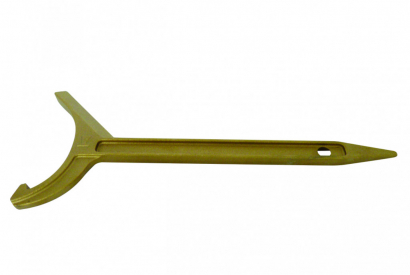
Fire hose spanner: why use one and how to choose it
A tool designed for firefighters, adopted by installers, refrigeration engineers and technical services — the fire hose spanner, known in French as a tricoise, is one of those rare tools whose long history has only deepened its relevance. But why does it remain the reference tool for locking a Guillemin coupling, and how do you choose the right material for your working environment? This guide answers both questions, as part of the Multitanks series on symmetrical couplings.
Origins and evolution: from firefighter tool to multi-function spanner
The fire hose spanner was born in fire stations. Its original purpose was strictly operational: allowing firefighters to tighten symmetrical couplings between two hoses in emergency conditions, where the speed and safety of the connection are absolutely critical. Its French name, tricoise, refers to the three functions of the original model, and it has remained in everyday trade language well beyond the reality of the tool.
You will find it under several names depending on the catalogue: fire hose spanner, hose coupling spanner, firefighter spanner, or the French terms tricoise and polycoise. All of these refer to the same tool.
What matters is knowing what the tool actually does, and why it remains essential far beyond the emergency services: industrial plumbing installers, refrigeration engineers, municipal technical staff, fire safety officers — all have concrete reasons to keep one within reach.
Tricoise or polycoise: what is the difference?
The question comes up often, and the answer fits in one sentence: they are the same tool, named after two different eras. The word tricoise refers to the three functions of the historical model. The version in use today has eleven, not three.
The term polycoise is therefore more accurate for the modern tool: the prefix poly reflects its real versatility, whereas tri no longer describes more than a fraction of its capabilities. Some manufacturers and professional catalogues use it for that reason.
In practice, tricoise remains the dominant term in everyday trade language, out of habit. A professional asking for a tricoise and a supplier offering a polycoise are therefore discussing the same product — there is no technical difference to look for between the two, beyond comparing the number of functions actually present on the model offered, which varies between references.
Spark-resistant materials: safety first
The fire hose spanner is not an ordinary tool, and neither is the choice of its materials. Versions intended for sensitive environments are made from so-called spark-resistant metals: brass, bronze, monel (copper-nickel alloy), aluminium bronze (copper-aluminium alloy) or beryllium bronze (copper-beryllium alloy). This property stems from the lower tensile strength of these metals compared with steel: on impact or friction, they do not produce a spark capable of igniting an explosive atmosphere.
The trade-off is direct: this lower mechanical strength means the tool wears out faster. In a context where the spanner is used precisely because the environment is hazardous, regularly checking its condition is not simply a maintenance matter: it is a safety requirement. A worn jaw slipping on a pressurised coupling is a real risk.
1️⃣ Spark-resistant brass
The reference choice for explosive atmospheres, hydrocarbon depots and any environment where a spark represents an ignition risk. Faster wear, to be monitored regularly.
2️⃣ Stainless steel
Preferred in damp, corrosive or chemically aggressive environments. Offers excellent mechanical durability without any particular spark-resistant property.
3️⃣ Epoxy-coated steel
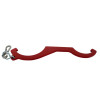
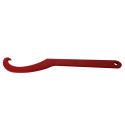
The general-purpose version, robust and economical, for routine work without hazardous atmosphere constraints. Red epoxy coating for quick identification in the field.
The choice between these three materials should be guided by the working environment, not by price — a point we return to in the expert box at the end of this article.
The 11 functions: one tool, a complete kit
Multi-function models available on the market can combine up to eleven functions in a single compact tool. Not every fire hose spanner offers them: the fittings vary by manufacturer and model. Each jaw or profile then corresponds to a specific use, mainly intended for the emergency services.
The function common to all of them, and the only one that concerns us here, is the sixth: tightening symmetrical couplings. That is what links this tool to the Guillemin series.
What stands out from this list is the coherence of the design: each function answers a concrete situation encountered during an intervention, whether emergency or maintenance. On a multi-function model, each function answers a situation met in the field. But these extra functions are not systematic: they depend on the model.
Before buying, always check the specification of the model concerned: a tool presented as a fire hose spanner may be a simple tightening spanner or a full multi-function tool. The two do not answer the same need.
The Triboulet fire hose spanner range
The spanners in the Multitanks catalogue are Triboulet tightening spanners intended for tightening and loosening symmetrical couplings. They do not include the multi-function jaws described above. The choice rests on three criteria: the material according to the environment, the diameter range, and the coupling type.
Reinforced steel, red epoxy — fire coupling
Four sizes available: DN20-DN40, DN30-DN65, DN65-DN150 and DN80-DN100. Red epoxy coating for quick identification in the field and corrosion protection.
Reinforced steel, red epoxy — symmetrical coupling
Covers DN40 to DN65. The general-purpose reference for the most common symmetrical couplings.
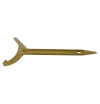
Spark-resistant brass
Three sizes: DN20-DN65, DN50-DN100 and DN20-DN150. The choice for explosive atmospheres and hydrocarbon environments, following the principle set out above.
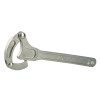
Stainless steel, all sizes
A single spanner for the DN25 to DN150 range. Resistant to corrosion and chemical agents, suited to damp or aggressive environments.
See the full range to compare the nine available references.
The link with the Guillemin coupling: why this spanner is the reference tool
Function number six — tightening symmetrical couplings — is what directly links the fire hose spanner to the Multitanks series on Guillemin couplings. To understand why, we need to return to the mechanics of the Guillemin coupling itself: this symmetrical flat-gasket coupling locks by rotating the two half-couplings against each other, and that is precisely where the spanner comes in. To achieve a perfect seal on the flat gasket, full tightening generally requires one spanner per half-coupling — a point detailed in the article on how the firefighter coupling works.
One important nuance must be added, as it is a frequent source of confusion in the field: the DSP coupling, visually very close to the Guillemin, does not work the same way for routine locking. On a DSP, locking is normally done by hand — the spanner is used only when necessary, typically to dismantle a coupling that has seized.
You should therefore not apply the spanner systematically to every symmetrical coupling: it is the reference tool for the Guillemin, not necessarily for the DSP. This distinction is developed in the Guillemin, DSP and Camlock comparison.
For professionals working regularly on installations combining several types of symmetrical coupling, this nuance is far from trivial: a spanner applied forcefully to a DSP that does not need it can damage the locking lugs or the gasket, and compromise the seal. The simple rule: identify the coupling type before reaching for the spanner.
Telling it apart from other firefighter keys: avoid buying the wrong one
The fire hose spanner (tricoise or polycoise) exists alongside other specialised keys in emergency and technical services equipment, and purchasing confusion is common. It is worth setting out the distinctions clearly.
In practice, a professional looking for a tool to work on Guillemin symmetrical couplings, open electrical cabinets or dry risers, and deal with handleless doors needs a fire hose spanner — not a PK key, not a hydrant key. The confusion often comes from the fact that these tools share a world of use (emergency services and fire safety) without being interchangeable.
💡 Multitanks expert tip: match the spanner material to the environment, not to the coupling.
A common mistake is to choose the spanner material according to the material of the coupling it is used on. That logic is wrong. The determining criterion is the working environment: in an explosive atmosphere or around hydrocarbons, a spark-resistant brass spanner is required, regardless of the material of the Guillemin coupling it is applied to. Conversely, in a corrosive environment with no spark risk, the stainless steel version will be more suitable. The epoxy-coated steel version remains for general use without particular constraints.
This environment-led logic is the same as the one applied to choosing the couplings themselves — a principle developed in the article on Guillemin coupling materials.
Frequently asked questions
What is the difference between a tricoise and a polycoise?
They are the same tool. Tricoise refers to the three functions of the historical model, polycoise to the versatility of the modern version, which has eleven. Polycoise is the more accurate term, but tricoise remains dominant in trade language.
How many functions does a fire hose spanner have?
Eleven on current multi-function models: 6, 8 and 12.5 mm female squares, 12 and 14 mm triangles, 19, 17 and 13 mm hexagons, symmetrical coupling tightening, tapered square, cross-head screwdriver and bottle opener. Some models add a carabiner hole.
Which material should I choose for a fire hose spanner?
The criterion is the working environment, not the coupling material. Spark-resistant brass is required in explosive atmospheres and around hydrocarbons, stainless steel in damp or corrosive settings, and epoxy-coated steel for general use without particular constraints.
Does the spanner work on all symmetrical couplings?
No. It is the reference tool for the Guillemin coupling, whose rotational locking generally requires one spanner per half-coupling. On a DSP coupling, visually similar, locking is normally done by hand and the spanner is only needed to dismantle a seized coupling.
What is the difference between a fire hose spanner and a hydrant key?
The hydrant key is reserved for fire hydrant valves, a single function. The fire hose spanner is multi-function: it tightens symmetrical couplings and opens electrical cabinets, dry risers and handleless doors.
Share this content