



 Accessoires IBC 1000 litres
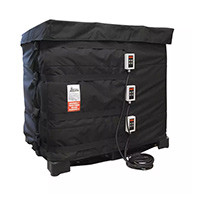
 Couvertures Chauffantes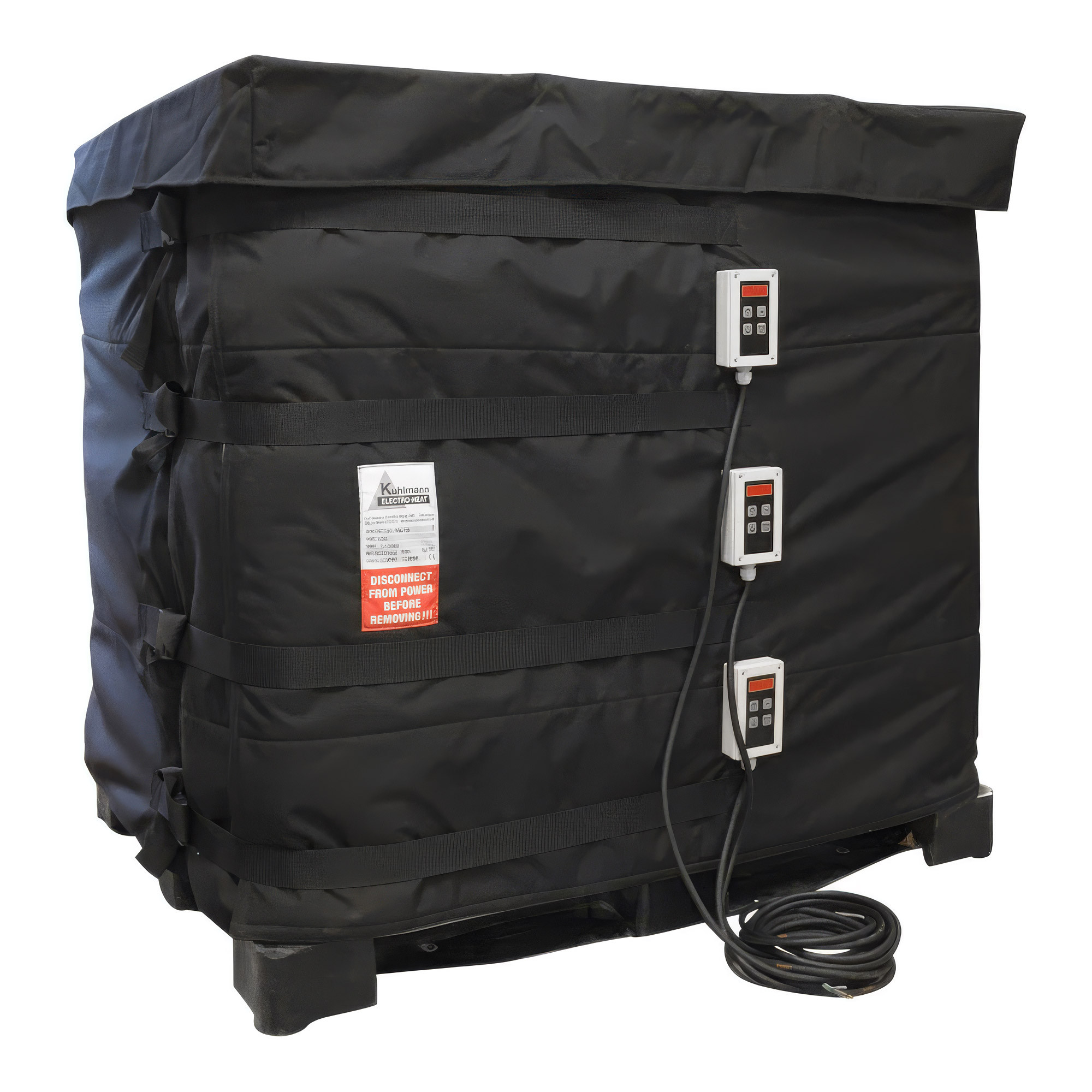
 Raccords Plomberie
 Bidons / Futs et raccords
 Semences




 Produits Phyto
 Jardin

 Espaces Verts
 Barbecue - Braséro - Cheminée
 Entretien

 Fluides & Climatisation
 Arrosage
Sizing the heating of an IBC tank or a drum: the method
"What power do I need to heat 1,000 litres?" has no single answer. Two installations of the same volume can require very different equipment depending on the nature of the product, the temperature difference targeted, the acceptable time frame and the installation conditions. This page sets out the method: the parameters to gather before any enquiry, the way they interact, and the trade-offs that follow. It does not provide a ready-made chart, because reliable sizing requires data specific to your configuration.
The six parameters to gather
Before any enquiry, assembling this information saves considerable time and avoids selection errors. None of it can be guessed.
1. Volume and container
A 1,000-litre IBC container, a 200-litre drum and a 25-litre can do not call for the same equipment. Beyond the volume, the nature of the container matters: a metal drum conducts heat far better than a polyethylene drum, and its temperature resistance is in a different league. On a plastic container, the thermal limit of the polyethylene caps the set point, whatever power is available.
2. The nature of the product
Three properties govern thermal behaviour: specific heat capacity, which determines the energy needed to raise one kilogram by one degree; thermal conductivity, which decides the speed of propagation through the bulk; and viscosity, which conditions the establishment of convection currents.
These values appear in the technical data sheets for the product or can be supplied by the manufacturer. They explain why the same equipment gives very different results on water and on a resin.
3. Starting and set point temperatures
The difference between the two determines the total energy required. Recovery from zero degrees in winter bears no comparison with maintenance from the temperature of a heated building. The starting temperature must be the least favourable encountered, not the average.
4. The acceptable time frame
This is the parameter most often omitted, and the one that weighs most heavily on cost. The same quantity of energy can be delivered slowly by modest equipment or quickly by powerful equipment. A product that must be available within two hours and a product that can be put on to heat the day before do not call for the same installation.
5. Installation conditions
A container stored outdoors continuously loses energy to the surroundings, the more so as the temperature difference is large and as wind is present. Inside a heated building, these losses are marginal. The presence or absence of insulation also changes the picture, as does the exposure of the container, whether it stands on the ground, on a pallet or against a cold wall.
6. Regulatory constraints
ATEX area, food contact, traceability requirement: these constraints do not change the energy calculation but they restrict the eligible equipment, sometimes severely. They must be known before, and not after, the technical choice.
Maintenance or temperature rise: two distinct calculations
This is the fundamental distinction, and the most frequent source of error in the enquiries we receive.
Maintenance
Keeping a product at temperature consists in offsetting losses to the surroundings. The power required does not depend on the volume but on the exchange surface, the temperature difference from ambient and the quality of the insulation. It is generally low, and effective insulation reduces it further.
A system sized for maintenance operates in a near-steady state, at reduced power, and its consumption over a season depends far more on the quality of the insulation than on its rated output.
Temperature rise
Raising the temperature of a volume requires energy proportional to the mass, to the specific heat capacity of the product and to the difference targeted. That energy must be delivered within the desired time frame, which determines the power, on top of which comes the compensation of losses throughout the heat-up period.
The consequence is direct: equipment correctly sized to maintain a product will not bring it up to temperature within a reasonable time. Many installations judged disappointing suffer from this confusion rather than from an equipment defect.
The case of decrystallisation
A solidified product adds a further difficulty: the energy of the change of state must be supplied before the temperature can even begin to rise. That energy is absorbed without the thermometer moving, which gives the impression that nothing is happening. Recovering a crystallised container is therefore always slower than a simple temperature rise, and raising the set point does not speed up the process; it merely overheats the layer in contact with the wall.
Why power alone is not enough
More powerful equipment does not automatically give a better result, and it may even make matters worse on a sensitive product. Three factors limit the actual transfer.
The heat exchange surface
Heat passes through the contact surface between the heating element and the wall. Concentrating high power on a small surface creates a hot spot without heating the volume any faster: the product in contact overheats, and the rest waits. This is why serious equipment favours a large surface at moderate power density.
On an IBC container, the quality of the contact is in any case rarely perfect: the metal cage, deformation of the inner tank and partial filling create inactive areas. Part of the rated power never reaches the product.
Conduction within the product
Once heat has been transferred to the outer layer, it has to progress towards the core. In a fluid liquid, convection takes care of that quickly. In a viscous or solidified product, only conduction remains, which is far slower, and the hot layer acts as a screen, its temperature rising while the core stays cold.
No amount of additional power corrects this phenomenon. The answer lies in distributing the heat, possibly in heating that combines several approaches, and in accepting a longer time frame.
Heat losses during the rise
For as long as the product is heating, it loses energy to the surroundings, and the more so as it approaches the set point. Without insulation, a growing share of the power serves only to offset those losses, up to an equilibrium at which the product stops rising, sometimes below the target set point.
This is why an insulated lid is not a convenience accessory. It reduces the power required, shortens the heat-up time and lowers the surface temperature needed. On a poorly sized installation, it often makes the difference between an acceptable result and a failure.
How many control zones
An IBC container filled with a viscous product stratifies: the lower part heats faster, the upper part lags behind. A single thermostat then has to arbitrate between overheating the bottom and under-heating the top.
Multi-zone equipment drives several sections independently over the height. Two zones handle ordinary stratification; three zones suit the most difficult products or the strictest uniformity requirements. On a fluid product, where convection evens things out naturally, simple control is sufficient.
The number of zones is therefore not chosen on the basis of volume but on the viscosity of the product and the uniformity required.
Trace heating of circuits
Sizing electric trace heating follows a different logic: it is expressed as power per unit length, in watts per metre, rather than as total power.
The usual values vary according to the objective. A low power per metre suits frost protection of an insulated water line; higher values are needed to keep a viscous product at temperature, or for high-temperature applications.
Three parameters determine the choice: the diameter of the pipework, the temperature to be maintained and the quality of the circuit insulation. This last point is decisive: trace heating on uninsulated pipework wastes most of its energy, and no power rating durably compensates for absent insulation.
Checks before installing
Available supply
Heating equipment consists of continuous resistive loads, from several hundred to several thousand watts. Checking that the intended circuit can carry the load, that it is protected by a suitable residual current device and correctly earthed is a prerequisite, not a finishing touch.
On an installation with several containers heated simultaneously, the cumulative power must be taken into account, including during heat-up phases when all the equipment runs at full power at the same time.
Container resistance
The target set point must remain compatible with the container. On a metal drum, the margin is wide. On a polyethylene IBC tank, the limit is markedly lower: exceeding the thermal resistance of the plastic deforms the tank, with a risk of leakage.
Product-material compatibility
With indirect heating, the question is limited to the contact between the jacket and the container. With direct heating by immersion heater, the chemical compatibility between the product and the alloy becomes decisive for the service life of the equipment, and must be verified case by case.
What each parameter changes in practice
| Parameter | What it influences | Consequence if it is ignored |
|---|---|---|
| Volume and container | Total energy and available exchange surface | Equipment unsuited to the format, insufficient contact |
| Nature of the product | Energy per degree, speed of propagation, need for multi-zone control | Time frame far longer than expected, risk of overheating at the wall |
| Temperature difference | Total energy to be supplied | Set point never reached in unfavourable conditions |
| Desired time frame | Power required | Power mismatched, either excessive or inadequate |
| Location and insulation | Continuous losses, maintenance power | Equilibrium reached below the set point, excess consumption |
| Regulatory constraints | Eligible equipment | Non-compliant equipment, to be replaced |
These parameters do not add up: they combine. A viscous product outdoors with a short time frame accumulates three difficulties, and the answer is not simply more power; it is often a combination of heat distribution, insulation and zone control.
The most common sizing mistakes
- Thinking in terms of volume alone. "I have 1,000 litres" is not enough to determine the equipment. Without the nature of the product, the temperature difference and the time frame, no sizing is possible.
- Omitting the time frame. This is the parameter that turns a requirement into a power rating. Failing to state it leads either to oversized equipment or to disappointment in use.
- Sizing on the average. The starting temperature must be the least favourable, that of a winter night rather than the annual average. Equipment calculated on average conditions falls short precisely when it is needed most.
- Neglecting insulation. It enters the calculation in the same way as power. Adding insulation often costs less than the additional power it saves.
- Forgetting the circuits. Sizing covers the whole: container, valve, discharge line. One cold link cancels the benefit of the rest.
What to send us
To prepare a recommendation, the following elements are required:
- the container: type, volume, material;
- the product: exact nature, and its technical data sheet if possible;
- the temperatures: least favourable starting point, target set point;
- the desired time to reach the set point;
- the location: indoors, outdoors, heated building or not;
- the objective: maintenance, temperature rise, or recovery of a solidified product;
- the constraints: ATEX area, food contact, traceability requirements;
- the available electrical supply.
This information makes it possible to rule out unsuitable solutions quickly and to propose correctly sized equipment rather than a power rating chosen out of excess caution.
If some data is missing, particularly the technical data sheet for the product, it remains possible to reason by analogy with comparable applications, taking a conservative assumption. A recommendation openly presented as approximate is better than a figure presented as exact when it is not.
Narrowing the choice before sizing
Before calculating a power rating, the right family of equipment for your configuration has to be identified. Our heating selector performs this first sort in five questions and gives you the list of possible solutions, with prices. Precise sizing comes afterwards, on the basis of the parameters detailed above; the selector points the way, it does not calculate.
Our range
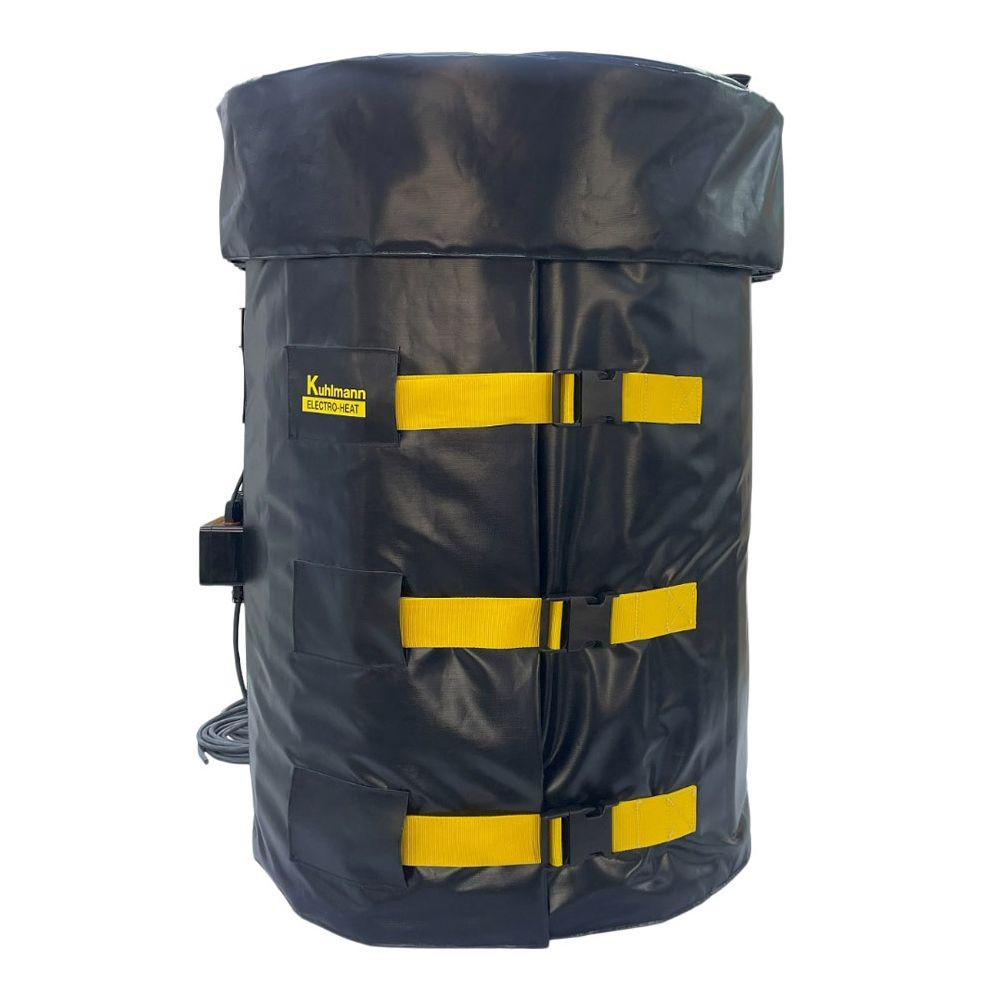
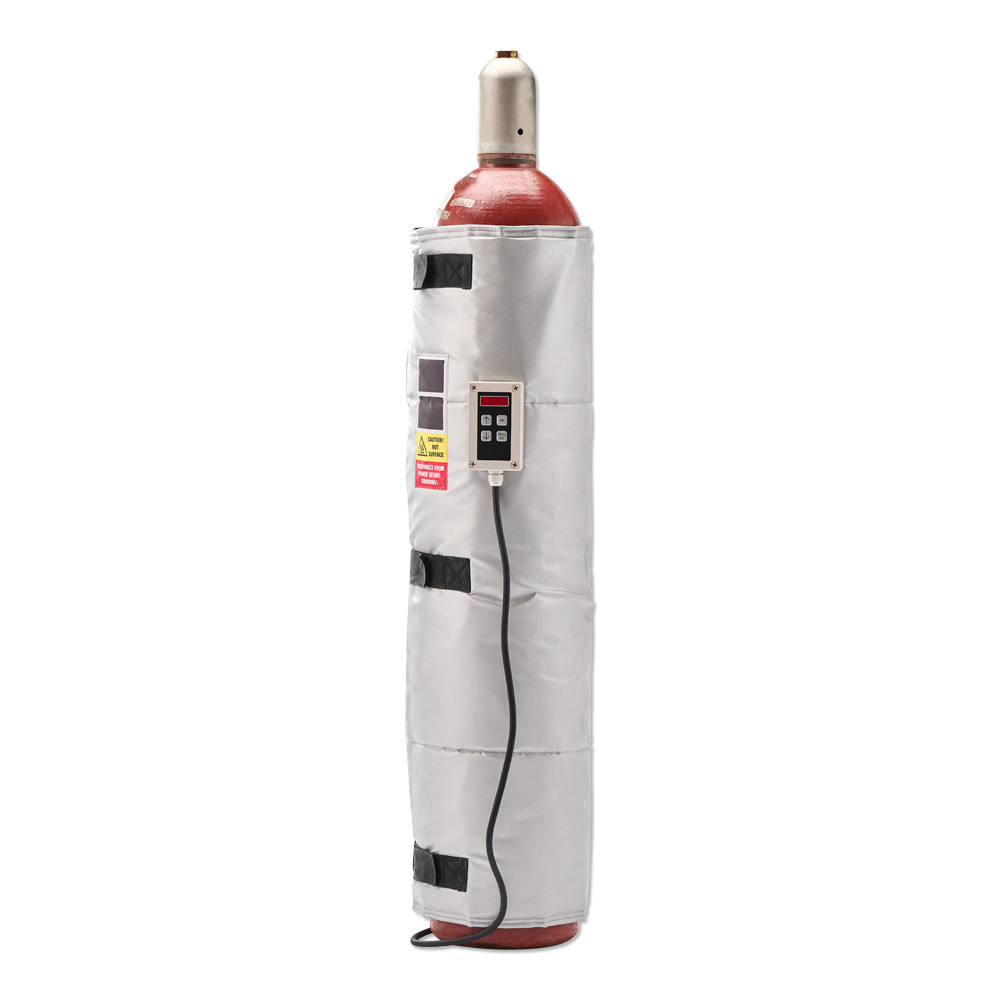
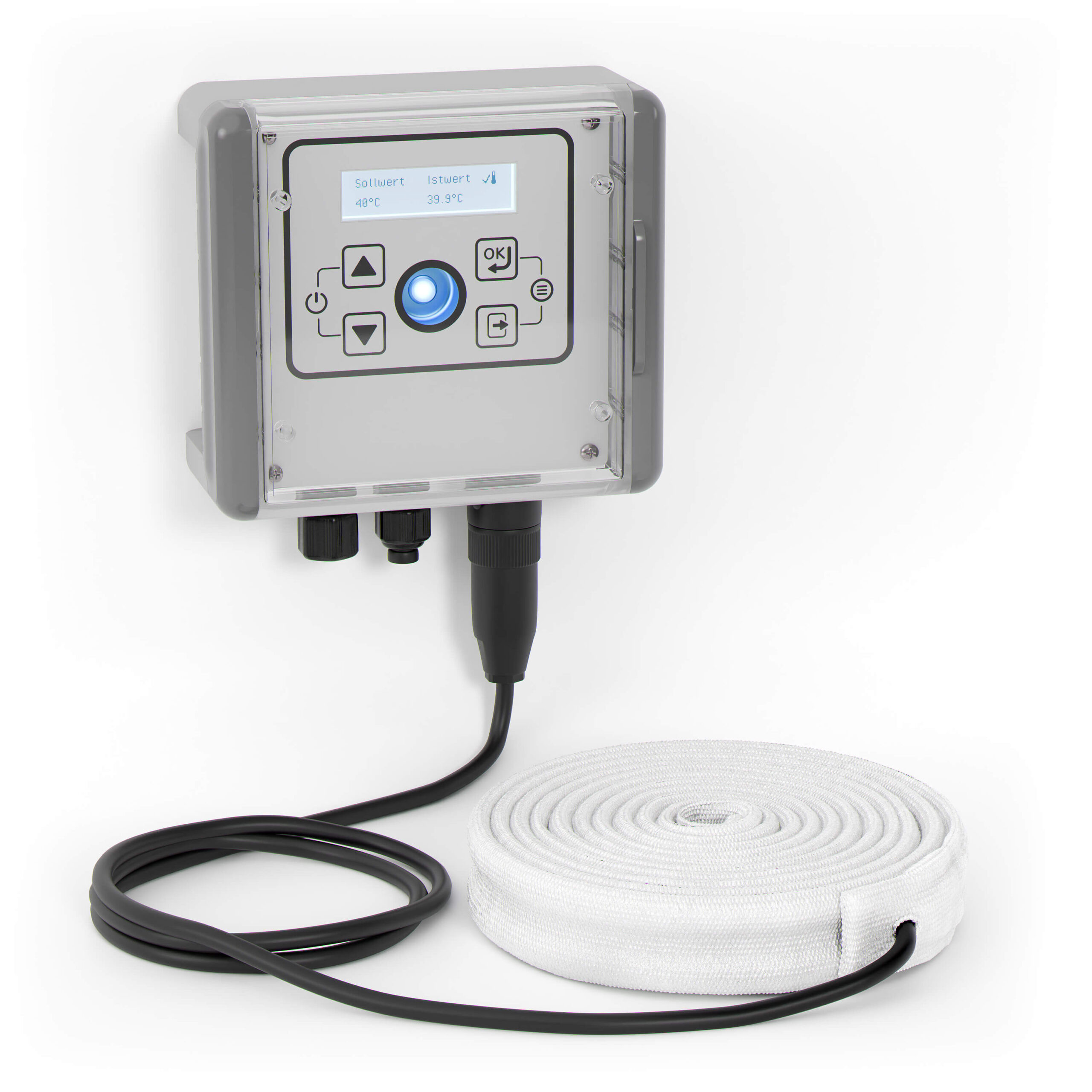
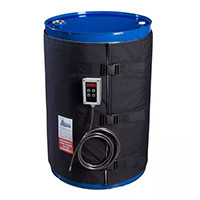
Multitanks distributes Kuhlmann industrial heating solutions for IBC containers, drums and gas cylinders: heating blankets with single, two or three-zone control, heating bases, immersion heaters, trace heating tapes in several power ratings per metre, insulated lids and controllers, in standard as well as ATEX versions.
The range is available from the IBC container heaters, drum heaters, gas cylinder heaters and trace heating tapes sections, grouped under heating blankets for IBC, drums and gas cylinders.
To choose between the available technologies, see our comparison of blanket, base, immersion heater or heating tape. For installations in explosive atmospheres, our page on ATEX heating. For sensitive products, our page on food and pharmaceutical applications.
Send us the elements listed above and our technical team will prepare a recommendation and a quotation on that basis, including the insulation and control accessories that the configuration calls for.