



 IBC 1000 L accessories
 Heating jackets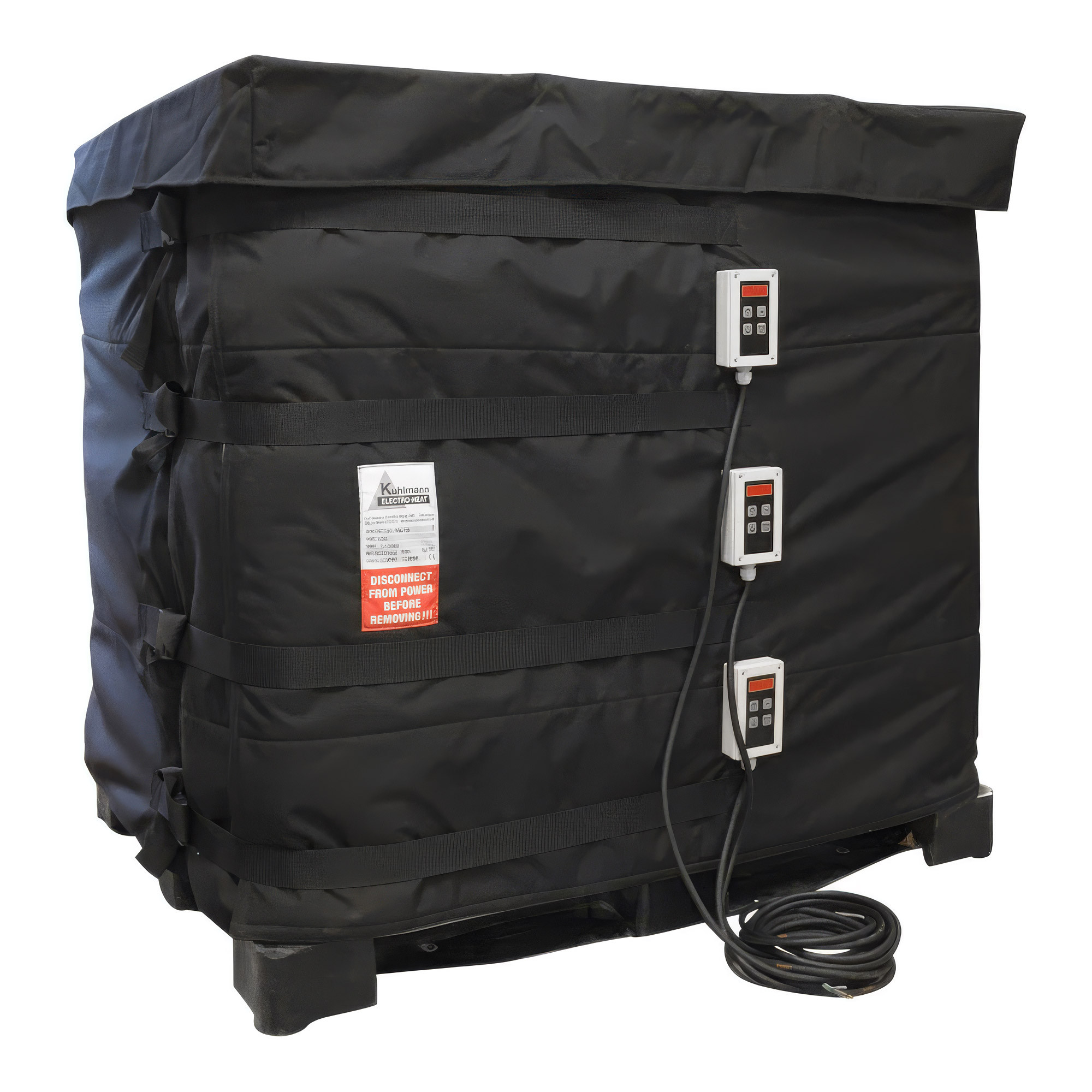
 Fittings
 Drums, jerrycans & fittings
 Seeds
Seeds 

 Plant protection & biocides
 Garden


 Green spaces & municipal
 Barbecue, fire pit & fireplace
 Cleaning & care
 Refrigerants & air conditioning
 Watering
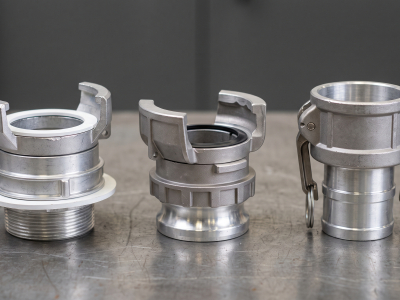
Guillemin, DSP, Camlock: which quick coupling to choose for your application?
Guillemin, DSP, Camlock: these three families of quick couplings are found in the same sectors — agriculture, industry, fluid transfer, firefighting — and yet they are not interchangeable. A wrong choice translates concretely into a leak under pressure, a coupling unusable for suction, or a dimensional incompatibility with existing equipment. The aim of this article is not to present side-by-side technical data sheets, but to provide operational decision criteria for choosing the right family based on the actual specifications of the installation. Browse our full range of couplings on Multitanks.
Our tool finds the fitting that goes with it — IBC tank, plumbing, garden — in 3 clicks, with live prices and stock.
🔧 GUILLEMIN AND DSP: THE TWO SYMMETRICAL COUPLINGS IN BRIEF
The Guillemin and the DSP share a fundamental property: their two halves are identical, which simplifies stock management and eliminates any risk of orientation error during assembly. That is where the similarity between the two families ends, and it is precisely this that structures the choice between them.
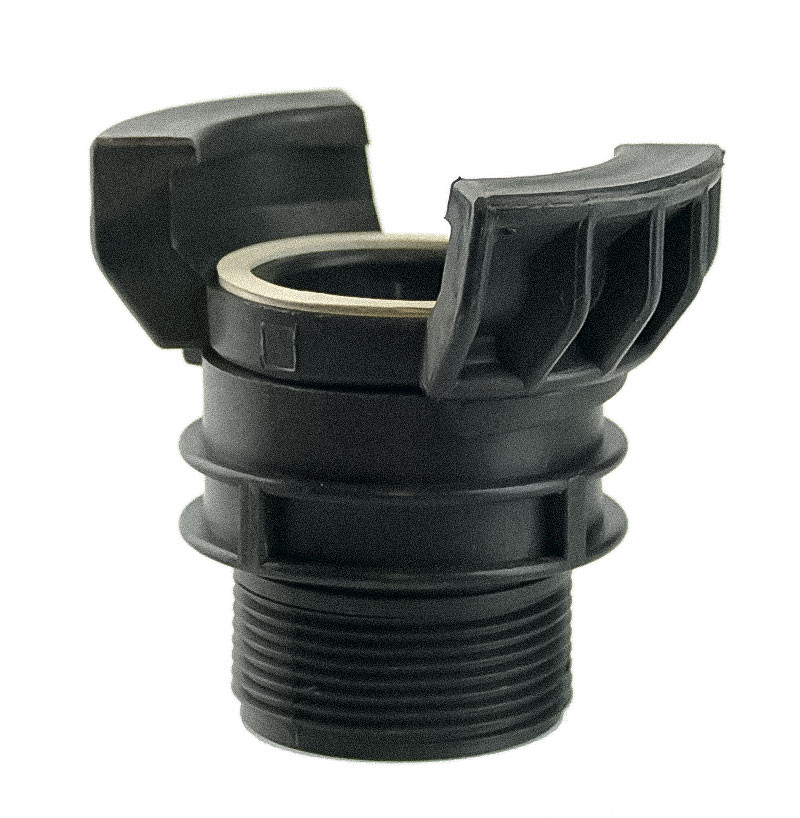
The Guillemin relies on a flat gasket and a locking ring or lock, generally tightened with a wrench to ensure a perfect seal. It works both in suction and discharge, making it the versatile coupling par excellence in agricultural and industrial installations. It is sized in metric DN (from DN20 to DN150) and covered by standards NF E29-572 / NF EN 14420-8, as well as NF S61-701 for firefighting applications. For a complete overview of how it works, we refer you to the dedicated article in this series.
The DSP, visually similar to the Guillemin, is distinguished by a lip seal whose sealing performance increases with pressure in the discharge direction. The direct consequence: it cannot be used for suction. Its locking mechanism, which snaps the lock into the notches, requires no wrench, which speeds up connection. Like the Guillemin, it falls within the scope of standard NF S61-701 for equipping emergency services and firefighting vehicles. The key point that structures the rest of this article is therefore: the Guillemin works in both directions, the DSP only in discharge.
🔧 THE CAMLOCK: OPERATION, STANDARDS AND SIZING
The Camlock is the cam and groove coupling: the male part carries a peripheral groove, the female part is fitted with two spring-loaded cam arms that lock into this groove by simple manual folding. No tool is required to connect or disconnect, which fundamentally distinguishes it from the Guillemin, whose optimal sealing requires a wrench.
Unlike the two previous families, the Camlock is not symmetrical: there is a male part and a female part, available in several standardised configurations designated by letters. Types A, B, C, D, E, F, DC and DP correspond to different combinations of threading, hose shank, or plug and dust cap. This non-symmetry requires more rigorous stock management and careful attention when ordering: the exact type of each end to be connected must be precisely identified.
From a standards perspective, the Camlock originates from the American military specification Mil-C-27487, replaced in 1999 by the federal standard A-A-59326A, since updated to A-A-59326D. In Europe, standard EN 14420-7, which came into force in 2004 replacing the former DIN 2828, adopts the specifications of the American federal standard, making couplings compliant with both reference frameworks interchangeable. One point to note: these standards cover the coupling connection itself, but not necessarily the levers, bolts, rings and gaskets, whose specifications may vary between manufacturers.
Camlock sizing is in inches (generally from 1/2" to 8"), unlike the metric DN system used for Guillemin and DSP. For a given nominal size, the exact dimensions of the male and female parts differ slightly by design, to allow coupling. As for working pressure, it varies significantly depending on the material: aluminium and plastics are generally not suitable for high-pressure applications, while stainless steel effectively handles higher pressures. Working pressure also decreases as temperature increases. Available materials cover a wide spectrum: aluminium, stainless steel (304 or 316), brass, polypropylene, glass fibre reinforced nylon.
The Camlock is used across a wide range of sectors: oil, chemicals, aerospace, mining, marine, agricultural machinery, compressed air and lubricating fluid transfer, brewing and food-grade liquid transfer, as well as on tanker trucks. This cross-sector versatility is explained by the speed of connection, the availability of materials compatible with aggressive fluids, and the complete absence of any required tooling.
Types A through F, DC and DP designate precise configurations of the male or female part: male or female thread, hose shank, plug or dust cap. When ordering, identifying the exact type of each end is essential to ensure compatibility with the existing installation. Confusion between types can render the coupling unusable without an adapter.
The choice of Camlock material is not trivial: aluminium is lightweight and economical but limited in pressure and incompatible with certain corrosive fluids. 316 stainless steel is preferred for chemical and food applications. Brass suits non-aggressive fluids. Polypropylene and reinforced nylon offer interesting chemical resistance for moderate pressures. The material directly determines the admissible working pressure.
🔧 COMPARISON TABLE: THE CRITERIA THAT MATTER
The table below summarises the key differences between the three families. It is not a list of characteristics to be read column by column, but a decision grid: each row corresponds to a criterion that can, on its own, rule out one family or make another mandatory.
| Criterion | Guillemin | DSP | Camlock |
|---|---|---|---|
| Symmetry | Symmetrical (2 identical halves) | Symmetrical (2 identical halves) | Non-symmetrical (male/female, types A to F) |
| Suction | Yes | No (discharge only) | Yes |
| Discharge | Yes | Yes | Yes |
| Sealing | Flat gasket | Lip seal | Sealing gaskets on cam arms |
| Locking tool | Ring/lock, wrench recommended for perfect seal | Snap lock, no wrench | Cam arms, no tool |
| Standard(s) | NF E29-572 / NF EN 14420-8, NF S61-701 (fire) | NF S61-701 (fire) | Mil-C-27487 then A-A-59326D (US), EN 14420-7 (Europe) |
| Sizing | DN (metric) | DN (metric) | Inches (imperial) |
| Origin / heritage | Firefighting (late 19th century), agriculture, industry | Firefighting | US military, oil / chemical / industry |
🔧 HOW TO READ THIS TABLE TO MAKE A DECISION
The first question to ask is about suction. If the installation needs to operate in suction — pumping from a tank, vacuum filling, any circuit where fluid is drawn rather than pushed — the DSP must be ruled out immediately. Its lip seal, which is its strength in discharge, becomes a structural weakness as soon as pressure reverses. Both the Guillemin and the Camlock remain usable in suction as well as discharge.
The second question concerns regulatory compliance. If the installation must comply with French fire standard NF S61-701 — equipping emergency services, firefighting vehicles, fire water networks — the choice is restricted to the Guillemin or the DSP. The Camlock, whose reference standards are American (A-A-59326D) and generic European (EN 14420-7), does not fall within this regulatory scope. Using a Camlock in a context where NF S61-701 is required constitutes non-compliance, regardless of the intrinsic quality of the coupling.
The third question concerns the speed and frequency of connection operations. If the priority is to connect and disconnect without any tools, particularly for repeated operations — tanker loading and unloading, frequent configuration changes on a tanker truck or agricultural machine — the Camlock offers a real operational advantage. The DSP, also tool-free, is faster than the Guillemin in this regard, but remains limited to discharge. The Guillemin, whose perfect sealing requires a wrench, is less suited to very frequent connections where tooling becomes a constraint.
The fourth question, often overlooked when ordering, is that of the sizing system. If the existing installation is already standardised in metric DN — which is the case for almost all French agricultural and fire networks — introducing Camlock couplings sized in inches requires adapters, with the associated risks of pressure drop and incompatibility. Conversely, an industrial or petrochemical installation already fitted with Camlock inch couplings has no reason to introduce DN couplings without a regulatory requirement.
🔧 PRAGMATIC SUMMARY: THREE DESIGN PHILOSOPHIES
These three families are not ranked: none is strictly superior to the other two. They respond to different design philosophies, stemming from distinct industrial histories. The Guillemin was born from late 19th-century firefighting and was adopted by French agriculture and industry for its versatility and robustness. The DSP shares this firefighting heritage but opted for a lip seal that optimises sealing in discharge at the expense of reversibility. The Camlock, originating from the American military world and adopted by the global oil and chemical sector, prioritised connection speed and configuration diversity at the expense of symmetry.
The right choice therefore depends on the actual specifications of the installation: flow direction, regulatory requirements, frequency of operations, existing equipment and the fluid being transferred. Multitanks offers a complete range of couplings covering these three families, with materials suited to each application. For installations also requiring shut-off elements, stainless steel butterfly valves effectively complement a circuit fitted with quick couplings.
🔧 Multitanks expert tip — The priority check before any order
If in doubt about compatibility between two existing pieces of equipment, check the sizing system first — metric DN or imperial inches — before even comparing the families. This is often where an incorrect order is made: two couplings from the same family but from different sizing systems will not mate, and an adapter introduced into a pressurised circuit is always an additional weak point. Identify the reference system of your installation first, then choose the appropriate family within that system.
Share this content