



 Accessoires IBC 1000 litres
 Couvertures Chauffantes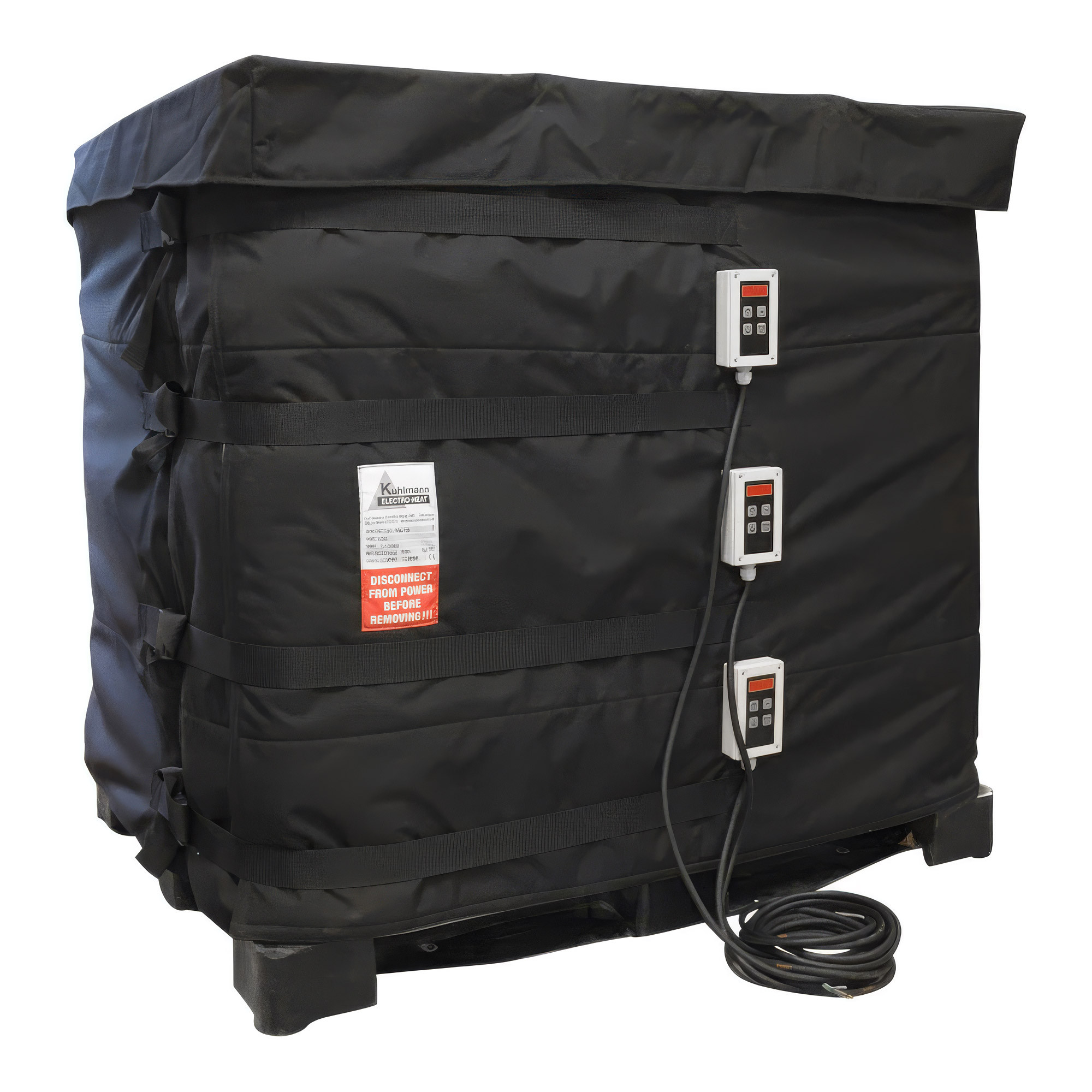
 Raccords Plomberie
 Bidons / Futs et raccords
 Semences





 Produits Phyto

 Jardin



 Espaces Verts


 Barbecue - Braséro - Cheminée
 Entretien

 Fluides & Climatisation
 Arrosage
Heating a food or pharmaceutical product stored in an IBC container or a drum
Heating honey, glucose, glycerine or an active ingredient does not follow the same rules as heating an industrial oil. The product is destined to be eaten or administered: its thermal degradation, contamination by the equipment or microbial growth have consequences that bear no comparison with a loss of yield. This page covers the constraints specific to these sectors, namely materials, temperature control and cleanability, and the technical choices that follow from them.
Why heating is used in food and pharmaceutical applications
Three needs come up repeatedly in these industries, and they do not call for the same settings or for the same equipment.
Preventing crystallisation
Many sugary or highly concentrated products crystallise spontaneously at ambient temperature. Honey is the best-known case: it gradually sets, and a crystallised container becomes impossible to discharge without thermal treatment. Glucose syrups, some saline solutions and concentrated pharmaceutical preparations behave in the same way.
Maintaining the temperature above the crystallisation threshold prevents the problem upstream. This is gentle, continuous heating, with no rapid rise, and it consumes far less energy than the later recovery of a container that has been allowed to set solid.
Reducing viscosity before transfer
A product that is viscous when cold flows poorly, is difficult to pump and leaves a significant part of its volume on the walls. In the food industry that residue is a straight loss of raw material; in pharmaceuticals, where the value per litre is often high, the financial stakes are considerable.
A reduction in viscosity is generally enough: there is no need to reach a high temperature, only to obtain proper flow at the discharge point and at the inlet of the transfer pump.
Recovering a product that has already set
This is the most delicate case. A solidified product does not conduct heat by convection, and recovery proceeds through an interface that advances slowly from the walls. The temptation to raise the temperature in order to speed the process up is precisely what must be avoided: the layer in contact with the wall is then subjected to a thermal stress well above the displayed set point.
Thermal degradation: the central constraint
The fundamental difference from an industrial application lies in the fact that the product degrades. Excessive or prolonged heating can lead to caramelisation, a change in colour or taste, a loss of nutritional properties, or the degradation of an active ingredient.
This degradation depends on the temperature-time pair: a brief exposure at high temperature and a long exposure at moderate temperature can produce the same effect. A set point value therefore says nothing on its own; it is the complete thermal profile that counts, including the hours during which the container remains powered without being discharged.
Two practical consequences follow. First, the set point temperature must be the lowest that produces the desired effect, not a comfort margin. Second, the temperature actually experienced by the product in contact with the wall matters as much as the average across the volume.
The hot spot problem
A heating system controlled from a single probe maintains a value at one point. Elsewhere the temperature differs, and it is always highest close to the heating surface.
On a fluid product, convection makes the volume uniform and the difference stays limited. On a viscous or solidified product there is no convection: the layer in contact with the wall can exceed the set point by a wide margin while the core stays cold. This is the mechanism by which a product degrades even though the display shows an acceptable temperature.
The answer rests on three points: limiting surface power density, spreading the heat over the largest possible area, and favouring control with several thermostats that treat the different heights of the container independently. A two-thermostat assembly, for example, makes it possible to drive the upper and lower zones separately.
The cold spot, its counterpart
Less obvious but just as problematic: an insufficiently heated area. In food applications, a pocket of product left within a temperature range favourable to microbial growth constitutes a health risk, even though the rest of the volume is compliant.
Cold spots occur wherever the heating does not reach: the upper part of the container above the level of the blanket, the bottom if heating is applied only to the sides, and above all in the downstream pipework, valves and hoses. An untraced discharge line is a permanent cold spot.
Materials in contact
Direct contact: the question of migration
An immersion heater sits in the product. Any material in contact with a foodstuff or a pharmaceutical product must be fit for that purpose: it must not release any substance into the product, must not alter its composition, and must withstand cleaning.
This constraint, combined with the difficulty of cleaning an element immersed inside a container, explains why indirect heating is widely preferred in these sectors. The surface of an immersion heater is also the hottest point of the installation, which adds a risk of local degradation on a sensitive product.
Indirect contact: the fabric of the jacket
A heating blanket does not come into contact with the product in normal operation. But it does touch the outer wall of the container, it is handled by the same operators, and accidental contact with the product remains possible during a spill or a leak.
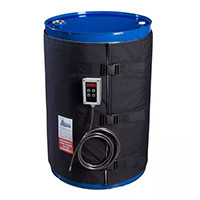
This is why blankets intended for these industries use an FDA-approved fabric: the material meets the requirements of the American regulations for food contact materials. This approval does not make the blanket sterile or submersible, but it guarantees the absence of undesirable substances in the event of contact.
Silicone for high temperatures
For applications going beyond the usual range, silicone jackets on a glass fabric backing offer several advantages: higher temperature resistance, compliance with hygiene regulations, a smooth non-porous surface that limits soil retention, and resistance to repeated cleaning.
The smooth surface is an underrated criterion. A porous or rough fabric retains residues and complicates disinfection; a smooth material can be cleaned by wiping, which matters when the equipment is moved from one container to another in a production area.
Hygiene and cleanability
A heating device in a food production area is subject to the same requirements as the other equipment present: it must be cleanable, must not act as a reservoir of contamination, and must not introduce foreign bodies.
The protection rating
The IP rating directly governs cleanability. An IP54 rating indicates protection against dust and water splashes, which allows damp wiping but not hose washing. A higher rating is necessary in areas cleaned with high-pressure equipment.
This characteristic must be compared with the actual cleaning protocol of the production area, and not with an intention: IP54 equipment installed in a hose-washed area will be damaged, with an electrical hazard as a result.
Straps, fixings and foreign bodies
Quick-release straps make fitting and removal easier, and therefore the cleaning of both the equipment and the container. They also have the advantage of requiring no tools, which limits the presence of removable items close to the product.
The general rule applies: anything liable to come loose, such as a fastener, a screw or a poorly attached label, constitutes a foreign body risk. Regular visual inspection of the fixings is part of the food safety plan in the same way as for other equipment.
Matching the equipment to the container
A heating blanket is sized for a specific container. Equipment that is too large for the drum does not grip it correctly and leaves areas without contact; too small, it covers only a fraction of the useful height and creates a marked gradient between the heated part and the rest of the volume.
On metal drums, equipment is available by capacity, from small 25-litre containers up to standard 200 to 220-litre drums, with power increasing with volume. This progression is not linear: the ratio between heat exchange surface and the volume to be heated worsens as the container grows, which explains why a large drum requires proportionally more power than a small one for the same result.
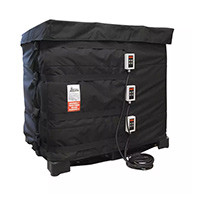
On IBC containers, height poses a particular difficulty. A volume of one thousand litres in a tall container stratifies naturally: the product heated by the side walls rises, the cold product sinks, and an equilibrium is reached with a noticeable temperature difference between the top and the bottom. This is what justifies control by independent zones rather than a single thermostat, particularly on viscous products where no convection comes in to correct the difference.
The case of the partially empty container
One configuration deserves particular attention: heating a container that has been partly used. The part of the blanket above the liquid level is no longer heating a product but air, with two consequences. The area concerned rises quickly in temperature, since nothing absorbs the energy supplied; and the probe, if it is located in that area, measures a value unrelated to the temperature of the product.
On a heat-sensitive product, this situation can cause localised degradation in the upper section while the whole appears to be correctly regulated. Zone control makes it possible to switch off the section concerned; failing that, it is necessary to check that the probe remains immersed in the useful zone and to watch the behaviour of the installation as the container empties.
Traceability and validation
In pharmaceuticals, and increasingly in the food industry, temperature control is not limited to a setting: it must be demonstrable.
This means knowing the temperature actually reached by the product, and not only the displayed set point. A measurement independent of the control system, such as a surface thermometer or a probe placed in the product, makes it possible to check the consistency between the display and reality.
Sensor drift over time makes this check necessary on a periodic basis. A system that showed the correct value at installation can gradually deviate, with no visible sign, which is why the interval between checks should be set in advance rather than decided after a problem occurs.
Five practical rules
- Heat as low as possible. The set point must be the minimum temperature that produces the desired effect. Every degree above that accelerates degradation with no benefit.
- Spread rather than concentrate. A large heating surface at low power density degrades the product less than a small, very hot surface, for the same total energy.
- Insulate systematically. An insulating cover reduces losses, therefore the power required, therefore the surface temperature. On a sensitive product, it is a quality item and not merely an economy measure.
- Do not leave the system powered needlessly. The temperature-time pair governs degradation: a container held hot for several days before discharge is subjected to a significant cumulative stress.
- Trace the circuits. A cold discharge line cancels the benefit of heating and creates a retention point. Trace heating of pipework is part of the installation.
Choosing according to the configuration
| Situation | Suitable solution | Point to watch |
|---|---|---|
| Keeping above crystallisation, product in an IBC container | Heating blanket with FDA fabric, several thermostats, with an insulating cover | Set point as tight as possible; check the actual wall temperature |
| Recovering a solidified product | Distributed heating, gradual rise, possibly a heating base | Do not raise the set point to speed things up: risk of degradation at the wall |
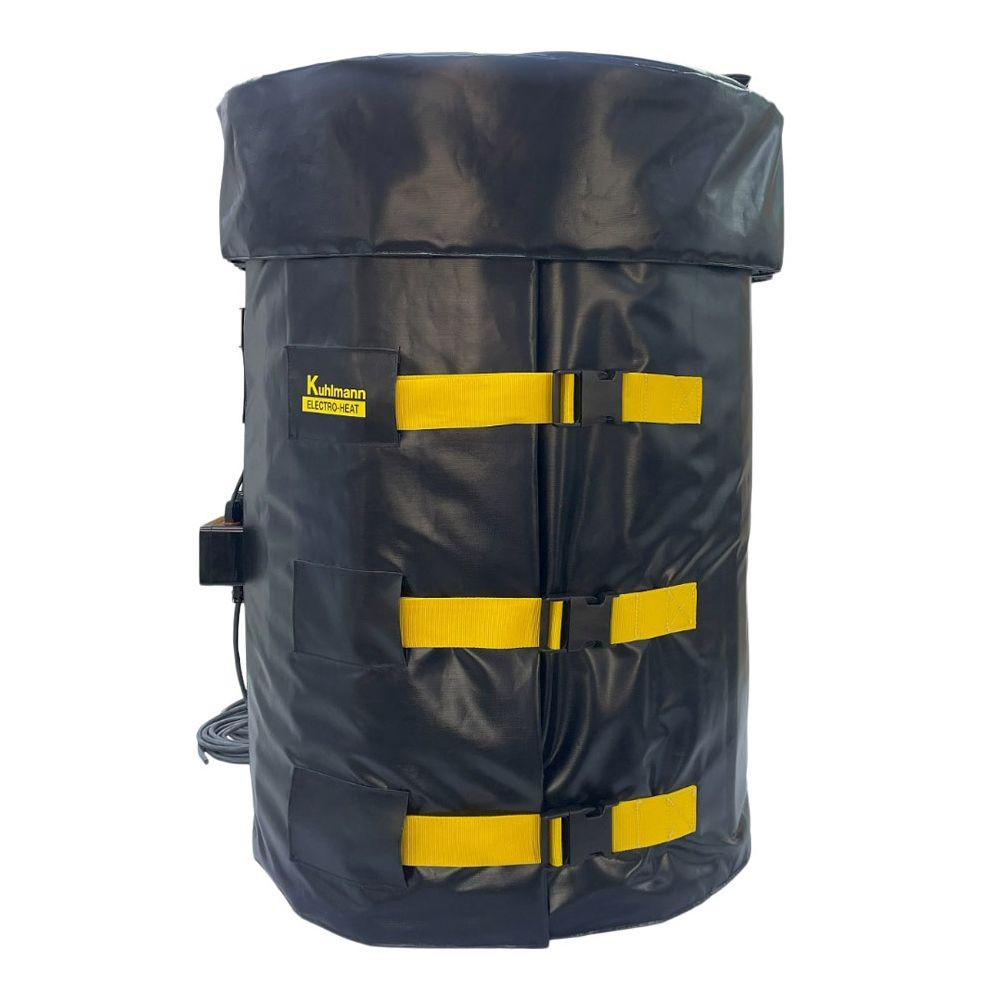
| Metal drums, high temperature | Silicone jacket on glass fabric, twin thermostat | Check the compatibility of the product with the target temperature |
| Hose-washed production area | Protection rating matched to the actual protocol | An IP54 rating does not withstand high-pressure washing |
| High-value product, traceability requirement | Multi-zone control and independent measurement | Periodic checking of probe drift |
Selecting equipment for a sensitive product
The constraints on materials in contact sharply reduce the choice of equipment in the food and pharmaceutical industries. Our heating selector takes this criterion into account: state your sector, and equipment with FDA-approved fabric moves to the top of the list. Where no compliant product exists in the family concerned, the selector says so explicitly rather than proposing unsuitable equipment.
Our range for the food and pharmaceutical industries
Multitanks distributes the Kuhlmann solutions intended for these industries: heating blankets for IBC containers with FDA-approved fabric and control by multiple thermostats, silicone drum heaters on a glass fabric backing for higher-temperature applications, and insulating covers sized for standard containers.
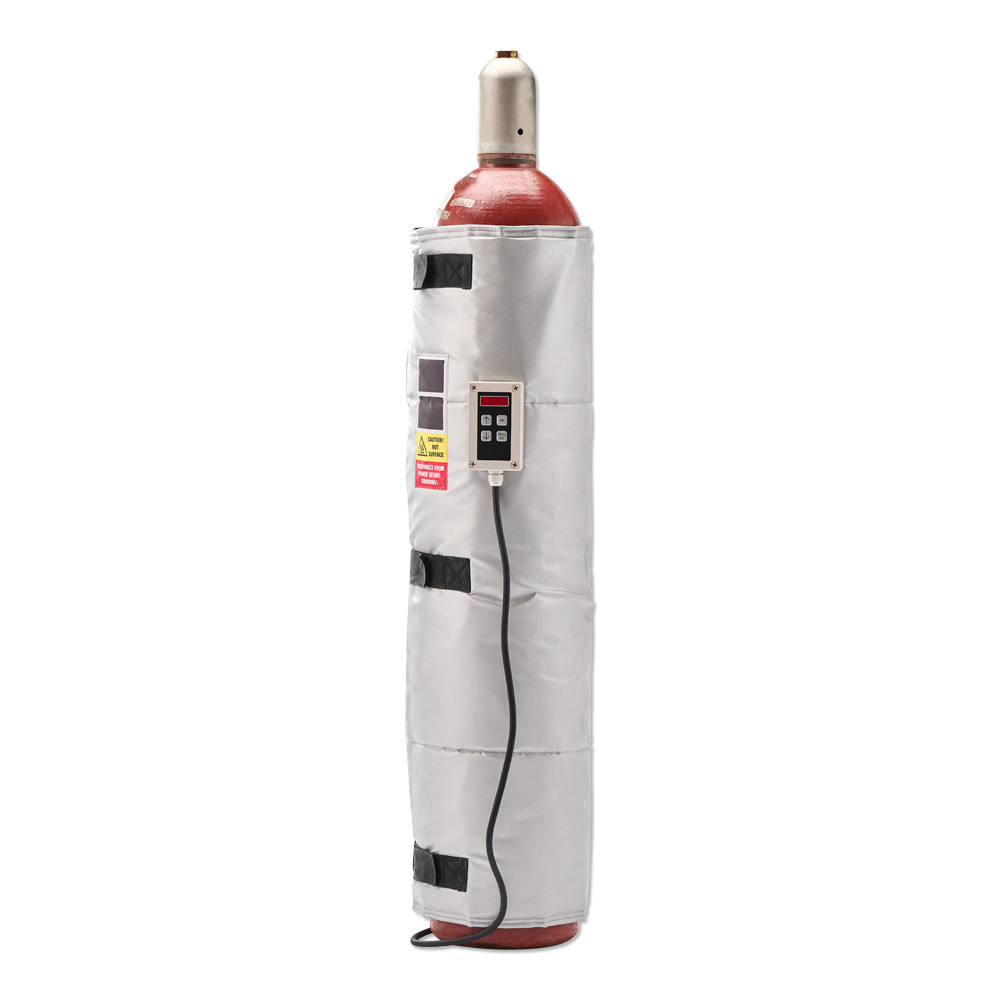
This equipment is available from the IBC container heaters and drum heaters sections, grouped under heating blankets for IBC, drums and gas cylinders. For an overview of the available technologies, see our comparison of blanket, base, immersion heater or heating tape; for installations in explosive atmospheres, our page on ATEX heating.
The choice depends on the product, its thermal sensitivity, the volume treated, the cleaning protocol in force, the frequency of handling and the applicable traceability requirements. Our technical team will prepare a quotation on the basis of these elements.