



 IBC 1000 L accessories
 Heating jackets
 Fittings
 Drums, jerrycans & fittings
 Seeds

 Plant protection & biocides



 Garden

 Green spaces & municipal
 Barbecue, fire pit & fireplace
 Cleaning & care
 Refrigerants & air conditioning
 Watering

Lawn care: everything you need to know about your grass
There is no secret to a good lawn: it needs looking after through the year. But the point is not to do a great deal - it is to do the right job at the right time. Scarifying in a heatwave damages a lawn; overseeding at the wrong moment wastes the seed. Here is the calendar, season by season.
The calendar at a glance
If you take away one thing from this article, take this table. The jobs are few; it is their placement in the year that makes the difference.
| Season | The jobs that matter | What not to do |
|---|---|---|
| Late winter, February-March | Correct defects, sharpen blades, treat moss | Mow: the growth is too short |
| Spring, April-May | Scarify, overseed, growth fertiliser, weed | Mow too short |
| Summer, June-August | Mow high, space out cuts, water if you can | Scarify, force fertiliser, cut close |
| Autumn, September-October | The best window: scarify, overseed, top dress | Neglect leaf clearing |
| Winter, November-January | Clear debris, avoid walking on frozen ground | Mow, sow, scarify |
Late winter: correct the defects first
Before the first cut of spring, walk your lawn. This is when defects show up most clearly, and when correcting them costs least.
A moss-killing lawn fertiliser works on both fronts in a single application: it destroys the moss and feeds the grass, which then closes the areas freed up. That is more effective than a treatment alone, because moss always returns wherever the grass is weak.
Mowing properly
Mowing is the first job of lawn care, and the one where most mistakes are made. Three rules are enough.
The one-third rule deserves explaining, because it is counter-intuitive: a severe cut forces the plant to draw on its root reserves to rebuild its foliage. It weakens, and its rooting stays shallow - so more vulnerable to drought. Mowing often and lightly beats mowing rarely and heavily.
Removing surface thatch
Over time, dead leaves, shallow roots and moss form a compact layer at the soil surface: thatch. It suffocates the soil, depriving it of water, air and light. The lawn yellows, then deteriorates.
The answer is scarifying: raking the soil to cut through that layer and let it break down. Once a year is enough on healthy soil, twice if the thatch returns quickly. A few days beforehand, mow fairly short, collect the clippings and water.
The full method - timing, blade depth, choice of tool and above all what to follow with - is covered in our dedicated article: why and how to scarify your lawn.
Top dressing and feeding the soil
If you have just scarified, do not stop there: the thatch is gone, the soil is open, and this is the ideal moment to enrich it. Spread a few spadefuls of compost and work them in with a rake, using a light touch so as not to damage the grass.
Choose your top dressing according to what you are correcting: a pine-based compost acidifies the soil, which is the opposite of what you want if you are fighting moss. Read the composition.
As for fertiliser, one application a year at the time stated by the manufacturer is enough in most cases. And do not overlook the simplest option: clippings left in place by the mulching function return nitrogen to the soil, free of charge.
For bare areas, BHS Overseeding grass GRE5 germinates in 5 to 8 days and covers up to 250 sqm with no need to turn the soil. For feeding, our guide to lawn fertilisers sets out the formulations season by season, and the lawn fertiliser range covers everyday needs.
Weeding the lawn
Weeds take advantage of every free space. The best time is spring, before they develop, then again in autumn once their growth has finished, and occasionally through the winter.
Water generously beforehand: roots come out far more easily from moist soil. Use an asparagus gouge or a weeding knife, twist the blade around the root and pull firmly - leaving the root in the ground amounts to doing nothing. A weedkiller, sprayed or spread, remains an option on larger areas.
The best weedkiller, however, remains a dense lawn: where the mat is thick, nothing settles. That is the main argument for regular overseeding.
Summer: support rather than force
In summer the lawn suffers from heat and water shortage. The useful instinct is to do less, not more: space out the cuts, raise the cutting height, and water the recently overseeded areas first, since they have no deep rooting yet.
Outside restriction periods, one or two generous waterings a week beat a light daily sprinkle: the water goes down, and the roots follow. And do not overdo fertiliser in high heat, at the risk of burning the most fragile blades.
If your lawn scorches every summer despite your efforts, the problem may not be care but species. Drought-tolerant grasses exist: our comparison of tropical grasses covers cynodon, dichondra and kikuyu, and BHS Rustic SUD grass was formulated for the Mediterranean climate.
Winter: clear what is lying around
A lawn is like the inside of a house: what you leave lying about ends up forcing a major clear-up, far more tiresome. Clear dead debris through the winter to let the soil breathe, and remove weeds as soon as they appear.
Avoid walking on frozen grass: the blades snap outright and the marks stay visible for weeks. And do not mow: growth has stopped, and cutting would only expose the soil to the cold.
What if the problem is the grass itself?
Flawless care does not make up for an unsuitable mixture. Before persevering, ask yourself about the original choice.
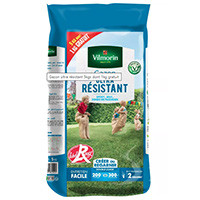
Our main mixtures: BHS Hardy for an ordinary garden, BHS High Resistance for play areas and paths, BHS Rustic SUD for the Mediterranean climate. The full range is in the turf seeds category.
Going further
This article covers everyday care. Depending on your situation, our other guides go into detail.
In short
Correct defects in late winter, mow often but never more than a third of the height, scarify once a year and overseed immediately afterwards, top dress and feed in spring, weed before the weeds run to seed, leave the lawn alone in high heat, and clear debris in winter. These jobs take a few hours per season.
Seed, fertiliser and overseeding grass are available in our turf seeds and lawn fertiliser categories, dispatched within 24 hours.
Share this content