



 IBC 1000 L accessories
 Heating jackets
 Fittings
 Drums, jerrycans & fittings
 Seeds
 Plant protection & biocides


 Garden

 Green spaces & municipal

 Barbecue, fire pit & fireplace
 Cleaning & care

 Refrigerants & air conditioning

 Watering

Kikuyu grass: how and when to sow this African grass
You see it more and more in southern gardens: originating in the highlands of East Africa, kikuyu grass copes with drought, high summer temperatures and soils close to the sea. But it is demanding on one specific point: temperature. Sow it too early and it will not germinate. Here is the method, the real rates and the limits to know before you commit.
What you need to know about kikuyu grass
Kikuyu grass, botanically Pennisetum clandestinum, takes its name from the Kikuyu people of East Africa, where it originates. It is a grass of the Poaceae family, fast and vigorous, used as turf throughout the warm regions of the world.
It grows naturally in the upland regions of Kenya and Tanzania, where it covers grassland and pasture. Its distinctive feature is its root system: underground rhizomes and creeping stolons that let it spread on its own and rebuild a dense mat after trampling or drought. That is what explains its success on sports fields.
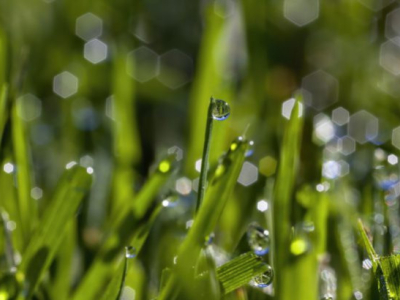
Visually, its leaves are a clear green, slightly hairy, flat at maturity. The mat it forms is thick and soft underfoot, quite different to the touch from a classic ornamental lawn.
Climate: the only question that really matters
Kikuyu comes from upland tropical areas. Before buying it, the question is not your soil or your aspect, but the winter climate where you live. A harsh winter does not suit it, and no precaution makes up for that.
In practice: kikuyu turns yellow as soon as temperatures stay in the low double digits or below. It does not die, it goes dormant and greens up again in spring. A sharp frost, however, burns the foliage, and prolonged freezing a few degrees below zero can reach the roots. This is a grass for mild regions, not a universal lawn.
Still unsure about your regional climate? Our article on kikuyu as a drought-resistant grass sets out how it really holds up against heatwaves and watering restrictions. And if your garden is in the south but you prefer a classic mixture, BHS Rustic SUD grass was formulated for the Mediterranean climate, with perennial ryegrass and fescue.
When to sow kikuyu grass
This is where most sowings fail. Kikuyu only germinates in warm soil: soil temperature must stay consistently above 15 C, which depending on the region happens between April and June. Sowing earlier gains nothing: the seed simply waits in the ground, or rots.
The useful window therefore runs from April to September, with a preference for May and June: the soil is warm, rainfall is still sufficient, and the plant has the whole summer to establish before winter. A September sowing germinates well but leaves a young lawn to face the cold.
| Period | Soil temperature | Expected result |
|---|---|---|
| February - March | Below 12 C | Avoid: no germination, seed wasted |
| April | 12 to 15 C depending on region | Possible in the south, slow germination elsewhere |
| May - June | Above 15 C | Ideal window: fast germination and full establishment before winter |
| July - August | Above 20 C | Possible, but sustained watering is essential |
| September | Still above 15 C | Acceptable, but the lawn enters winter young |
| October to January | Too cold | Avoid: no germination at all |
How to sow: rate and steps
Sowing works as for a classic lawn, with one important difference: the rate. Kikuyu is sown far more thinly than a traditional grass, because each plant then spreads by itself through its stolons. The reference rate is 12 g per square metre. Over-sowing does not thicken the mat: seedlings compete and the result is worse.
Adding compost during preparation speeds up establishment, especially on poor soil. On sloping ground, a light hemp or flax mulch limits erosion and holds moisture during germination.
Three pack sizes are available depending on the area to cover: BHS Kikuyu in a 300 g box for 25 m2 for a small area or a trial, the pack of 4 boxes, 1.2 kg for 100 m2 for a whole garden, and the 500 g bag for targeted overseeding. These seeds are enriched with organic fertiliser, which feeds the seedlings from germination onwards.
The first year: patience required
This is the main surprise for anyone sowing kikuyu: the first year is slow. The plants establish, develop their rhizomes, and the mat stays thin. Do not fill the gaps with more seed: the stolons will take care of it.
From the second year the dynamic reverses completely. Kikuyu colonises, thickens, and becomes the resilient lawn you chose it for. That is also when you need to start watching where it spreads.
Looking after your kikuyu lawn
Kikuyu is light on maintenance, but it differs from a classic lawn on two points: you mow high, and you water little.
| Task | Classic lawn | Kikuyu grass |
|---|---|---|
| Mowing height | 4 to 5 cm | 8 to 15 cm |
| Mowing frequency | Weekly in full growth | Monthly in summer, fortnightly in spring |
| Watering at maturity | Regular once the soil dries | One generous watering per week is enough |
| Response to drought | Yellows and thins out | Yellows, then greens up with the first rain |
| Traffic tolerance | Moderate | Very good, repairs itself |
Mowing high is not a detail: a close cut exposes the soil, speeds up evaporation and deprives the plant of the leaf reserve it needs to get through high heat. It is exactly the opposite of the usual reflex.
If your lawn yellows during a long dry spell, a single watering restores its colour. And if you have children playing outside, its soft texture cushions falls well.
The point to watch is the soil: very sandy ground can prove too poor. An application of fertiliser, or seaweed, corrects the deficiency. Our guide to lawn fertilisers covers formulations and rates, and the lawn fertiliser range meets the needs of the season.
The downside: an invasive grass
What makes kikuyu strong is also its flaw. Its stolons advance several tens of centimetres per season and do not stop at the boundary. With no physical barrier it crosses into the neighbour's garden, colonises beds and settles into paving joints.
Kikuyu is not the only drought-tolerant grass
If the climate or kikuyu's creeping habit gives you pause, other species handle heat. Cynodon dactylon and Dichondra repens answer the same need with different constraints: we compare them in our article on tropical grasses. And to repair an existing lawn scorched by summer without starting over, BHS overseeding grass germinates in 5 to 8 days with no need to turn the soil.
All our mixtures, kikuyu included, are gathered in the turf seeds category, each with its coverage and recommended rate.
Frequently asked questions about kikuyu grass
Does kikuyu really survive without watering? At maturity, yes: it gets through summer unwatered, yellows, then greens up with the first rain. But for the first three to four weeks after sowing, watering is essential.
How long before the mat is dense? Allow a full season for decent cover, and two years for a truly dense mat. That is the price of its resilience.
Can kikuyu be mixed with a classic lawn? Not advisable: kikuyu ends up dominating and the mixture becomes uneven. Better to choose one or the other for each part of the garden.
Does kikuyu tolerate shade? It tolerates partial shade but thickens far more slowly. Under trees, a red fescue based mixture gives a more even result.
Should it be scarified? Not like a classic lawn: its mat of stolons is not thatch. Mechanical aeration is enough if the soil compacts.
Is kikuyu permitted everywhere? In France, yes. It is however considered invasive in several countries, which is why containing its spread matters if your plot adjoins a natural area.
In short
Kikuyu grass is an excellent choice for a mild-region garden exposed to drought, provided you accept its two constraints: a slow first year and a creeping habit that needs containing. Sow it between April and September in soil above 15 C, at 12 g per square metre, mow high and water little. You will get a lawn that gets through summer without faltering.
Our kikuyu seeds are available in a 300 g box for 25 m2 and a 1.2 kg pack for 100 m2, dispatched within 24 hours.
Share this content