



 Accessoires IBC 1000 litres
 Couvertures Chauffantes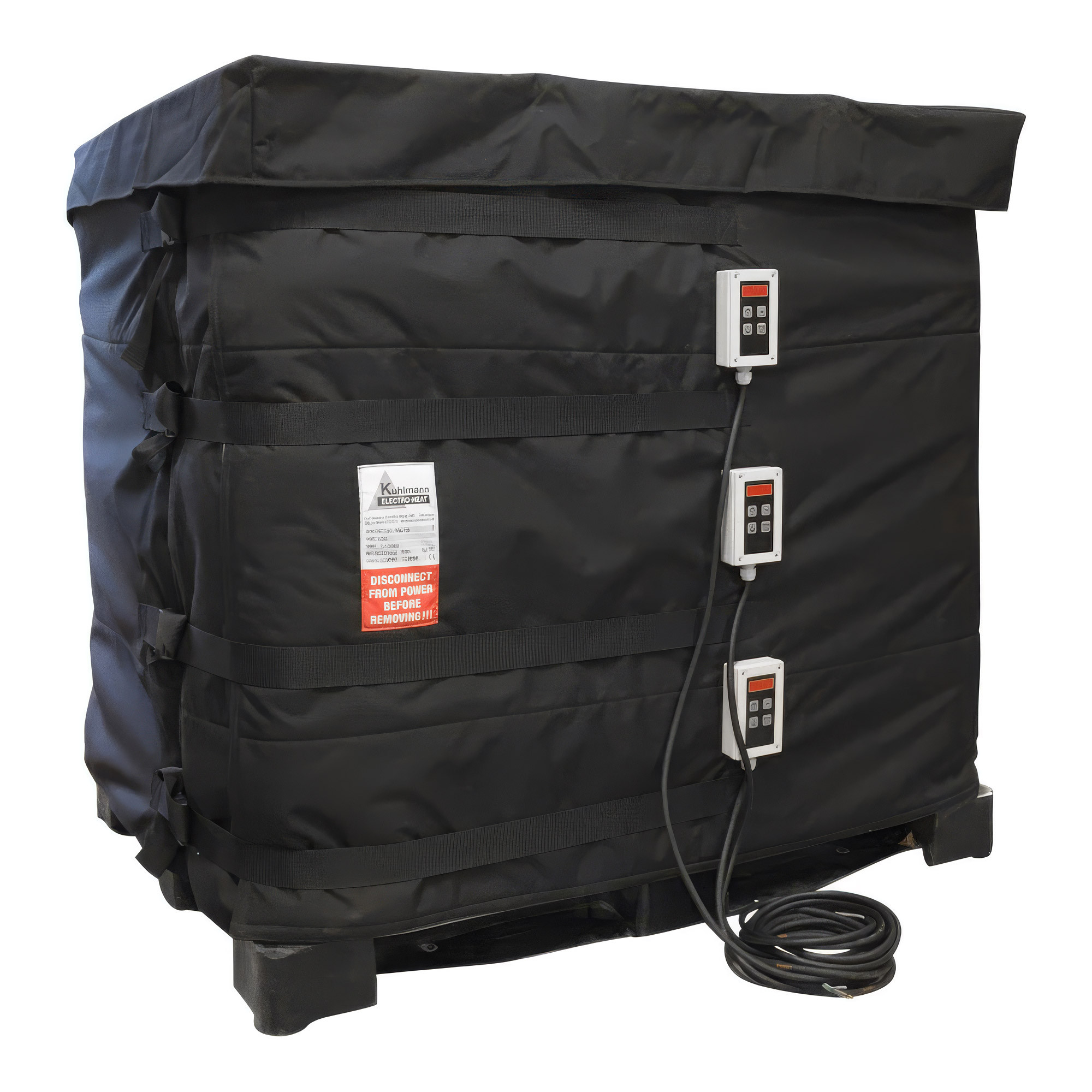
 Raccords Plomberie
 Bidons / Futs et raccords
 Semences


 Produits Phyto
 Jardin

 Espaces Verts
 Barbecue - Braséro - Cheminée
 Entretien
 Fluides & Climatisation
 Arrosage
Heating an IBC tank or a drum: blanket, base, immersion heater or heating tape?
Four technologies are available to heat a liquid stored in an IBC container or a drum: the heating blanket, the heating base, the immersion heater and the trace heating tape. They are not interchangeable. The choice depends on three parameters: the nature of the product, the thermal objective (frost protection, fluidisation before discharge, process temperature rise) and the hazardous area classification of the installation point. This page compares the four solutions, sets out their respective limits and details the ATEX and food-grade constraints.
The comparison table
| Technology | Principle | Contact with the product | Preferred use | Container | Point to watch |
|---|---|---|---|---|---|
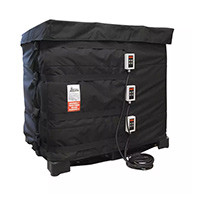
| Heating blanket | Flexible jacket wrapped around the container, heating through the side walls | None | Fluidisation before discharge, temperature maintenance, frost protection | 1000 L IBC, metal and plastic drums | Requires firm contact with the wall; a partially empty container heats less effectively in its upper section |
| Heating base | Flexible plate placed under the container, heating through the bottom | None | Highly viscous or semi-solid products, recovery of a solidified product | IBC, 200-220 L drums | Requires lifting the container for installation; heat rises by convection, and therefore slowly |
| Immersion heater | Heating element immersed directly in the liquid | Direct | Fast, uniform temperature rise in low-viscosity liquids | IBC, through the top opening | Direct contact: chemical compatibility is mandatory, and the element must never operate out of the liquid |
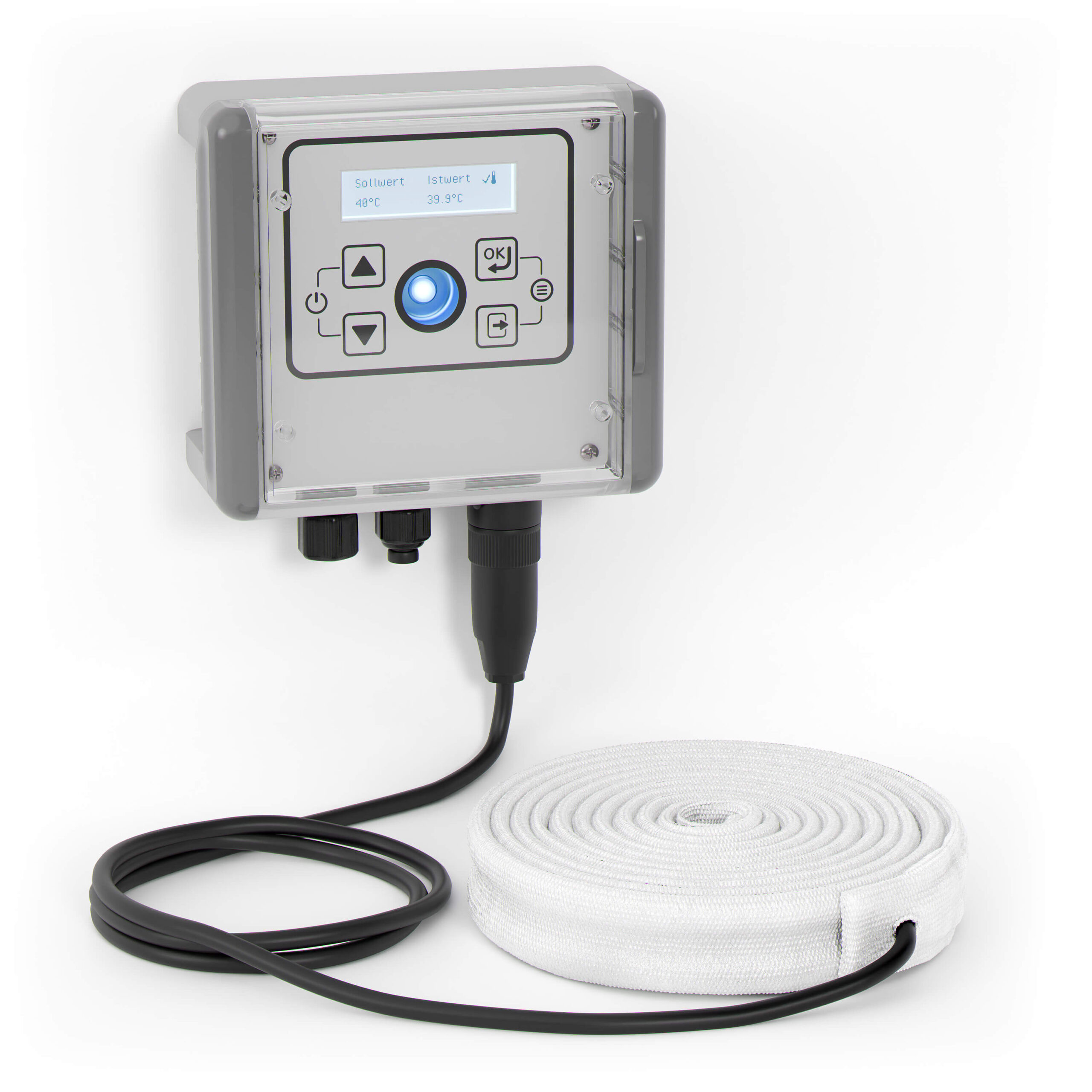
| Heating tape | Trace heating cable wound onto the pipework or the valve | None | Frost protection and temperature maintenance of circuits, not of the stored volume | Pipework, valves, pumps | Does not heat the contents of a tank: it treats the line, not the volume |
Choosing according to the thermal objective
Keeping above freezing
This is the most common requirement for outdoor storage or in an unheated building. The aim is not to raise the temperature but to offset heat losses. A heating blanket combined with an insulated lid is sufficient in the vast majority of cases: the power demand remains low, and insulating the top of the container sharply reduces consumption.
AdBlue is a good illustration of this need. This urea solution crystallises at low temperature, and unprotected outdoor storage becomes unusable for part of the winter. The same reasoning applies to emulsions, water-based paints and any product with a high water content.
Fluidising before discharge
This is the classic industrial case: oils, resins, adhesives, greases, honey, glucose, viscous chemicals. At ambient temperature these products flow poorly, discharge is slow and incomplete, and a significant share of the contents remains stuck to the walls. The cost of that residue often exceeds the cost of the heating equipment itself, especially where the product has a high value per litre or where the container has to be returned clean.
The heating blanket is the reference solution here, because it acts on the side wall, which is where the product adheres. The heating base becomes preferable when the product is solidified or semi-solid: heat applied through the bottom creates a liquid layer that starts the recovery process.
Raising the temperature for a process
When the product has to reach a precise and uniform temperature before transformation, the immersion heater has the advantage: heating takes place within the bulk, without passing through the wall. It is the fastest and most consistent solution, provided the product is fluid enough for convection to establish itself and chemically compatible with the immersed element. Where either of those two conditions is not met, an indirect solution remains preferable, even if the temperature rise takes longer to complete.
Protecting a circuit
Electric trace heating answers a different need: preventing freezing or solidification in pipework, valves and pumps. It complements the other three technologies, and never replaces them. A heated tank whose discharge line freezes remains unusable, and the fault is then attributed to the heating equipment rather than to the line that was left untreated.
What actually determines heating time
Installed power is only one factor in the result. Three others carry just as much weight, and they explain most of the differences observed between two apparently comparable installations.
The contact surface
A heating blanket transfers its heat only where it touches the wall. On an IBC container, the metal cage, deformation of the inner tank and partial filling create areas where contact is poor or non-existent. The rated power of the equipment then bears no relation to the power actually transferred to the product. This is the leading cause of disappointment with this type of installation, and it cannot be corrected by increasing power: it is corrected by careful fitting and by making sure the heated zone matches the zone that is actually filled.
Heat losses
Anything that is not insulated radiates. The top of the container, the pallet and the uncovered walls all contribute to losses, the more so as the difference from ambient temperature increases. Outdoors and in winter, these losses can absorb a significant share of the energy supplied, to the point where the product plateaus below the set point without the equipment being at fault.
This is why the insulated lid is not a comfort accessory: it treats the most heat-losing face of the container, the one through which heat naturally escapes. On an installation in a classified area, insulation is also a safety factor, since it allows the set point to be reached with a lower surface temperature.
The properties of the product
Two liquids of the same volume require neither the same energy nor the same time to reach the same temperature. Specific heat capacity determines the energy needed, thermal conductivity governs the speed at which it propagates through the bulk, and viscosity conditions the establishment of the convection currents that make the volume uniform.
A highly viscous product suffers twice over: it conducts heat poorly and it does not mix. The layer in contact with the wall heats up while the core stays cold, with a risk of local overheating if the control system measures temperature close to the wall. This is precisely what multi-zone control addresses, and it is what makes the heating base relevant for solidified products: by heating through the bottom, it creates an upward convection movement that side heating does not produce.
Constraints that rule out certain solutions
ATEX areas: a regulatory obligation, not an option
As soon as an explosive atmosphere can form, whether from solvent vapours, combustible dusts or hydrocarbons, the installation falls under the ATEX regulations. The hazardous area classification determines which equipment is permitted:
- Zones 1 and 2: explosive gas atmosphere, respectively likely to occur in normal operation (1) or only occasionally and briefly (2).
- Zones 21 and 22: the same logic applied to combustible dusts.
Standard heating equipment is prohibited in these areas, whatever its quality. ATEX equipment is distinguished by its design: intrinsically safe Ex-i control on the probes, galvanic isolation, a temperature limiter independent of the controller, and a temperature class rating (T6 to T3) defining the maximum permissible surface temperature.
Control then becomes a safety function in its own right, and not merely a convenience: an ATEX controller-limiter provides both set point management and a safety cut-out if that set point is exceeded.
Food and pharmaceutical applications
Direct heating with an immersion heater implies contact between the heating element and the product. In food or pharmaceutical applications, that contact imposes material compatibility and cleanability requirements that complicate the installation.
Contactless solutions, whether blanket or base, avoid this difficulty. What remains is to check the compliance of the blanket fabric, an FDA-approved coating guaranteeing the absence of migration into the product in the event of accidental contact. These applications generally aim to prevent crystallisation and to make complete discharge easier, without ever exceeding a temperature that would degrade the product.
Chemical compatibility
For an immersion heater, the nature of the alloy determines the service life of the equipment. AISI 316L stainless steel, through its molybdenum content and low carbon level, resists corrosion better than common stainless grades, which allows mild acids to be heated among other applications. This check must be carried out product by product: a fluid that is compatible with one alloy may attack the next.
Four common mistakes
- Heating without insulating. An IBC container that is heated but open at the top loses most of its energy through the top face. Adding an insulated lid reduces this loss, speeds up the temperature rise and lowers consumption. It is the accessory with the best cost-to-benefit ratio in any heating installation.
- Confusing maintenance with temperature rise. A system sized to offset heat losses will not bring a cold product up to temperature within an acceptable time. These are two distinct requirements, calling for different power ratings.
- Overlooking the area classification. Installing standard equipment in a classified area engages the operator's liability, irrespective of any incident. The classification must be established before the equipment is chosen, never afterwards.
- Treating the tank and forgetting the line. A product fluidised inside the container but solidified in the valve or the hose will flow no better. Trace heating of the circuits is part of the installation, not an option.
Control: single, multi-zone or ATEX
Three levels of temperature control exist side by side, and the choice weighs as heavily on the result as the heating technology itself.
Single-thermostat control is suitable for maintaining a homogeneous product at temperature. It assumes that temperature is uniform throughout the volume, which is rarely true in a tall IBC.
Multi-zone control drives several sections of the blanket independently. It addresses thermal stratification: a liquid heated through the walls warms up faster in the lower section, and a single control output leads either to overheating the bottom or to under-heating the top.
ATEX control is, as noted above, a matter of safety. It combines control and limitation, with tighter measurement accuracy and an independent safety chain.
Installation and operation
Probe position
The control probe measures the temperature where it is located, and nowhere else. Placed against the heated wall, it reads a value higher than that of the product core and cuts out too early; placed too far away, it lets the wall rise above the set point. On a viscous product, where the difference between wall and core is significant, this choice directly determines the quality of the result and, for heat-sensitive products, the integrity of the contents.
Electrical supply
Industrial heating equipment consists of continuous resistive loads, often of several kilowatts. The circuit must be sized accordingly, protected by a suitable residual current device, and the earthing must be verified, particularly outdoors where moisture is permanent. The protection rating of the equipment must match real conditions: equipment intended for indoor use will not survive outdoor storage, and an IP65 rating indicates resistance to dust and water jets, which is not a guarantee of immersion protection.
Maintenance and service life
Failures observed on this type of equipment rarely originate from the heating element itself. They come from cables pinched by the container cage, connectors exposed to splashing, fabric punctured by rough handling, or probes displaced during a tank change. Regular visual inspection of the cables and the fabric, together with flat storage of blankets between uses, appreciably extends the service life of the equipment.
In a classified area, this inspection goes beyond routine maintenance: any damage to the jacket or the wiring calls the compliance of the installation into question and requires it to be taken out of service until repaired.
Summary
| Your situation | Recommended solution |
|---|---|
| Outdoor storage, risk of freezing | Heating blanket plus insulated lid |
| Viscous product that is difficult to discharge | Heating blanket, multi-zone if the container is tall |
| Solidified or semi-solid product | Heating base, possibly supplemented by a blanket |
| Fast temperature rise, fluid and compatible product | 316L stainless steel immersion heater |
| Pipework, valves and pumps to protect | Electric trace heating tape |
| Classified ATEX area | Certified ATEX equipment and Ex-i controller-limiter, without exception |
| Food or pharmaceutical product | Contactless solution, FDA-approved fabric |
Finding the right equipment for your case
The four technologies compared here cover different needs, and the right choice depends on your precise configuration. Our heating selector guides you through five questions covering container, area classification, thermal objective, industry sector and target temperature, then returns the list of matching equipment with prices and a direct link to each product page. It covers the entire catalogue and distinguishes heating equipment from insulation and control accessories.
Our range
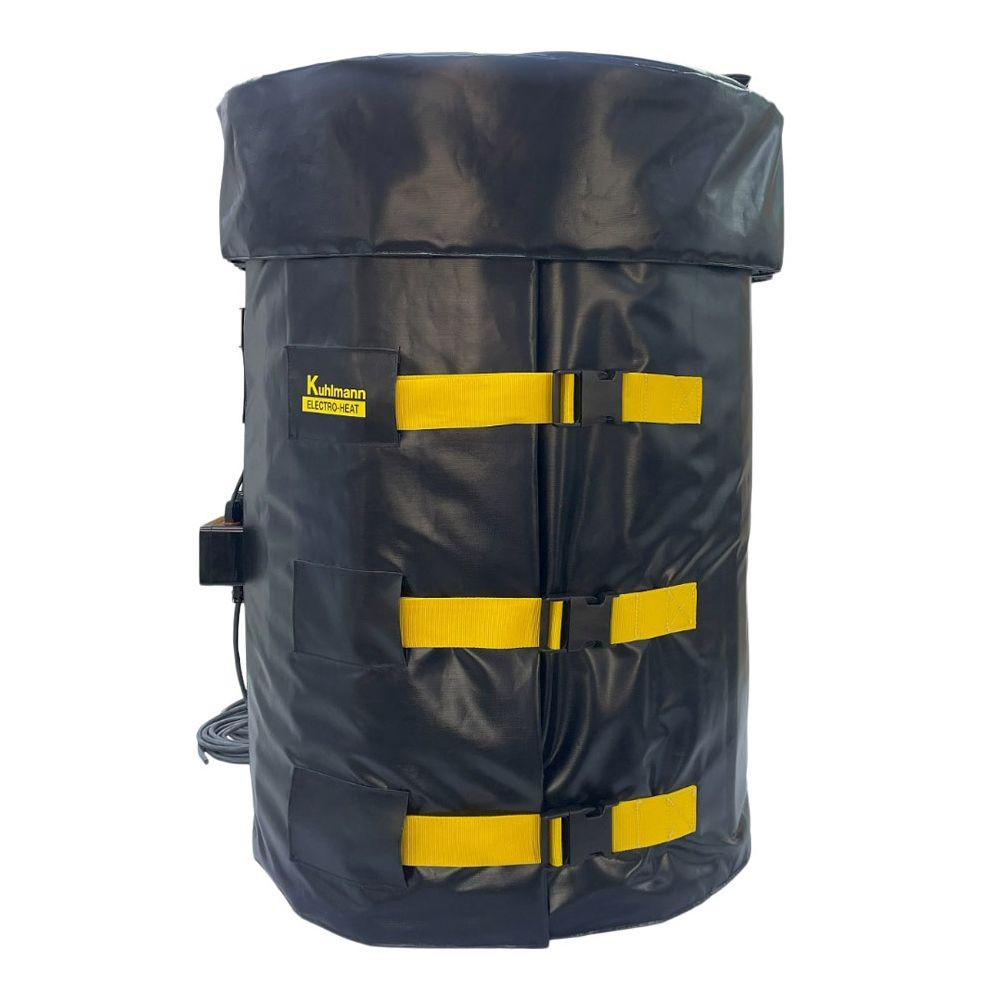
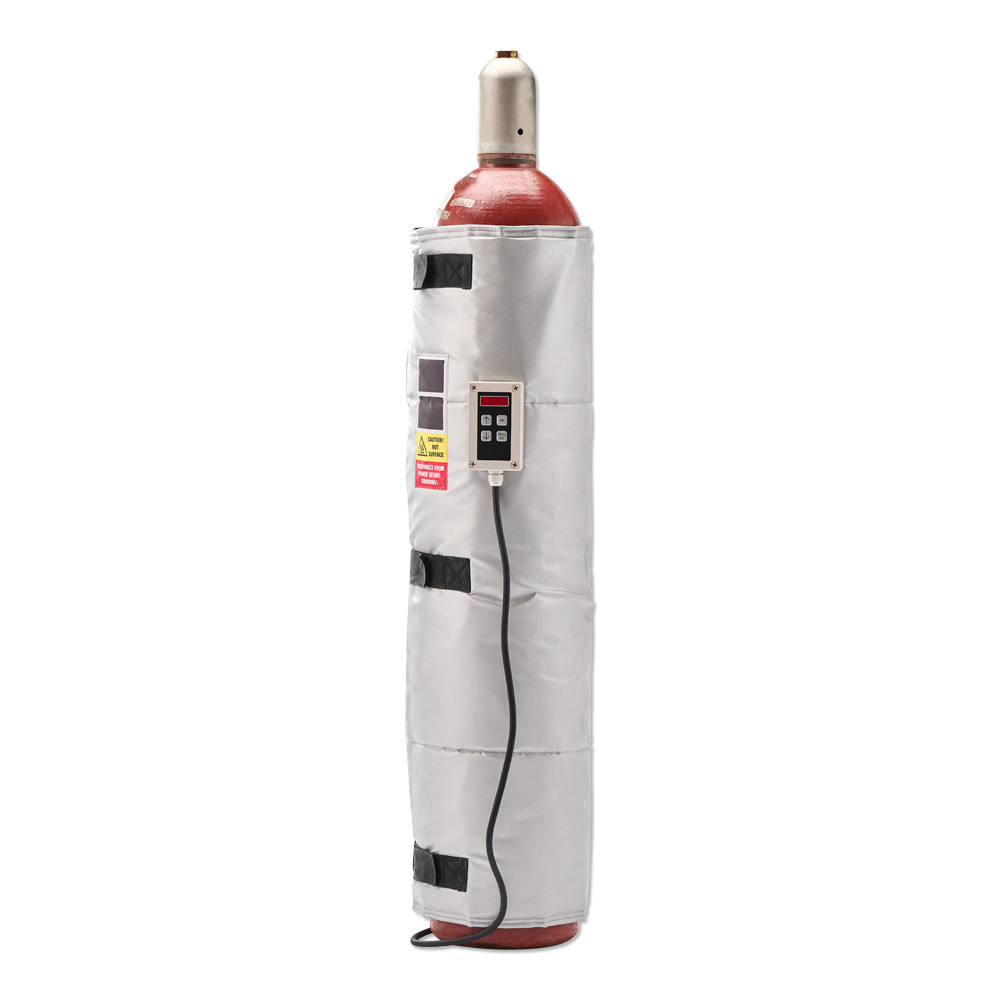
Multitanks distributes Kuhlmann industrial heating solutions for IBC containers, drums and gas cylinders, in standard and ATEX versions: IBC container heaters, drum heaters, gas cylinder heaters and trace heating tapes. The complete range is available from the heating blankets for IBC, drums and gas cylinders section.
Sizing depends on the volume, the starting temperature, the target set point, the acceptable time frame and the installation conditions, together with the classification of the area and any constraint on the materials in contact with the product. These parameters interact: two installations of identical volume can call for very different power ratings. For a specific configuration or a request concerning a classified area, our technical team will prepare a quotation on the basis of your specification.