IBC 1000 L accessories
 Heating jackets
 Fittings
 Drums, jerrycans & fittings
 Seeds

 Plant protection & biocides



 Garden

 Green spaces & municipal
 Barbecue, fire pit & fireplace
 Cleaning & care
 Refrigerants & air conditioning

 Watering


Overseeding, 7-day or meadow lawn: which one to choose?
After the classic mixtures - hardy, hard-wearing, dry ground - here are three grasses that answer very specific needs. They are not interchangeable: one repairs, another works fast, the third covers large areas. Choosing the wrong one means paying for a result that does not match the expectation.
Which one for which need?
| Your situation | The right mixture | Time to result |
|---|---|---|
| My lawn has bare patches, the rest holds | Overseeding | 5 to 8 days to germinate |
| I have just scarified, the soil is open | Overseeding | 5 to 8 days |
| I am selling my house next month | 7-day | One week, but intensive watering |
| I have 500 sqm to cover on a budget | Universal meadow | 2 to 3 weeks |
| My soil is heavy clay | Universal meadow | 2 to 3 weeks |
| I am creating a lasting ornamental lawn | None of the three | See the hardy mixtures |
The key point: overseeding grass is not a mixture for creating a lawn. It is formulated to germinate very fast on soil already in place, not to build a lawn from nothing. For a new lawn, look at BHS Hardy grass or read our guide to the 9 types of lawn.
Overseeding grass
This is the most useful mixture of the three, and the least known. Its job is to repair: fill thin areas, thicken a mat that is opening up, close the damage from a dry summer or a scarifying pass. It relies on varieties selected for express germination, in the order of 5 to 8 days.
The best moment is autumn, in September or October: the soil is still warm, the rain returns, and the new growth has time to establish before winter. Spring works too, straight after the first cut and a scarifying pass.
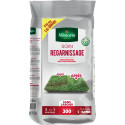
BHS Overseeding grass GRE5 is our reference here: germination in 5 to 8 days, 200 to 250 sqm covered by a 5 kg bag, and strong tillering that thickens the mat. Universal overseeding grass is the alternative. The full preparation method is in our article on scarifying.
7-day grass
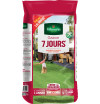
Its name states its single argument: the first growth appears in about a week. It relies on very fast-germinating ryegrass varieties, often combined with a quick-release fertiliser.
That speed comes at a price, and you need to know it before buying: it uses a great deal of water. Accelerated germination demands constant moisture, without interruption, throughout emergence. In a dry region, or during a hosepipe ban, this is not the right mixture - and that is precisely the situation where it disappoints.
Sow in spring or autumn, when soil temperature sits between 10 and 20 C. Prepare the ground by loosening and levelling it, sow, firm, then keep the soil moist without interruption. A single dry day during germination compromises the result.
7-day grass in a 5 kg bag is in stock. If your need is to repair rather than to create quickly, BHS Overseeding germinates almost as fast for more everyday use.
Universal meadow
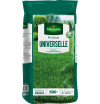
Intended for large areas, universal meadow favours economical cover over fineness. It combines hardy grasses that cope with heavy clay soils, where an ornamental lawn would struggle.
It is the right choice to cover a large area without an ornamental budget: building surrounds, a large plot, an orchard area, a maintenance meadow. On a small garden visible from the house, a hardy mixture will look far better.
Universal meadow in a 5 kg bag covers 500 sqm. For a smaller area or a finer finish, BHS Hardy grass remains the best compromise.
Combining them sensibly
Nothing obliges you to choose a single mixture for the whole garden. It is rarely the best solution.
Frequently asked questions
Can you overseed without scarifying? Yes if the thatch is thin: a short cut and a raking are enough. If the lawn is mossy or spongy, scarifying is essential, otherwise the seed never touches soil.
Does 7-day grass really germinate in 7 days? The first growth, yes, if temperature and moisture are right. A usable lawn still takes three to four weeks, like any other mixture.
Can you mix two types of grass on the same area? Yes, provided they are from close families. Mixing an ornamental lawn with a tropical grass gives an uneven result, the latter ending up dominant.
How often should you overseed? Once a year in autumn on a normally used lawn, twice on heavily used ground. It is the cheapest and most effective maintenance there is.
Should you fertilise at the same time? A growth fertiliser usefully accompanies spring overseeding. In autumn, prefer a low-nitrogen formulation. Our guide to lawn fertilisers sets out the rates.
In short
Overseeding grass repairs and maintains: it is the mixture to keep permanently to hand. 7-day answers an emergency, at the cost of sustained watering. Universal meadow covers large areas cheaply, with a meadow finish. None of the three is a mixture for creating an ornamental lawn: for that, turn to a hardy mixture.
You will find these three mixtures and the full range in the turf seeds category. To choose between all the types available, our guide to the 9 types of lawn compares them in a single table, and our article on tropical grasses covers hot, dry regions.
Share this content