



 IBC 1000 L accessories
 Heating jackets
 Fittings
 Drums, jerrycans & fittings
 Seeds

 Plant protection & biocides



 Garden

 Green spaces & municipal
 Barbecue, fire pit & fireplace
 Cleaning & care
 Refrigerants & air conditioning
 Watering
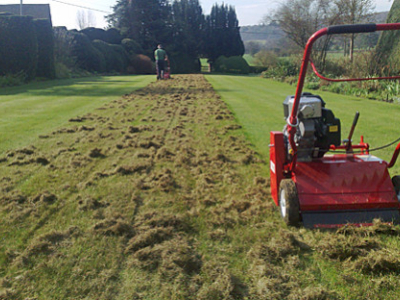
Why and how to scarify your lawn?
The word sounds technical, the job is simple: scarifying means raking the soil to cut through the layer of thatch that builds up between the blades of grass. It is one of the few tasks that visibly transforms a tired lawn. On one condition, often left unsaid: what you do immediately afterwards matters as much as the scarifying itself.
Scarifying: what is the point?
Over time, a compact layer forms at the soil surface: a mixture of moss, shallow roots and plant debris known as thatch. While it stays thin, it protects. As soon as it thickens, it smothers.
The mechanism is mechanical, not mysterious: water no longer penetrates and stands on the surface, nutrient exchange is blocked, and the root system stops developing downwards. The result is a dull lawn, prone to disease, that yellows at the first spell of heat because its roots stayed near the surface.
Moss is not the cause, it is the symptom
Pulling out moss without asking why it is there guarantees seeing it again next year. It takes hold when the grass is struggling: acidic soil, too compact, too wet, too shaded, or an underfed lawn. It occupies the space left free.
Scarifying removes the moss that is there. To stop it returning, you have to treat what let it settle: aerate compacted soil, correct acidity, thin out excessive shade, and feed the grass so it takes the ground itself.
A moss-killing lawn fertiliser works on both fronts: it destroys the moss and feeds the grass in the same application, letting it close the areas freed up. Apply it before scarifying - blackened moss comes away far more easily.
What time of year should you scarify?
Twice a year is enough, and the two passes serve different purposes. The soil should be neither waterlogged nor dry: slightly moist, as after rain the previous day.
| Period | Purpose | What to follow with |
|---|---|---|
| Spring, after the last frosts | Remove winter moss and restart growth | Fertiliser, then regular watering |
| Autumn, September-October | The most useful pass | Overseeding and top dressing before winter |
| Summer, in full heat | Avoid | The lawn is already stressed and would not close up |
| Winter, frozen or waterlogged soil | Avoid | Blades are ineffective and roots get damaged |
The autumn pass is the most rewarding: the soil is still warm, the rain returns, and the lawn has time to close up before the cold. It is also the best window for overseeding.
The method, step by step
If your machine is electric or petrol-driven, start it tilted, then lower it gently onto the ground: with the blades already turning, it would tear into the lawn at start-up.
Which tool should you choose?
The choice depends mainly on area. We do not sell scarifiers, but here is what you need to decide without going wrong.
| Type | Suitable area | What to know |
|---|---|---|
| Manual, bladed rake | Up to 100 sqm | Inexpensive and effective, but physically demanding |
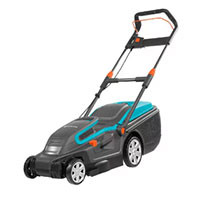
| Electric | 100 to 500 sqm | The best compromise for a garden; collection box usually included |
| Petrol | Over 500 sqm | Powerful and self-contained, but heavy, noisy and costlier to run |
| Towed scarifier | Large areas | For sports grounds and professionals |
Two points apply to every model: blades, not simple springs - springs remove moss, they do not scarify - and an adjustable depth, so you never exceed 4 mm.
The step everyone forgets: overseeding
After scarifying, your lawn is open, thinned, and in places frankly bare. That is normal, and it is precisely the moment not to miss: raked soil takes seed infinitely better than closed soil. Doing nothing means letting weeds occupy the space.
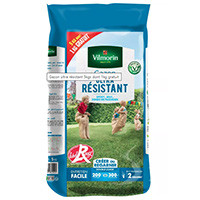
BHS Overseeding grass GRE5 is made for this stage: it germinates in 5 to 8 days, covers 200 to 250 sqm and requires no digging. It is the direct answer to a lawn left bare after scarifying, or damaged by summer drought.
If the lawn is too far gone for simple overseeding, consider a rebuild. Depending on your region and aspect, BHS Hardy grass suits most gardens - perennial ryegrass, creeping red fescue and meadow grass, with good tolerance of partial shade - and BHS High Resistance grass suits heavily used ground.
What to do with the debris?
One pass produces a surprising quantity of material. Do not leave it on the lawn: it would rebuild the thatch you have just removed.
Thatch and dead roots go on the compost heap, where they break down well. Moss, however, is acidic and hard to compost in quantity: add only a little, or take it to a green waste site. If your scarifier has no collection box, rake up along the route you took, so you do not tread debris back into the freshly opened lawn.
Scarifying and aerating are not the same thing
The two jobs are often confused, although they address different problems. Scarifying works at the surface: you cut the thatch. Aerating works at depth: you perforate the soil to let air and water in.
Compacted soil - heavy clay, trodden ground - needs aerating, and scarifying alone will change nothing. Conversely, a mossy lawn on loose soil needs scarifying. The two jobs complement each other, and autumn is the right season to do both.
Frequently asked questions
My lawn looks terrible after scarifying, is that normal? Yes, and it is a good sign: it means the thatch has gone. It closes up within three to four weeks if you have overseeded and watered.
Can you scarify a new lawn? Not before its second year. A young lawn has not rooted deeply enough and the blades would tear it out.
Should you scarify every year? Only if the thatch builds back up. On healthy, well-maintained soil, once every two years can be enough. Scarifying too often weakens the lawn.
Should I fertilise before or after? Moss killer before, to make removal easier. Growth fertiliser after, with the overseeding, to support the new growth.
What if my problem is drought, not moss? Then scarifying is not the answer. A lawn scorched by summer is repaired by overseeding, and prevented by changing the mixture: see our comparison of heat-resistant grasses.
In short
Scarify twice a year, in spring and above all in autumn, on slightly moist soil, after a short cut, with blades set to 4 mm at most. Collect the debris, then overseed immediately: it is that second step that separates a lawn merely cleaned from a lawn genuinely recovered.
For the stage after scarifying: BHS Overseeding GRE5 germinates in 5 to 8 days, and moss-killing fertiliser treats the cause of the thatch. The full range is in the turf seeds category, and our guide to lawn fertilisers covers the formulations by season.
Share this content