IBC 1000 L accessories
 Heating jackets
 Fittings
 Drums, jerrycans & fittings

 Seeds






 Plant protection & biocides



 Garden





 Green spaces & municipal


 Barbecue, fire pit & fireplace

 Cleaning & care


 Refrigerants & air conditioning
 Watering
R22 gas banned: replace it without changing everything
Is your air conditioner or cold room still running on R22, and are you dreading having to replace everything at great expense? That fear is understandable, but usually unfounded. In the vast majority of cases the installation itself can be kept — it is the refrigerant that has to change, and you still need to know which one to choose. This article walks you through it step by step: why R22 is banned, which families of gas can replace it depending on your type of installation, and why the hydrocarbon alternative offered by Multitanks makes the job considerably simpler.
❄️ Why is R22 completely banned?
R22, chemical name chlorodifluoromethane, belongs to the HCFC family — chlorinated hydrofluorocarbons whose impact on the ozone layer is scientifically established. Long used as the standard refrigerant in air conditioners and refrigeration systems, it was progressively restricted and then banned under the Montreal Protocol, transposed into European law by Regulation (EC) 1005/2009.
The ban came in two stages. From 1 January 2010, the use of virgin (new) R22 to service existing installations was prohibited. Then, on 1 January 2015, the ban became total: even recycled or reclaimed R22 can no longer be legally bought or used in the European Union. Since that date, any installation still running on R22 is operating illegally, and its operator is exposed to penalties. The question is therefore no longer “whether” to change refrigerant, but “to what” and “how”.
❄️ The conventional replacement families: R407C and R404A
In response to the R22 ban, the market first turned to HFC (hydrofluorocarbon) refrigerants, which contain no chlorine and therefore have no direct impact on the ozone layer. Two references became established, but they are not aimed at the same types of installation.
R407C is a zeotropic blend of three refrigerants (R32, R125 and R134a) with a global warming potential (GWP) of 1774. It was long regarded as the natural substitute for R22 in air conditioning and heat pumps, mainly because its operating pressures are close to those of R22, which limits the hardware changes required. However, being zeotropic, it has a “temperature glide”: the blend must always be charged in the liquid phase, never as a gas, otherwise the composition of the refrigerant changes and the performance of the installation deteriorates.
R404A (and its close relative R507A) established itself in commercial refrigeration — cold rooms, refrigerated display cabinets, flooded evaporators. Unlike R407C, using it to replace R22 generally requires the expansion valve to be replaced in order to compensate for the pressure difference between the two refrigerants.
It is essential to distinguish between two approaches that must not be confused. A retrofit consists of replacing only the refrigerant, keeping hardware changes to a minimum. A conversion is a deeper operation that also involves changing the lubricant — the polyolester (POE) oil required by HFCs is incompatible with the original mineral oil used with R22 — and potentially several components (filter drier, seals, expansion valve depending on the refrigerant chosen). Underestimating this distinction can lead to costly compressor damage. Moreover, these HFC refrigerants are themselves now subject to the progressive restrictions of the European F-Gas Regulation, which aims to reduce the use of high-GWP refrigerants — pushing the market increasingly towards low-impact alternatives.
❄️ Comparison table: R22, R407C, R404A and the hydrocarbon alternative
To make things clearer, here is a summary table of the four refrigerants, letting you compare at a glance the technical and regulatory constraints of each option.
| Criterion | R22 (banned) | R407C | R404A | Hydrocarbon alternative (Multicool / Climapure) |
|---|---|---|---|---|
| Family | HCFC | HFC (R32/R125/R134a blend) | HFC | Hydrocarbon |
| Typical use | Air conditioning & refrigeration | Air conditioning, heat pumps | Commercial refrigeration | Air conditioning & refrigeration |
| Oil change | — | Generally required (POE) | Required (POE) | Not required (compatible with existing oils) |
| Expansion valve change | — | Generally not required | Required | Not required |
| Regulatory status | Banned since 2015 | Subject to F-Gas restrictions | Subject to F-Gas restrictions | F-Gas compliant |
❄️ The hydrocarbon alternative: the solution that simplifies the job
Given the technical and regulatory constraints of HFC refrigerants, the hydrocarbon alternative is particularly attractive for installations originally charged with R22. Its main advantage is its compatibility with the materials and lubricants already in place: unlike R407C or R404A, no oil change is required, and the existing expansion valve can be kept. The job is considerably lighter, both in duration and in labour cost. These refrigerants also operate at lower pressures than synthetic refrigerants, which reduces the mechanical stress on the compressor.
A useful rule of thumb, observed on this product family from comparable manufacturers: around 40% of the original charge weight is enough with a hydrocarbon substitute — a practical benchmark for estimating the quantity needed, without presenting it as an absolute rule applicable to every reference without a prior diagnosis. Finally, from an environmental standpoint, these refrigerants have zero ozone impact and a very low GWP, which places them outside the scope of the progressive F-Gas restrictions that weigh on high-GWP HFCs.
Multitanks offers two formats suited to different usage profiles, available in the ecological refrigerant range.
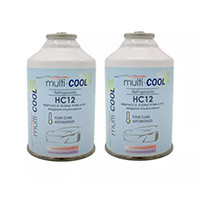
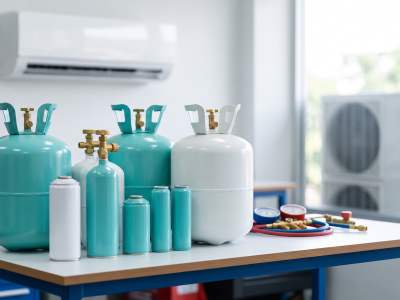
The Multicool-R22 can (ref. MC0002) is designed to replace R22, R502 and R404A in compatible compressors. Its 400 g format makes it ideal for a one-off job — topping up a residential air conditioner, or an occasional repair on a small refrigeration system. Compatible with existing heat-exchange and expansion equipment, it requires no oil change. Warning: this refrigerant is highly flammable and must be handled away from any source of ignition.
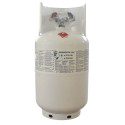
The Climapure 22A 5.4 kg cylinder is the go-to solution for professionals who regularly work on several installations. A natural hydrocarbon with zero ozone impact, it offers advertised energy savings of up to 40% compared with conventional gases. Its 5.4 kg format is a good compromise between handling and capacity, covering several small jobs or topping up a larger installation. Manufacturer's tip: in cold weather, warm the cylinder slightly to ease the transfer, never exceeding 40°C and using only an indirect heat source.
❄️ The regulatory framework: what cannot be ignored
Whichever solution you choose — HFC refrigerant or hydrocarbon alternative — replacing the refrigerant in a fixed installation is not something you do yourself by “simply pouring in the new gas”. Two prerequisites are unavoidable. First, the complete recovery of the old refrigerant must be carried out by a certified professional using approved recovery equipment — releasing R22 into the atmosphere is illegal and punishable. Second, a prior diagnosis of the installation is essential to check the condition of the circuit, identify any leaks and determine the optimum charge of the new refrigerant.
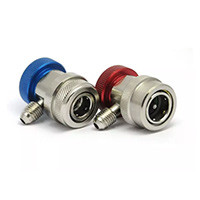
From a regulatory standpoint, the work remains subject to the refrigerant handling certification in force in your country, and handling must in any case be entrusted to a qualified, properly equipped professional, whichever refrigerant is chosen. Suitable refrigeration tools — manifold gauge set, vacuum pump, leak detector — are also essential to carry out the job properly.
💡 Multitanks expert tip — Can or cylinder: the right criterion
The choice between the Multicool-R22 can and the Climapure 22A cylinder depends less on the size of the installation than on the frequency of intervention. A professional handling several sites in the same season is better off with a cylinder: the 5.4 kg format provides the autonomy needed to chain jobs without repeated purchases. Conversely, a private individual or a technician called out occasionally to a single installation will be perfectly served by a 400 g can, lighter to carry and ideally suited to occasional use. In both cases the technical approach is the same: prior recovery, diagnosis, then charging the new refrigerant by a certified professional.
❄️ Why the hydrocarbon alternative is the most future-proof option
Beyond the technical simplicity it brings to the installation, the hydrocarbon alternative has a strategic advantage it would be wrong to overlook: its lasting compliance with environmental requirements. Whereas HFC refrigerants such as R407C or R404A are themselves in the sights of the European F-Gas Regulation — which provides for a progressive phase-down of high-GWP refrigerants — natural hydrocarbons have a very low GWP and are not affected by these restrictions. Choosing a hydrocarbon solution today therefore means avoiding finding yourself, in a few years' time, in the same situation as with R22: forced to change refrigerant again under regulatory pressure.
For refrigeration professionals, this future-proofing argument comes on top of operational simplicity: fewer components to change, less time on site, and a refrigerant in line with the long-term environmental trajectory. For private individuals, the reassurance is simple: the existing appliance can be kept, and the transition involves no heavy work, provided the operation is entrusted to a qualified technician.
To explore the full range of R22, R502, R407C and R404A substitutes available from Multitanks, visit the ecological refrigerants category. There you will find all the references suited to each type of installation, as well as the refrigeration tools needed to carry out the job properly.
Share this content