IBC 1000 L accessories
 Heating jackets
 Fittings
 Drums, jerrycans & fittings
 Seeds
Seeds 



 Plant protection & biocides

 Garden

 Green spaces & municipal

 Barbecue, fire pit & fireplace
 Cleaning & care
 Refrigerants & air conditioning
 Watering
Did mosquitoes disappear during the heatwave? What you really need to understand (and do)
During the most intense days of the historic heatwave of late June 2026, many people experienced a puzzling sensation: sleeping with windows wide open, without a single bite, without the familiar buzzing that ruins summer nights. Had mosquitoes truly disappeared? The reality is more nuanced, and far less reassuring than it might seem.
🦟 A deceptive relief: where were they really?
The feeling of nocturnal peace experienced by millions during the heatwave of late June 2026 was very real, but it was based on a misunderstanding. Mosquitoes do not disappear during extreme heat waves: they go into hiding. Unlike mammals, insects have no internal thermal regulation mechanism. Their body temperature follows that of their immediate environment, making them extremely vulnerable to heat and, above all, to the rapid dehydration it causes.
Beyond approximately 30 °C, entomologists observe a sharp drop in mosquito activity. They take refuge in the cool, humid microclimates offered by dense vegetation, the undersides of leaves, crevices in walls, and all the shaded spots a garden has to offer. A study published in 2023 by the University of Zurich confirmed and quantified this remarkable ability: mosquitoes are capable of locating and exploiting refuge zones several degrees cooler than the surrounding air, very effectively reducing their exposure to temperatures that would be lethal to them. When thermometers were reading 38 or 39 °C in some parts of France, mosquitoes were therefore very much present — simply motionless, hidden, waiting for a more favourable window of activity.
This behaviour also explains why the rare mosquito outings during a heatwave occur in the final hours of the night, when temperatures drop more significantly. On days when heat remains intense even after midnight — as during the tropical nights of June 2026 — activity remains near zero, reinforcing the impression of a total disappearance. But this is merely a forced dormancy, not a mass die-off.
💧 Drought and breeding sites: partial and temporary destruction
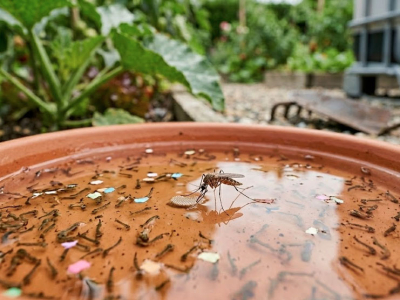
The other mechanism at work during a prolonged heatwave directly concerns mosquito reproduction. To lay eggs, the female needs standing water, even in very small quantities: a saucer under a flowerpot, a clogged gutter, a forgotten bucket, a discarded tyre left outside. When drought sets in alongside the heatwave, these small breeding sites dry up, which does effectively kill some of the eggs and larvae currently developing. This is a real phenomenon that contributes to reducing local populations in the very short term.
However, mosquito control specialists are unanimous: this effect is limited and temporary. Even an intense period of drought never destroys all breeding sites. Some sites, deeper or more shaded, retain enough residual moisture. And above all, tiger mosquito (Aedes albopictus) eggs have remarkable resistance to desiccation: they can survive several weeks out of water and resume development as soon as moisture returns. Drought merely interrupts the cycle — it does not break it.
⚠️ It is only a reprieve: why their return can be sudden
This is the central message that entomologists and environmental health specialists struggle to get across: the apparent disappearance of mosquitoes during a heatwave is a deceptively good piece of news. As soon as temperatures drop and humidity returns — which inevitably happens after every heatwave episode — mosquitoes emerge from their torpor and resume egg-laying with increased intensity.
Worse still, the typical post-heatwave weather pattern in France — violent and sudden storms following weeks of drought — creates near-ideal conditions for a population rebound. Rain rapidly fills all outdoor containers, breeding sites multiply within hours, and females, whose reproductive cycle was interrupted by the heat, seize this opportunity to lay eggs en masse. Specialists speak of a catch-up effect that can, within two to three weeks, generate local populations even larger than before the heatwave.
The message is therefore clear: the reprieve offered by the heatwave is not a victory. It is a window for action. And the best time to tackle breeding sites is precisely now, before the first storm that follows.
🌍 The underlying trend: the spread of the tiger mosquito in France
To understand the real stakes, this episode must be placed within a worrying broader trend. The tiger mosquito (Aedes albopictus), easily recognisable by its black and white stripes, is a vector of serious diseases such as dengue fever, chikungunya and the Zika virus. Originally from Asia, it has established itself and is spreading: in 2025, metropolitan France recorded 809 locally acquired cases of chikungunya, a record since enhanced surveillance was introduced in 2006. These cases were not imported from tropical countries: they resulted from bites on French soil.
The EID Méditerranée, the reference body for mosquito monitoring and control in southern France, has published striking data: the larval breeding surfaces monitored in the south nearly doubled between winter 2024-2025 and winter 2025-2026, rising from approximately 2,900 hectares to nearly 6,000 hectares. This spectacular increase illustrates just how much the mosquito issue in France is no longer merely a matter of nocturnal comfort, but a public health challenge that justifies active prevention on the part of every resident, at the scale of their own garden.
🔍 Act now: hunting down breeding sites in your garden
The good news is that every gardener has a concrete and immediate lever for action. Eliminating breeding sites is recognised by all health authorities as the most effective and sustainable method for reducing mosquito populations at the local level. And this effort requires neither chemicals nor costly equipment: it calls above all for observation and regularity. Here are the essential steps to take today, before the first rains refill outdoor containers:
These actions, applied collectively across a neighbourhood or housing estate, can significantly reduce mosquito pressure. Every breeding site eliminated potentially means several hundred fewer mosquitoes in the weeks that follow.
🪣 The rainwater collector: the number one breeding site in your garden
Among all the potential breeding sites found in a private garden, rainwater collectors and storage tanks occupy a category of their own. A simple barrel or a tank of 500 to 1,000 litres left open represents, for female tiger mosquitoes, a virtually unlimited and predator-free egg-laying surface. Within just a few days after a storm, a single unprotected container can produce several hundred larvae, and then several hundred adult mosquitoes capable in turn of colonising the entire neighbourhood.
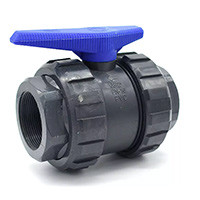
The solution is, however, simple and lasting: ensure that the collector is fitted with a hermetic lid or a cover adapted to the tank, and that all water inlets (gutter connection, overflow) are protected by a fine-mesh screen or mosquito net. The overflow deserves particular attention: it is often an open pipe running towards the ground that provides a free entry point for mosquitoes in search of standing water. Simply fitting this overflow with a mosquito net fabric sleeve held in place by a clamp is enough to neutralise this risk. You will find filtration and water access solutions in our watering section, designed to fit most outdoor storage configurations.
For IBC tanks and large reservoirs, vigilance must be even greater, as their surface area and volume make them exceptionally productive breeding sites if access is not properly secured. A tarpaulin or rigid cover placed without being fixed can leave gaps wide enough for a female mosquito to find her way through. Investing in appropriate protection is therefore not only beneficial for the quality of the stored water, but directly effective against mosquito proliferation.
A well-fitted lid on your water collector is enough to eliminate the risk of egg-laying. No female mosquito can penetrate a closed surface. Choose lids specific to your tank model, or tightly stretched tarpaulins with no free space at the edges, available in the IBC accessories range.
The gutter connection and the overflow are the two entry points to protect as a priority. A fine-mesh screen (less than 1 mm) is sufficient to prevent any egg-laying while allowing water to flow freely. Also consult our fittings section for pipe adaptations.
Even with protection in place, a quick inspection after each rain event remains necessary. A worn seal, a lid displaced by the wind, or a poorly repositioned tarpaulin can be enough to allow egg-laying. Vigilance is a reflex to adopt throughout the season, from May to October.
🌿 Protecting yourself when they return: solutions for garden and patio
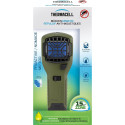
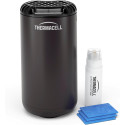
Even with exemplary management of breeding sites, it is unrealistic to claim that mosquitoes can be completely eliminated from your immediate surroundings, as they also arrive from neighbouring gardens and public spaces. Physical and biological protection devices therefore complement the fight against breeding sites, rather than replacing it. For the patio and outdoor evenings, several solutions exist: door and window mosquito screens, thermal repellent diffusers (such as Thermacell range products, recognised for their effectiveness in open environments), or mosquito traps that capture females attracted by CO2 and heat. Find our selection in the gardening section to help you enjoy your outdoor space in peace.
These solutions are effective at reducing day-to-day nuisance, but their effect remains local and temporary. They do not act on populations at the neighbourhood level. This is why public health authorities always emphasise the priority of eliminating breeding sites: it is the only action that genuinely contributes to reducing mosquito numbers for the entire neighbourhood, rather than simply driving them away from your patio temporarily.
💡 The Multitanks expert tip
The near-disappearance of mosquitoes during a heatwave is a reassuring illusion that can prove costly if it leads you to let your guard down. The only truly effective long-term action remains eliminating standing water and securing all your water reserves. An uncovered rainwater collector can generate hundreds of adult mosquitoes in less than two weeks after the first storm following a heatwave. Acting now, during the reprieve, means ensuring a more peaceful summer — and contributing to the collective fight against the spread of the tiger mosquito. Find all our protection and accessory solutions for tanks and IBCs at Multitanks.
Share this content