IBC 1000 L accessories
 Heating jackets
 Fittings
 Drums, jerrycans & fittings
 Seeds
Seeds 


 Plant protection & biocides
 Garden

 Green spaces & municipal
 Barbecue, fire pit & fireplace
 Cleaning & care
 Refrigerants & air conditioning
 Watering
Barbecue and fire pit in drought: what you need to know before lighting up
France has just come through its hottest spring on record, and a new heatwave is forecast for the first half of July 2026 with peaks of 38–40 °C in some areas. Against this backdrop of historic drought, the question of using a barbecue or fire pit is no longer trivial: it engages your legal responsibility and, far beyond that, the safety of the countryside and forests of a country where vegetation has never been as dry as it is now since records began. Here is everything you need to understand before lighting anything outdoors this summer. You will find on our selection of barbecues, fire pits and outdoor fireplaces equipment designed for thoughtful and safe use.
🔥 A HISTORIC DROUGHT THAT CHANGES EVERYTHING
Spring 2026 will go down in French meteorological history: it established itself as the hottest ever recorded, with a thermal anomaly of +1.7 °C above seasonal averages, accompanied by a rainfall deficit of around 30 %. The record heatwave that followed in June finished drying out soils that were already weakened, and on 1 July 2026, according to the Bureau de Recherches Géologiques et Minières (BRGM), no fewer than 77 % of groundwater levels were trending downward nationwide. This figure, rarely reached at the start of summer, reflects a deep water stress that goes far beyond the usual episodes.
The most visible consequence of this situation is territorial and without recent precedent: on 1 July 2026, 84 metropolitan departments out of 96 had at least one municipality under drinking water restrictions. When the scope is extended to all uses — agriculture, irrigation, industrial use — 92 to 93 departments are affected, leaving only a dozen territories still spared. And the new heatwave announced for 6 to 10 July, with no significant rainfall forecast before mid-July, threatens to worsen an already alarming situation.
Why does all this matter for a barbecue? Because the dryness of soil and vegetation is the number-one factor in the ignition and spread of fires. Yellowed grass, a shrub that has not been watered for weeks, an embankment at the edge of a garden: in these conditions, a single spark can travel several dozen metres in a matter of minutes. It is precisely this exceptional context that drives prefectures to activate prohibition measures that go far beyond the usual legal framework.
🔥 THE 200-METRE RULE: THE PERMANENT LEGAL BASIS
Even before talking about drought, there is in France a fundamental rule applicable all year round, in all weather conditions, to every citizen: Article L.131-1 of the Forestry Code. This text prohibits any person — other than the owner of the land in question or their rights holders — from carrying or lighting a fire within 200 metres of woodland, forests, moors, scrubland or garrigue. This distance is measured as the crow flies from the fire source to the nearest forest, regardless of the nature of the intervening land.
The penalty provided is a fine of around 135 euros for the basic offence. But this amount may seem trivial compared to what happens in the event of an actual fire: if your barbecue or fire pit is the cause of a blaze, you can be held criminally liable for involuntary destruction by fire, a far more serious offence, especially if property or persons are affected. The 200-metre rule is therefore a physical boundary to be taken very seriously, independently of any seasonal emergency.
It is important to note that this rule applies to third parties: the owner of a forested plot may, under certain conditions, carry out work involving fire there, but only under specific rules and during periods defined by order. For an individual who wants to bring out their fire pit or garden fireplace in summer, the question to ask is simple: am I more than 200 metres from any wooded or scrubby area? If the answer is uncertain, caution prevails. And if the answer is no, the prohibition applies by operation of law, with no need for any additional prefectural order.
🔥 PREFECTURAL ORDERS: WHEN THE RULES GO MUCH FURTHER
Beyond the Forestry Code, departmental prefects have regulatory powers that allow them to go much further during periods of drought or high fire risk. By order, they can temporarily prohibit all outdoor fires across the entire departmental territory, including barbecues and fire pits using solid fuel (wood, charcoal, pellets), and sometimes even fire pits and fireplaces running on electricity in areas of severe risk, allowing fire only inside the home.
These orders have a crucial characteristic: they apply immediately, without notice, and evolve continuously as the weather episode unfolds. A department that was on “alert” last week can move to “crisis” overnight with a total ban on all outdoor fires. This regulatory dynamism is the reason why it is impossible to give a universal answer valid for all departments and all dates. Only the website of the prefecture of your department is authoritative on this point.
To give a concrete idea of what these texts contain, some departmental orders have been drafted with extreme rigour during recent episodes: a general ban on solid-fuel fire pits and barbecues, with a very strictly framed exemption for private plots adjoining a dwelling — provided that the fire is not placed directly on the ground, that the surrounding area is cleared for several metres, that no accelerant is used, and that supervision is constant and effective. These conditions perfectly illustrate the underlying logic of these orders: the prohibition is not a punishment, it is a proportionate response to an objective risk.
🔥 CONDOMINIUMS, LEASES AND THE ABSENCE OF A EUROPEAN RULE
The regulation of outdoor fires is an exclusively national and local competence in France. There is no European directive on garden barbecues or fire pits: each member state manages this issue according to its own legislation. In France, this results in an overlapping set of rules that may seem complex but follows a clear logic: national law sets the foundation, prefects can strengthen it according to local context, and private regulations can add an additional layer in shared living spaces.
This last layer directly concerns tenants and co-owners: your condominium rules or your lease may prohibit the use of a barbecue or fire pit on the balcony or terrace, independently of any prefectural order and any drought situation. This prohibition is often motivated by safety and cohabitation reasons (smoke, risk of falling embers), and it applies even during periods when no prefectural order is in force. Before investing in a fire pit or outdoor fireplace, it is therefore worth re-reading your lease or condominium rules to ensure that its use is permitted in your specific living situation.
Article L.131-1 of the Forestry Code prohibits, all year round and in all weather conditions, lighting a fire within 200 metres of woodland, forests or scrubby areas. This rule applies to any third party, independently of any situational order, with a fine of up to 135 € and criminal liability in the event of a fire.
During periods of drought, each prefect can extend the prohibition to all outdoor fires across their department, including barbecues and fire pits. These orders apply immediately, without notice, and evolve continuously. Only the website of your departmental prefecture is authoritative.
Independently of the law and prefectural orders, your condominium rules or lease may prohibit all outdoor fires on balconies or terraces. This restriction applies in all circumstances and in any weather episode. Re-read your documents before lighting up.
🔥 HOW TO CHECK CONCRETELY BEFORE LIGHTING UP
Faced with regulations that evolve at the pace of the weather and differ from one department to another, there are fortunately two complementary tools that allow you to get reliable and quick information. The first is the official platform VigiEau (vigieau.gouv.fr), which centralises in real time, by municipality, the orders restricting water use. It classifies each municipality according to four levels of water stress: vigilance, alert, reinforced alert and crisis. Consulting VigiEau gives you a precise and up-to-date indicator of the level of drought in your municipality, and therefore of the general regulatory context in which you operate.
However, it is essential to understand what VigiEau is — and what it is not. This platform tracks water use restrictions (watering, washing, irrigation), not fire or barbecue bans, which fall under separate orders. VigiEau is a very good indicator of local water stress, and a “crisis” or “reinforced alert” level should alert you that anti-fire orders are likely in force in your department. But to know precisely whether your barbecue is prohibited or not, the only authoritative source is the website of the prefecture of your department, where current orders are published and updated.
| VigiEau Level | Meaning | Likely implications for fire use |
|---|---|---|
| Vigilance | Moderate stress, situation monitored | 200 m rule applies. Check prefecture. |
| Alert | Insufficient water resources | First anti-fire orders possible. Prefecture must be consulted. |
| Reinforced Alert | Confirmed drought, broad restrictions | Outdoor fire prohibition orders likely. Prefecture essential. |
| Crisis | Extreme situation, resources severely affected | Total ban on all outdoor fires very likely. Do not light up without formal verification. |
This cross-reading of the two sources — VigiEau to assess the water context, prefecture to know the current fire order — is the only way to make an informed decision. In the context of July 2026, where virtually all French departments are already subject to water restrictions, the general level of risk justifies making this check a systematic reflex before every outdoor use.
🔥 GOOD HABITS: CHECK, PREPARE, SUPERVISE
Suppose you have carried out all the necessary checks, that you are more than 200 m from any wooded area, that no prefectural order prohibits it, and that your condominium rules or lease are silent on the matter. There remains a set of practical rules that determine the safety of use, and which become absolutely non-negotiable in the context of an exceptional drought. These rules are not optional recommendations: they are the actions that separate a controlled barbecue from the start of a fire.
The first category of good habits concerns preparation of the area. Before lighting a fire pit or garden fireplace, it is essential to clear several square metres of dry vegetation around the fire source. In July 2026, with vegetation as dry as in usually Mediterranean areas, this precaution applies across the entire national territory. Yellow grasses, accumulated dead leaves, low branches of shrubs: everything combustible and nearby must be cleared before lighting. Fire pit and barbecue accessories such as spark guards can also reduce the projection of embers.
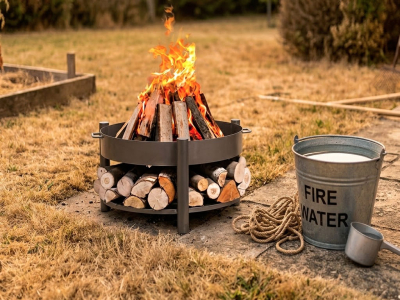
The second category of good habits concerns supervision and extinguishing. An outdoor fire during a drought must never be left without active supervision, not even for five minutes. Having a water source immediately at hand — a filled bucket, an unrolled garden hose, a fire extinguisher — is not a luxury but a matter of common sense. And fully extinguishing the fire before going indoors does not mean “when the embers are glowing red” but when there is no perceptible heat remaining in the ashes, which often takes much longer than one might think.
💡 The Multitanks expert tip
In a summer where virtually the entire French territory is experiencing unprecedented water stress, clearing several metres of dry vegetation around your fire pit or garden fireplace and keeping a water source immediately at hand are no longer optional precautions: they are the two fundamental reflexes that prevent most incidents. Vegetation that has not been watered for weeks catches fire much faster than your instinct suggests. Also prefer calm evenings without wind and paved or gravelled surfaces for installing your fire pit, and consider disconnecting the hose from your irrigation system to keep it available in case of immediate need.
Share this content