IBC 1000 L accessories
 Heating jackets
 Fittings
 Drums, jerrycans & fittings
 Seeds
Seeds 

 Plant protection & biocides

 Garden

 Green spaces & municipal
 Barbecue, fire pit & fireplace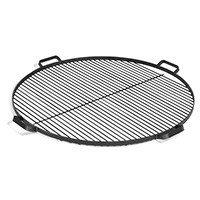
 Cleaning & care
 Refrigerants & air conditioning
 Watering
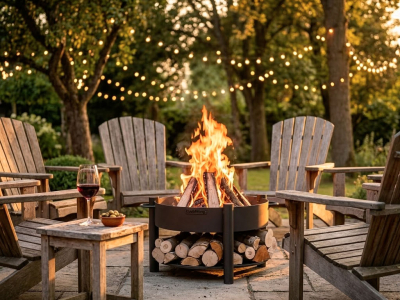
Summer Evenings: How to Choose and Use Your Fire Pit
Picture the scene: the evening wears on, the air cools gently, but no one thinks of heading inside. A fire pit crackles at the centre of the garden, its orange embers casting dancing shadows on every face, and that radiant warmth pushes the end of the night back in the most pleasant way. Few garden features possess this kind of magic. This guide is here to help you choose the fire pit that truly suits your space and your needs, then use and maintain it in the best possible conditions — because a good fire pit, well chosen and well cared for, is an investment in dozens of evenings yet to come. Browse our full selection in the barbecues, fire pits and chimineas category on Multitanks.
🔥 THE DIFFERENT TYPES OF FIRE PIT: WHICH ONE IS RIGHT FOR YOU?
Before discussing materials or dimensions, it is worth understanding what you are truly looking for in a fire pit. Because under this generic name lie appliances with very distinct purposes, which do not meet the same expectations depending on whether you want to warm yourself while watching the flames or grill skewers over a drink with friends.
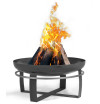
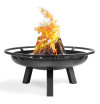
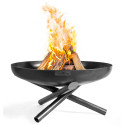
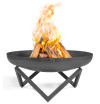
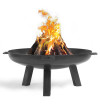
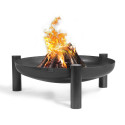
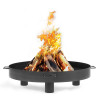
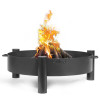
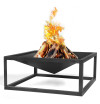
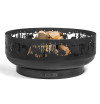
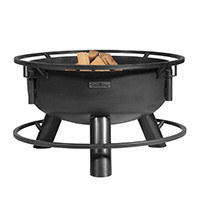
The simple open-bowl fire pit is the classic choice: a deep bowl, generally mounted on three or four legs, that holds logs and lets the fire burn freely. It is the most pared-back option, the one that generates the most radiant heat and the most beautiful light. Its only drawback is that it does not contain ember projections, which requires particular vigilance around the fire and a greater safety distance from any combustible materials nearby.
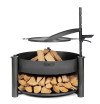
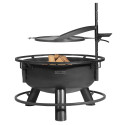
The fire pit with a cooking grate — integrated or removable — adds a welcome culinary dimension. Its primary purpose is warmth, but it also allows you to place a grate over the embers to cook meat, vegetables or even bread. This is the ideal option for those who want a single piece of equipment that can serve as an evening focal point and an impromptu barbecue. Bear in mind, however, that a grate used regularly requires thorough cleaning after every cooking session.
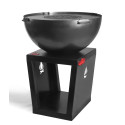
The chiminea-style or spark-guard fire pit is a more sophisticated design, often cylindrical and taller, which channels smoke upwards and considerably reduces the projection of incandescent particles. This model is particularly well suited to gardens in urban areas, terraces close to the house, or spaces where proximity to neighbours calls for a degree of discretion. It is generally heavier and bulkier, but offers superior passive safety.
🔥 STEEL, CAST IRON OR STAINLESS STEEL: THE MATERIAL MAKES ALL THE DIFFERENCE
If the type of fire pit defines what you will do with it, the material determines how long it will last — and what condition it will be in five years from now. This is often where the true value for longevity lies, regardless of the purchase price.
Raw steel or corten steel is highly regarded for its industrial and contemporary aesthetic. Corten steel naturally develops a rust patina on its surface that acts as a protective layer, significantly slowing deep corrosion. It is an aesthetically deliberate choice: you need to accept this visual evolution, which is sought after by many but may surprise those who are not expecting it. Painted or treated steel is generally less expensive to buy, but the thermal paint flakes over time under the effect of intense heat cycles and moisture, exposing the underlying metal to corrosion. An entry-level painted steel model therefore requires regular maintenance to last.
Cast iron is the material of traditional fire pits — heavy, substantial, it absorbs heat into its mass and releases it long after the flames have died down. Around a cast iron fire pit, you can still enjoy the radiant warmth for a good while after the embers have burned out, making it an ideal option for extending evenings without constantly adding more wood. Its weight is its only drawback: moving it is no small feat. Stainless steel, finally, is the most resistant material to corrosion and moisture, particularly suited to coastal regions or highly exposed gardens. More expensive to purchase, it requires little maintenance over the long term and retains its neat appearance season after season.
🔥 SIZE AND COMPARISON: WHICH FIRE PIT FOR WHICH SPACE?
The question of size is often underestimated at the time of purchase, yet it directly determines safe use. A small fire pit of 40 to 50 centimetres in diameter is perfectly suited to a terrace or small garden, and is more than enough for an evening with two to four people. A model of 70 to 90 centimetres is justified for welcoming a larger group around a generous fire. What must be avoided at all costs is choosing an oversized model for the available space: a large fire pit in a small garden makes it very difficult to maintain safe distances from vegetation, fencing or the facade of the house.
The table below summarises the main categories to help you quickly visualise the key characteristics of each type:
| Type of fire pit | Primary use | Key advantage | Point to watch |
|---|---|---|---|
| Simple open bowl | Ambience and radiant heat | Simplicity, accessible budget, beautiful flame | Uncontained ember projections |
| With cooking grate | Heat + wood-fire cooking | Versatile, convivial meals, 2-in-1 | Grate cleaning required after every cook |
| With chiminea / spark guard | Urban areas or close terraces | Reduces smoke and ember projections | Greater bulk and weight |
In practice, the most decisive factor remains the proximity of surrounding structures: if your terrace is made of wood or if your fire pit will be placed near a hedge or fence, a spark-guard model becomes almost an obvious choice. If you have open space around you and dream of wood-fire grilling, a model with a cooking grate will give you ideal versatility. And if what matters most to you is the atmosphere — watching the flames, keeping warm, enjoying the stillness of the evening — then the simple open bowl, properly sized, is often the most beautiful choice.
A fire pit made of cast iron or thick steel releases stored heat well after the flames have gone out. This is what lovers of long evenings appreciate most: that gentle, radiant warmth that persists without having to constantly rekindle the fire.
With a suitable removable grate, your fire pit becomes a real wood-fire barbecue. The advantage over a classic charcoal barbecue: the luminous ambience of the fire remains, and cooking takes place at a comfortable height with guests gathered all around. Discover the available accessories to equip your fire pit.
A spark guard cover or integrated chiminea does not replace vigilance, but it significantly reduces the risk of incandescent particle projections onto a wooden terrace or into a hedge. A particularly relevant safety investment during the summer months.
🔥 PLACEMENT: THE FIRST SAFETY MEASURE
Even before lighting the first log, the correct positioning of the fire pit in your space is the most important decision you will make. This is not a logistical detail — it is the foundation of all safe use. The fundamental rule is simple: the fire pit must always rest on a non-flammable surface. A concrete slab, gravel, compacted earth or paving stones are all perfectly suitable. Dry lawn, a wooden terrace, composite decking or any combustible material must be absolutely avoided — unless you place an adequate thermal protection between the fire pit feet and the ground.
The distance from surrounding structures is equally critical. A minimum clearance of two metres around the fire bowl is required — or even more for large open-bowl models — from the facade, fencing, hedges and all vegetation. Do not forget to account for wind: even a light breeze can carry embers several metres. Before lighting, observe the wind direction and position your fire pit so that flames, smoke and any projections are directed towards open space rather than towards your house or fence.
🔥 LIGHTING, FUEL AND SUPERVISION: THE RIGHT HABITS
Lighting is a moment when the most common mistakes occur, and they are almost always linked to impatience or the use of unsuitable products. The use of methylated spirits, petrol or any flammable liquid to speed up ignition must be absolutely avoided: flashback can occur in a fraction of a second and cause serious burns. A safe method exists and it is not complicated — you simply need to follow it methodically:
This gradual method is infinitely safer and, once mastered, produces a fire that holds better and lasts longer. Regarding fuel choice, dry wood logs (with a moisture content below 20%) are the best choice for pure heat and ambience. If your fire pit has a cooking grate and you wish to cook, charcoal provides a more even and longer-lasting bed of embers. In all cases, absolutely avoid any treated, painted, varnished or damp wood: it produces thick smoke, fouling deposits and may release toxic substances.
Supervision is an obligation, not an option. A fire pit in use must never be left unattended, even for a few minutes. Always keep a bucket of water or a suitable fire extinguisher nearby, and ensure that the embers are completely extinguished before going to bed or leaving the area — even a discreetly glowing ember can reignite if the wind picks up. It goes without saying that a fire pit must never be used indoors, under a closed shelter, or under a covered pergola without adequate ventilation.
Finally, a common-sense reminder is in order: during periods of intense drought, local authorities may temporarily prohibit or restrict outdoor fires. Before lighting up, check the regulations in force in your area — your local council or prefectural website will provide the information in just a few minutes. This simple reflex can save a great deal of trouble.
🔥 MAINTENANCE AND PROTECTION: SO YOUR FIRE PIT LASTS FOR YEARS
A fire pit that lasts is above all a fire pit that is maintained regularly. The first and simplest step is to empty the ashes after each use — but only once they are completely cold, which can take several hours. Damp ashes sitting at the bottom of the bowl accelerate steel corrosion and degrade the material far more quickly than the fire itself. Making this a systematic habit after every evening considerably extends the lifespan of your fire pit.
Protection from rain is the other key lever for longevity. A cover suited to the size of your fire pit, placed as soon as the bowl has cooled, significantly limits exposure to moisture and bad weather. For painted or treated steel fire pits, a visual inspection at the beginning and end of the season allows you to spot areas where the paint is flaking and to apply a rust treatment before corrosion progresses. At the end of the season, ideally before the first hard frosts, a thorough cleaning of the bowl and legs, followed by an application of high-temperature thermal paint on the affected areas, will give your fire pit a fresh lease of life and prepare it for the following season. For cast iron fire pits, a light oiling of the surface after cleaning prevents rust formation during winter storage. These steps, which take no more than an hour a year, often make the difference between a fire pit that wears out in three or four seasons and one that accompanies you for ten or twenty years.
💡 Multitanks tip: A well-maintained cast iron or thick steel fire pit will easily last for decades. It is often a far better investment than a lighter, less expensive model that corrodes after two or three seasons under the effect of heat and moisture cycles. Remember also to protect the ground beneath your fire pit with a dedicated accessory if you are on a terrace, and find all the useful accessories — grates, spark guards, covers — in our fire pits and outdoor chimineas category. For your related garden and outdoor needs, also feel free to browse our gardening and green spaces and landscaping categories.
Share this content