IBC 1000 L accessories
 Heating jackets
 Fittings
 Drums, jerrycans & fittings
 Seeds
Seeds 





 Plant protection & biocides


 Garden




 Green spaces & municipal


 Barbecue, fire pit & fireplace
 Cleaning & care

 Refrigerants & air conditioning

 Watering

Unions and Valves Fittings: The Guide to the Pro Technical Room
The equipment room is the beating heart of every swimming pool. This is where the magic of filtration, water treatment and heating takes place. However, a design error during initial installation can turn this space into a veritable nightmare as soon as a maintenance operation becomes necessary. How many homeowners find themselves having to saw through their PVC pipes to replace a simple pump seal or control probe? Designing a "demountable" technical room is not a luxury, it's an investment strategy. This in-depth guide gives you the keys to organizing a hydraulic network that's intelligent, sustainable and, above all, entirely reversible.
Our tool finds the fitting that goes with it — IBC tank, plumbing, garden — in 3 clicks, with live prices and stock.
1. The philosophy behind demountable equipment rooms: Anticipate the inevitable
A pool system has an average lifespan of 15 to 20 years, but its critical components (pump, chlorinator, filter charge) will need to be handled well before that. It's not a question of *if* you'll need to dismantle a part, but *when*. A rigid assembly, in which each component is permanently glued together without any breaking point, is a major technical error.
The aim of a successful equipment room is to enable any filtration component to be removed in under 5 minutes, without the need for heavy tools or wasted consumables. To achieve this, two allies are essential: the 3-piece union and the double-union valve. These components make it possible to isolate a section of the circuit and physically disconnect it by simply unscrewing it by hand.
2. The 3-piece union: the strong link in your installation
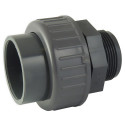
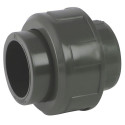
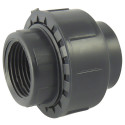
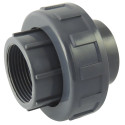
The union, or "3-piece" fitting, is the key to modularity. It consists of two parts to be glued (or screwed) together, and a movable nut that compresses an O-ring between them. Its presence is imperative at every strategic point: at the pump inlet and outlet, before and after the filter, and on either side of automatic processing equipment.
- The importance of the O-ring: Unlike a glued connection, the union's seal is based on an elastomer gasket. This means that you don't need to tighten to death to prevent leaks. A firm hand-tightening is usually all that's needed, protecting plastic threads from bursting.
- Accessibility and clearance : When installing, make sure you leave enough space around the movable nut. A union stuck against a wall or behind another pipe loses 90% of its usefulness. The space must allow for the passage of a hand, or even a strap wrench for 63 mm diameters.
- Compatibility and interchangeability: using the same brand and range of union fittings throughout the technical room can sometimes make it possible to recover spare nuts or joints without having to order complex, specific parts.
3. Valve sectorization: the art of flow control
Organizing your machine room means first and foremost creating cut-off zones. Imagine having to clean the basket of your pump located below water level: without isolation valves on suction and discharge, you empty part of your pool into the room.
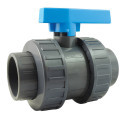
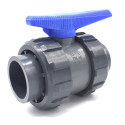
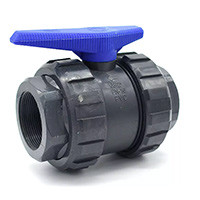
Choose "double union" ball valves. Why is that? Because they combine two functions: they cut off the water and act as a removal point. If your valve leaks, or if you need to modify the suction manifold, you unscrew the unions and remove the valve body without cutting anything. The result is an upgradeable technical room where you can add a bypass for a heat pump or UV treatment without having to redo all the hydraulics.
4. Layout and ergonomics: avoiding "spaghetti dishes
A clean machine room is a safe room. The organization should follow the direction of the water: Suction (Skimmers, Bottom drain, Brush intake) → Pump → Filter → Treatment → Heating → Discharge.
| Zone | Recommended components | Maintenance objective |
|---|---|---|
| Suction manifold | Double union valves x3 + Unions 3 pcs | Pump cleaning without draining |
| Filtration unit | Removable union fittings | Easy sand/glass change |
| Heating bypass | 3 double-union valves | Heat pump winterization without cutting off flow |
5. Professional tips for durable bonding
Even in a system that can be dismantled, the fixed parts must be flawless. Chemical "cold welding" (PVC bonding) is the most critical stage. For a pressurized technical room, use only blue glue or high-pressure glue with its associated stripper. The stripper is not optional: it "opens" the PVC pores to allow the glue to fuse the materials. Without stripper, you're not gluing, you're simply applying an adhesive seal that will eventually blow up under the effect of the pump's vibrations.
Conclusion: Invest in modularity
The extra cost of buying a few extra unions and valves is derisory compared with the price of a new pump or a technician's intervention. A technical room designed for dismantling is the guarantee of a stress-free pool. By choosing high-quality components, such as those available in our store, you can be sure that every unscrewing will be as smooth ten years from now as it was on day one. The cleanliness of your equipment room reflects your peace of mind as a pool owner.
Prepare your technical room with our Interactive Configurator
To go beyond theoretical advice, Multitanks provides you with a unique tool: our **Modular Assembly Configurator**. Simply select the equipment you wish to install or optimize (pump, filter, PAC or chlorinator) and the diameter of your piping. In just one click, you'll receive the exact list of fittings, valves and accessories you need to ensure a durable, easy-to-maintain and fully dismountable installation. No more guesswork: build your equipment room with the precision of a professional.
Professional Modular Assembly Configurator
Understand the purpose of each part for an uncompromising installation.
⚠️ The fatal error: The mounting direction of your valves
This is the trap into which even some installers fall: installing a double union valve the wrong way round. Unlike a simple pipe, a ball valve has a safety aspect.
How to avoid making a mistake?
On all professional-grade valves, one of the two rings (nuts) locks the seat that holds the ball. This locking ring must always be located on the constant pressure side (basin side).
Why is this vital? If you install the valve the wrong way round and unscrew the union on the pump side for maintenance, the pressure of the water coming from the pool can eject the ball from its seat. The result: you won't be able to turn off the water, and your equipment room will be flooded in seconds.
Expert's tip: Before gluing, always simulate dismantling to check that the remaining part of the tube on the "water side" retains the ball.
Share this content