



 IBC 1000 L accessories
 Heating jackets

 Fittings
 Drums, jerrycans & fittings
 Seeds
Seeds 
 Plant protection & biocides

 Garden

 Green spaces & municipal

 Barbecue, fire pit & fireplace

 Cleaning & care
 Refrigerants & air conditioning

 Watering
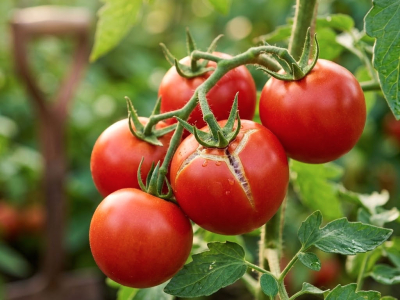
Watering Your Tomatoes in Summer Without Splitting Them
You watched your tomatoes swell for weeks, their colour deepen to a rich red, the harvest seemingly within reach — and the next morning, several fruits are split, cracked from top to bottom or ringed with fissures around the stem. This setback is one of the most frustrating in the summer vegetable garden. The good news is that it has almost nothing to do with a disease or a pest: in the vast majority of cases, tomatoes split because of watering. And what comes from watering can be corrected very easily.
🍅 WHY DO TOMATOES SPLIT IN SUMMER?
To understand tomato splitting, you need to imagine what happens inside the fruit after a period of drought. When the soil remains dry for several consecutive days, the plant slows its water supply to the fruits. The skin of the tomato, which continues to ripen, gradually tightens and loses its elasticity. Then the triggering event occurs: a generous watering, a sudden downpour, or simply a late resumption of irrigation. Water flows massively into the flesh of the fruit, which swells very rapidly — far faster than the skin can stretch. The tension becomes unbearable, and the skin tears, giving rise to the concentric cracks around the stem or the vertical splits so often observed.
Summer heat considerably amplifies this phenomenon. During a heatwave, soil evaporation accelerates, roots draw water irregularly, and the swings between drought and rehydration become more pronounced. The tomato is a fruit that reacts directly and quickly to fluctuations in soil moisture: it is this sensitivity that makes it a demanding vegetable in terms of water management, but also an excellent indicator of the quality of your watering routine.
💧 THE GOLDEN RULE: REGULARITY ABOVE ALL
If you could retain only one principle to protect your tomatoes from splitting, it is this: it is better to water a little and often than a lot and rarely. Soil that maintains a stable and constant level of moisture does not cause hydraulic shock in the fruit. It is irregularity — soil that dries out completely and then receives a massive input — that triggers splitting. The total amount of water supplied over a week is ultimately less important than the rhythm at which it is given.
This regularity rule applies to supposedly robust varieties as well. Even a meaty beefsteak tomato will split if it endures five days of drought followed by a generous watering on a Saturday morning. This is why gardeners who go away on holiday — even for just a few days — often return to find several split fruits: it is the rehydration after the absence, not the absence itself, that causes the damage.
🌿 THE RIGHT WATERING TECHNIQUE IN THE VEGETABLE GARDEN
Beyond the rhythm, the way you water matters enormously. The first technical rule is to water at the base of the plants, never on the foliage or the fruits. Wetting the leaves encourages fungal diseases such as blight, and cold water falling on a warm fruit exposed to the sun can cause an additional micro thermal shock. Direct the flow straight to the soil, slowly, so that it infiltrates deeply rather than running off the surface.
The time of day also matters. Watering early in the morning is ideal: the water benefits the roots before temperatures rise, evaporation is minimal, and the foliage has time to dry if a few drops have reached it. Watering in full midday sun must be absolutely avoided, not only because of thermal shocks but also because a large proportion of the water will evaporate before it even reaches the roots.
Frequency and volume must be adapted to your specific situation. Here is an indicative summary to help you calibrate your routine:
| Growing situation | Normal temperature (< 30°C) | Heatwave (> 33°C) |
|---|---|---|
| In-ground, clay soil | Every 2–3 days, 2–3 litres/plant | Every day or every other day, 3–4 litres |
| In-ground, sandy soil | Every other day, 2–3 litres/plant | Every day, 3–4 litres/plant |
| Container or pot | Every day, 1–2 litres/plant | Twice/day (morning and evening), 1–1.5 litres each time |
Container growing deserves special attention: a plastic or terracotta pot dries out much faster than a garden bed, especially in summer. The limited volume of growing medium offers very little water reserve, and moisture fluctuations can occur within just a few hours in extreme heat. If you are growing your tomatoes on a balcony or an exposed terrace, watering frequency must be even higher, and large-capacity pots are preferable.
Always at the base of the plant, never on the leaves or fruits. Targeted watering at soil level allows deep infiltration and prevents fungal diseases. Use a watering can without a rose or a suitable irrigation system for a gentle, precise flow.
An in-ground plant in mild weather does not have the same needs as a potted plant under 36°C. Check the soil 5 cm deep: if it is dry, it is time to water. Regularity takes priority over quantity, whatever the situation.
If you forgot to water for two days, do not compensate with a massive watering. Resume gradually over two closely spaced sessions. It is this brutal return to moisture that causes already-formed fruits to split.
🌾 MULCHING: A DECISIVE ALLY AGAINST SPLITTING
If regular watering is the first line of defence against splitting, mulching is its indispensable complement. Applied in a 5 to 10 centimetre layer around tomato plants, it acts as a thermal and moisture insulator: it reduces soil evaporation, maintains a cooler temperature at the root surface and, above all, dampens sudden moisture fluctuations after watering or a rainstorm. A mulched soil dries out far less quickly, which mechanically reduces the risk of hydraulic shock.
The choice of mulching material is flexible depending on what you have available: straw, dried grass clippings, shredded dead leaves, wood bark, ramial chipped wood (RCW) or even unprinted cardboard. What matters is the consistency of the layer and its renewal if it degrades. In the height of summer, well-laid mulch can halve the necessary watering frequency, while protecting roots from heat spikes that weaken the plant. Combined with regular watering, it is the winning duo for getting through a heatwave without losing a single tomato.
⚙️ AUTOMATED WATERING: REGULARITY WITHOUT EFFORT
Even with the best intentions, it is difficult to maintain regular watering for several weeks of heatwave, especially if you work or go on holiday. It is precisely during these critical periods that automating irrigation becomes a very worthwhile investment. A drip irrigation system coupled with a watering timer delivers small amounts of water directly to the base of each plant, at a fixed time, every day — exactly what tomatoes need to never experience prolonged drought.
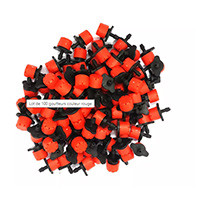
Installing such a system is not reserved for large market gardens. In a family vegetable plot with a few rows of tomatoes, a few metres of drip tubing and micro-irrigation drippers are enough to set up a precise, water-efficient irrigation system. By connecting this system to a rainwater harvesting tank, you combine water savings, independence from the mains supply and respect for the environment — an increasingly popular choice among gardeners mindful of their resources.
🍃 OTHER FACTORS NOT TO BE OVERLOOKED
Beyond watering and mulching, a few other elements are worth mentioning for complete risk management. Some varieties are noticeably more susceptible to splitting than others: thin-skinned cherry tomatoes, such as Sweet 100 or Gardener's Delight, split at the slightest opportunity when fully ripe, even with careful watering. This is not a reason to give them up, but it does require being even more attentive to soil moisture regularity with this type of crop.
The weather also plays a role that cannot always be anticipated. If a violent storm is forecast and your tomatoes are reaching full maturity, do not hesitate to harvest them a little early, just before the rain arrives. A fruit harvested slightly before it is fully ripe, which will finish ripening indoors on a windowsill, is infinitely better than a split and wasted fruit. This is a simple reflex that can save a beautiful harvest. Finally, remember to adapt your practices by regularly checking weather forecasts during heatwave periods, and keep an eye on the gardening range from Multitanks for all your vegetable garden needs.
🌿 Multitanks expert tip: After several days of intense drought — whether due to missed watering or an absence — do not try to catch up with a single massive input. Resume watering gradually over two to three closely spaced sessions (for example in the evening, then the following morning, then again in the evening). This gentle rise in moisture gives the skin of the fruits time to rehydrate gradually without experiencing sudden tension. A brutal catch-up watering after five dry days is an almost guaranteed recipe for finding your most beautiful tomatoes split two days later.
Share this content