IBC 1000 L accessories
 Heating jackets
 Fittings
 Drums, jerrycans & fittings
 Seeds
Seeds 
 Plant protection & biocides
 Garden
 Green spaces & municipal
 Barbecue, fire pit & fireplace
 Cleaning & care
 Refrigerants & air conditioning
 Watering
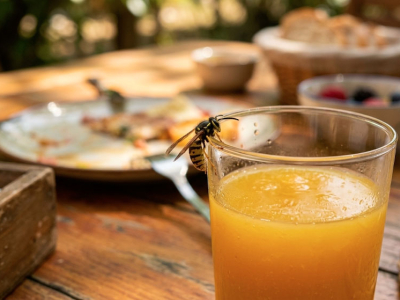
Wasps on the patio: act fast and stay safe
The cheese platter has barely been set on the table when the first ones are already inspecting the fruit juice glasses. One, then three, then a dozen: wasps have taken over your patio and the pre-dinner drinks have turned into an obstacle course. This scenario is experienced by millions of people every late summer. Before acting, you first need to understand what is happening — and above all, act without putting yourself in danger.
🐝 Why wasps invade the patio in late summer
Late summer marks the absolute peak of activity for wasp colonies. Over the course of the season, a colony can reach several thousand individuals, and it is precisely at this time that energy demands become most intense. The developing young queens need large quantities of sugar and protein, and the workers multiply their back-and-forth trips to supply the nest. Your fruit, sugary drinks, grilled meats and cheeses represent an ideal windfall for them.
This behaviour is compounded by the fact that, towards the end of the season, natural sources of sugar become scarcer in the environment. Wasps therefore become more insistent, bolder and less cautious than usual. They venture right up to your plates without hesitation. It is important to bear in mind that this behaviour is not gratuitous aggression: it is a quest for survival. Understanding this helps you stay calm, which is, as we shall see, the first rule of safety.
⚠️ Safety first: how to react without making things worse
The most dangerous reflex when faced with a wasp is to crush it or wave it away violently. When a wasp is crushed or in danger, it releases alarm pheromones that immediately signal danger to its companions. Within seconds, other wasps can swarm towards the source of the alarm, multiplying the risk of stings. The right attitude is therefore exactly the opposite of what instinct dictates: stay still, avoid sudden movements, and move away slowly and calmly if a wasp is circling around you.
A wasp sting is painful, but for the vast majority of people it simply causes local redness and swelling that disappears within a few hours. However, a minority of people are allergic to hymenoptera venom, and this allergy can manifest at any age, even after having been stung many times without reaction. If the reaction spreads beyond the sting site — swelling of the face or throat, difficulty swallowing, breathing difficulty, dizziness or general malaise — this is a potential anaphylactic shock. Call 999 or 112 immediately, lay the person down and, if an epinephrine auto-injector is available, use it straight away. This information is worth knowing before summer, not just in the moment of emergency.
🔍 Wasp, European hornet, Asian hornet or bee: identify correctly before acting
Not all yellow and black striped insects should be treated the same way. The honey bee is a protected insect essential to pollination: if you spot one on your flowers or around a pot of honey, leave it alone and never kill it. It only stings in self-defence, and dies afterwards. The common wasp is more aggressive around food, slimmer, shinier, with a noticeably narrow waist. The European hornet is imposing (up to 35 mm) but rarely aggressive away from its nest, which resembles a grey paper balloon. The Asian hornet, recognisable by its almost entirely dark abdomen with a single yellow-orange band, poses a specific threat to bee colonies and must be reported to the authorities.
The following table summarises the main visual and behavioural differences to help you quickly identify what you are dealing with:
| Insect | Size | Appearance | Behaviour | What to do |
|---|---|---|---|---|
| Common wasp | 12–17 mm | Bright yellow and black, slim waist, shiny | Aggressive around food and sugary drinks | Trap, aerosol spray, nest destruction |
| European hornet | 25–35 mm | Reddish-brown and yellow, more robust | Rarely aggressive away from nest, grey paper nest | Caution, professional if nest is nearby |
| Asian hornet | 25–30 mm | Very dark abdomen, one orange band, yellow legs | High nests (trees), hunts bees | Mandatory reporting, specialist intervention only |
| Honey bee | 13–15 mm | Golden brown, hairy, less contrasted | Rarely stings, dies afterwards, leaves stinger | Never kill, call a beekeeper |
For people living in areas where the Asian hornet has established itself — which has spread considerably in recent years — vigilance is essential. If you think you have spotted an Asian hornet nest, never intervene alone: contact your local council or the relevant specialist services directly. For more information on this invasive insect, also consult our resources in the gardening and green spaces category.
🎯 Locating the nest without approaching it
Before choosing a course of action, it is very useful to understand where the wasps are coming from. Observing their flight paths — keeping a safe distance and without provoking them — often makes it possible to determine the approximate location of the nest. Wasps like to nest under roof tiles, behind shutters, in wall crevices, in loft spaces, in holes in the ground in the garden, or even in disused letterboxes. In late summer, a fully developed nest can reach the size of a football.
This observation from a distance is valuable for guiding your action, but it requires one absolute rule: never approach the entrance of an active nest. Sentinel wasps stand guard and can trigger a collective attack within seconds. Similarly, shining a torch on a nest in the evening can be enough to agitate the colony. Identify the location, make a mental note of it, and depending on the situation, decide whether you can intervene yourself or whether professional intervention is required.
🛡️ Solutions, from the gentlest to the most radical
The first approach to adopt is always one of deterrence and prevention. Many wasp problems on the patio are solved simply by eliminating sources of attraction: always covering dishes and sugary drinks, never leaving ripe or rotting fruit lying around, keeping bins tightly sealed and cleaning up food scraps quickly. These good habits considerably reduce the attractiveness of your living space to insects.
When prevention is no longer sufficient, wasp traps are an effective and relatively simple solution to implement. The idea is to attract wasps towards a sweet bait (sugar syrup, beer, fruit juice) placed in a device from which they cannot escape. Placement is crucial: always position the trap away from your table, ideally around ten metres away, so as to divert wasps from your dining area rather than concentrating them near you. Also take care to choose a selective trap that avoids catching bees: some models use a beer or vinegar-based bait, which bees generally ignore. Find our advice on gardening and outdoor living accessories to complete your summer equipment.
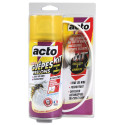
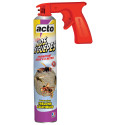
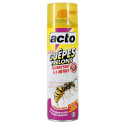
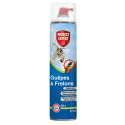
Finally, if a nest has been located and is at a reasonable accessible distance, a long-range nest-destroyer aerosol spray is the most suitable tool for independent intervention. These products project the insecticide several metres, allowing you to treat the nest entrance without dangerously approaching it. The safe method is to intervene in the evening, at dusk or after dark, when almost all the wasps have returned to the nest and colony activity is at its lowest. Wear appropriate protection — full-coverage clothing, gloves, goggles — and maintain the distance recommended on the packaging. One absolute common-sense rule: never intervene from an unstable stepladder or ladder; a fall under the effect of an attack would be far more serious than a sting. For your protective equipment, consult our maintenance products section.
The timing of intervention entirely determines your safety. In the evening, between 10pm and 6am, all the wasps are gathered in the nest, numbed by the cool air. This is the ideal window for aerosol treatment. Never intervene in the middle of the day or when the sun is shining directly on the nest.
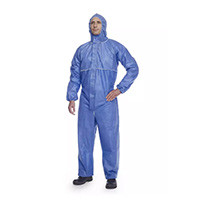
Even at a distance, minimal protection is essential: long-sleeved clothing, trousers, closed shoes, thick gloves and protective goggles. A single sting is unpleasant; several simultaneous stings can be serious. Browse our green spaces catalogue for suitable equipment.
A single treatment is not always sufficient. If wasps reappear the following day around the nest entrance, repeat the treatment for two to three consecutive evenings. Once the nest is empty, wait a few days before physically removing it to make sure no wasps remain.
🚫 When to give up and call a professional
Not all situations are suited to independent intervention. If the nest is located at height — in the loft, under the ridge or high up in a tree — it is not reasonable to intervene yourself. Similarly, a large nest (bigger than a football) potentially houses thousands of individuals and a collective attack would be dangerous. In these cases, specialist pest control companies have the equipment, products and techniques needed to intervene safely.
The presence of an allergic person in the household completely changes the equation. Even if the nest appears easily accessible, the risk of a sting during the intervention is not worth taking. In this case, always delegate to a professional, regardless of the size of the nest. If you have the slightest doubt about your ability to intervene safely, the same principle applies: it is better to pay for a professional intervention than to take an unnecessary risk.
🧠 Multitanks expert tip — Two mistakes to never make
First classic mistake: blocking the entrance of an active nest without treating it. The wasps, trapped inside, immediately break through another exit — sometimes into the interior of the home — and become extremely aggressive. This "solution" always makes the situation worse.
Second point that is often overlooked: tolerance. When a nest is located far from areas of passage and daily life — at the back of the garden, in a corner of a barn — cohabitation is often possible until the end of the season. Wasps play a useful role as beneficial insects by destroying harmful caterpillars and larvae. After the first autumn frosts, the colony dies naturally and the nest will never be reused the following season.
Share this content