IBC 1000 L accessories
 Heating jackets
 Fittings
 Drums, jerrycans & fittings
 Seeds
Seeds 


 Plant protection & biocides

 Garden


 Green spaces & municipal

 Barbecue, fire pit & fireplace
 Cleaning & care
 Refrigerants & air conditioning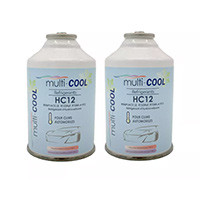
 Watering
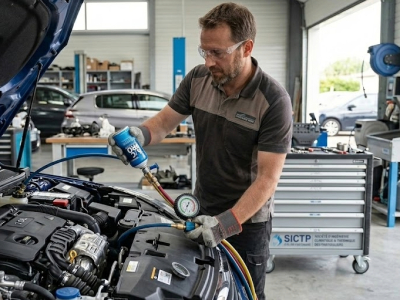
Recharging Your Car AC with Duracool 12a: A Step-by-Step Guide
Your car AC is blowing warm air in the middle of summer, and the thought of waiting hours at a garage for a simple recharge doesn't appeal to you? That's exactly the situation Duracool 12a and its all-in-one recharge hose were designed to solve. This guide walks you through every step to take control of your car's air conditioning yourself, safely and in full compliance with the law.
❄️ Duracool 12a: an eco-friendly refrigerant with real advantages
Duracool 12a is a hydrocarbon refrigerant, composed primarily of isobutane, designed as an alternative to synthetic fluorinated gases. Its most frequently cited advantage is its GWP (Global Warming Potential) of around 3, compared to 1,430 for the R134a it is intended to replace in automotive circuits. In practical terms, this means that, for an equivalent refrigerating effect, its climate impact is incomparably lower than that of conventional refrigerants.
Its more compact molecules and thermodynamic properties allow it to work with significantly lower charge volumes. A 170 g can of Duracool 12a can thus replace a much larger charge of conventional fluid, which explains the energy savings of up to 40% reported by users, due to lower operating pressure placing less strain on the compressor. One point must be made clear from the outset: Duracool 12a is not manufacturer-approved. Purchasing and using it on a circuit that has been previously emptied of all fluorinated fluid requires no special certification for a private individual, but it does not appear on the list of fluids approved by car manufacturers. It is an informed and responsible choice, not a clandestine operation.
🔧 Equipment: the all-in-one hose at the heart of the process
The tool that makes this operation accessible to a DIY enthusiast is the Multitanks recharge hose, designed as a radically simpler alternative to a professional two-way manifold gauge set. Rather than juggling high pressure and low pressure, two gauges and multiple valves, this tool concentrates everything a private individual needs into a single logical hose that can be understood within seconds.
On the can side, the hose terminates with a self-piercing valve with a 1/2 ACME thread and a needle. Simply screw this fitting firmly onto the Duracool 12a can, then gradually turn the needle to pierce the can's cap and allow the fluid to access the circuit. No additional tools, no dangerous handling: the piercing is guided and controlled.
At the centre of the hose lies the true brain of the tool: a single integrated gauge, calibrated for low pressure. Its dial is divided into colour-coded zones — LOW, FILLED, ALERT, WARNING — allowing intuitive reading even without technical training. This is the key argument for the private user: unlike a two-way manifold where two simultaneous readings must be correlated, here you monitor a single needle, on the only pressure that matters for a recharge. On the vehicle side, the hose terminates with a quick-connect low-pressure fitting compatible with R134a, which simply clips onto the vehicle's LP valve.
There are two variants of this hose: one has a detachable LP fitting (with an intermediate 1/4 SAE junction), while the other has the LP fitting crimped directly onto the hose, eliminating any intermediate junction and therefore any risk of leakage at that point. This second version is even simpler and recommended for occasional use with R134a only. Regarding Duracool 12a cans (170 g), the number required depends on your vehicle's original charge, indicated on the label under the bonnet: refer to the table below to assess your needs before you begin.
| Original R134a charge (g) | Duracool 12a equivalent (g) | Number of 170 g cans |
|---|---|---|
| 400 g | ~170 g | 1 can |
| 500 g | ~210 g | 2 cans (stop at gauge) |
| 600 g | ~250 g | 2 cans (stop at gauge) |
| 700 g | ~295 g | 2 cans (stop at gauge) |
| 800 g and above | ~335 g and above | 2 to 3 cans (stop at gauge) |
These values are given as a guide. In all cases, the gauge remains the sole arbiter of the charge: stop as soon as the needle enters the FILLED zone, regardless of the quantity injected. Never empty an entire can if the needle has already reached the zone.
⚠️ Safety and legal framework: what you need to know before you start
Duracool 12a is a hydrocarbon: it is flammable. This characteristic must be integrated into every step of the procedure, not relegated to a footnote. Always work in a well-ventilated area, ideally outdoors, in the absence of any open flame, spark or heat source nearby. Safety glasses and hydrocarbon-resistant gloves are not optional: a splash of liquid refrigerant on the skin or in the eyes causes cold burns.
From a legal standpoint, the rule is absolute and non-negotiable: never recharge a circuit that still contains R134a or 1234yf. Mixing refrigerants is prohibited, potentially dangerous for the circuit, and constitutes an offence. If your air conditioning system still contains fluorinated fluid, even in very small quantities, it is essential to have it recovered by a professional holding the required certification. Releasing refrigerant into the atmosphere is prohibited by law, and no one should ever be advised to purge their own circuit.
Once the circuit is empty of all fluorinated fluid, Duracool 12a can be freely injected by a private individual, without certification. It is this precise framework that makes the process legal and responsible. Also bear in mind that its use generally voids the manufacturer's warranty on the air conditioning circuit, and any future professional technician must be informed of this — hence the importance of labelling at the end of the operation.
🔍 Pre-diagnosis: do not recharge a leaking circuit
Before investing in Duracool and starting the procedure, it is essential to understand why the AC has stopped cooling. An air conditioning circuit is a closed circuit: if it has lost its charge, it is either because there is a leak, or because the circuit was opened (part replacement, previous work). Recharging a leaking circuit is completely pointless: the fluid escapes as quickly as it is injected, and you waste your money.
A leak test is therefore the first step. For this, you can use an electronic leak detector passed over the circuit's fittings and components, or a UV tracer injected beforehand. For micro-leaks on aged seals or slightly porous fittings, the SystemSeal additive can be a complementary solution, injected through the low-pressure valve. However, if the leak is visible, if the compressor fails to engage or makes abnormal noises, recharging alone will not solve the problem: a workshop visit is necessary.
🛠️ Circuit preparation: a key step
As stated, recharging with Duracool 12a must be done exclusively on a circuit that is empty of all fluorinated fluid. This recovery of existing fluid must have been carried out by a certified professional using approved recovery equipment. Once the circuit has been emptied, the ideal step is vacuuming: using a vacuum pump, residual air and moisture are removed from the circuit — two enemies of the compressor that accelerate its degradation. This operation is generally carried out at the time of fluid recovery and circuit opening; it is not included in the consumer kit, but it determines the quality and longevity of the recharge.
A properly vacuumed circuit, dry and free of contamination, is the best guarantee that your Duracool 12a recharge will be effective and long-lasting. If you have any doubt about the condition of the circuit (presence of moisture, circuit open for a long time), the Duradry additive can be injected via the LP valve to ensure additional drying. It is a modest investment for significant compressor protection.
The Multitanks all-in-one hose eliminates the complexity of a professional manifold gauge set. A single colour-coded gauge, a single connection on the low pressure side: even without refrigeration experience, the reading is immediate and the risk of overcharging is minimised.
With a GWP of 3 versus 1,430 for R134a, Duracool 12a is one of the most climate-friendly refrigerants available for automotive use. Less charge, less pressure, less energy consumption: the refrigerating effect is fully delivered.
On a circuit emptied of all fluorinated fluid, recharging with Duracool 12a requires no certification. The framework is clear, the approach responsible, provided the safety rules related to the product's flammability are respected.
❄️ The step-by-step recharge procedure
You are ready: the circuit is empty of fluorinated fluid, the diagnosis is good, and the equipment is in front of you. Here is how to proceed with the Multitanks all-in-one hose, with a single connection on the low pressure side. Always start in the shade, with the engine off for preparations, then start it for the recharge: the pressure in the circuit is only representative of the charge state when the compressor is running.
Once the recharge is complete, the simplest validation is measuring the blow temperature: air coming out of the vents at 5-8 °C confirms that the recharge was successful. If cooling remains insufficient and the needle has not reached the FILLED zone, a second can may be needed — always applying exactly the same procedure and stopping as soon as the gauge indicates the zone. It is never useful or desirable to go beyond this point.
📋 Finishing, labelling and circuit maintenance
The procedure does not end when the hose is disconnected. An essential and often overlooked step is labelling the circuit: attach a label to the circuit indicating the product used (Duracool 12a), the date of the operation and the quantity injected. This information is crucial for any future professional technician, who will need to know that they are dealing with a circuit charged with a flammable hydrocarbon, not a fluorinated fluid. This is a matter of collective safety as much as transparency.
To enhance the durability of the installation, two complementary additives available from Multitanks in the automotive parts and supplies category can be injected through the low-pressure valve before or after the recharge. Duradry is a desiccant that eliminates residual moisture traces in the circuit, protecting the compressor from internal corrosion. SystemSeal targets micro-leaks on slightly degraded seals, by swelling the elastomers in a controlled manner to restore sealing. Both products are injected in exactly the same way as Duracool: through the LP valve, engine running, AC on.
💡 Multitanks Expert Tip
Never judge your circuit's charge by the cold air felt in the cabin: the perception of cold depends on the outside temperature, humidity and the condition of the ventilation system. The only reliable arbiter is the colour-coded zone on the gauge, read under stable conditions (warm engine, stabilised RPM, AC on max). Always work in the shade: a bonnet exposed to the sun heats the high-pressure circuit and distorts the overall pressure reading, even on the low-pressure side. A shaded garage or the shaded side of a building are the best locations for an accurate reading.
Share this content