IBC 1000 L accessories
 Heating jackets
 Fittings
 Drums, jerrycans & fittings
 Seeds
Seeds 





 Plant protection & biocides


 Garden




 Green spaces & municipal

 Barbecue, fire pit & fireplace


 Cleaning & care

 Refrigerants & air conditioning
 Watering
Car AC no longer blowing cold: the complete diagnosis before recharging
The heat is here, the sun is beating down on the dashboard, and the air coming out of your vents is barely cool enough to comfort anyone. The immediate reflex is often to go buy a recharge can and get started. Yet recharging an air conditioning system without diagnosing the real cause of its failure is, more often than not, throwing money out the window — and sometimes making an already tricky situation worse. Because an AC that no longer cools is not always an AC that is low on refrigerant gas.
❄️ What the symptoms are already telling you
Even before opening the bonnet, the signals you observe inside the car are valuable clues. Air that is only slightly cooler than the outside, which still comes out a little cool but not enough, often suggests a partially discharged circuit. In this case, the compressor is working, it is still compressing fluid, but in insufficient quantity to provide effective cooling. This is generally the least serious situation.
On the other hand, if the air blown is genuinely lukewarm — as if the air conditioning did not exist — or if the cold comes back intermittently then disappears, the situation is different. Adequate cold at idle that is lost as soon as the engine revs up may indicate a condenser problem (clogging, loss of efficiency) or abnormal pressure. Conversely, cold that works while driving but disappears at idle points more towards a faulty condenser fan.
Unusual noises are another strong signal. A squeaking or metallic clicking when the air conditioning engages, or conversely a complete absence of any engine sound change when you press the AC button, indicates that the compressor is not engaging at all. In this case, recharging the circuit with gas will have absolutely no effect: the problem is mechanical or electrical, not related to the refrigerant level.
❄️ Three causes to absolutely distinguish
Progressive loss of charge is the most common and most benign situation. Every air conditioning circuit naturally loses a small amount of fluid each year, through osmosis through seals and hoses. On a vehicle that is five or ten years old and has never been recharged, it is perfectly normal for the charge to have become insufficient. In this case, the circuit is intact, the compressor is working, and a simple recharge is enough to restore optimal performance. This is the only situation where rushing out to buy a recharge can is justified — provided you have first verified that everything else is in order. You will find on Multitanks the recharge guide for Duracool 12a, an ecological refrigerant fluid suited to this type of intervention.
A leak is a radically different cause, and it changes everything about the strategy to adopt. If your circuit has emptied within a few weeks when it was recently charged, or if a recharge carried out last summer did not survive the winter, you almost certainly have a leak. Recharging without treating the leak is literally filling a leaky bucket: the fluid will escape again within a few days or weeks, and you will have spent money for nothing, while releasing gas into the atmosphere.
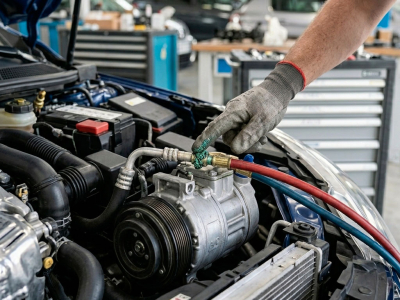
To suspect a leak, visual inspection is your first tool. Refrigerant fluid circulates mixed with a lubricating oil: when the gas escapes, this oil remains in place and forms greasy, slightly sticky traces, generally dark or iridescent. Carefully check around the circuit fittings, along the hoses, on the condenser (located in front of the radiator) and if possible around the evaporator (on the cabin side, often accessible through the glove box). For precise location, an electronic leak detector or a UV fluorescent tracer are the reference tools used by professionals.
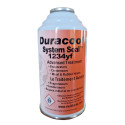
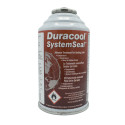
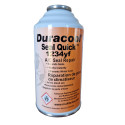
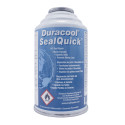
For micro-leaks only — those that are suspected but cannot be seen with the naked eye, often located on the circuit itself or on the seals — there are sealant additives. The key is to choose one that is compatible with your vehicle's gas and suited to the type of leak in question. Vehicles manufactured before approximately 2013 mostly use R134a (sometimes R12 on very old models), while more recent vehicles are fitted with R1234yf. Some sealants are formulated for seals and gaskets, others for micro-leaks in the metal circuit: be sure to read the product description carefully before any purchase. Find the selection of automotive parts and additives available on Multitanks. To be clear: a sealant is never a solution for a major leak on a damaged component or a punctured hose. In that case, mechanical repair is the only viable option.
Mechanical or electrical failure is the third category, the one that recharging will never resolve. If the compressor does not engage — meaning you hear no clutch click and observe no variation in engine idle when you activate the AC — the cause can be very varied. A simple blown fuse, a faulty low-pressure sensor that cuts the circuit as a safety measure (which triggers precisely when the circuit is empty), a broken belt, or the compressor itself at the end of its life. These failures require electronic diagnosis and mechanical work, and injecting gas into the circuit will change absolutely nothing.
If the cold has decreased very gradually over the seasons and the compressor engages normally, it is probably a lack of charge due to natural fluid loss. A recharge with a fluid suited to your system is the right response, after a visual check to confirm the absence of a leak.
A circuit that loses its charge within a few weeks or months has a leak. Inspect for oil traces, locate the leak using a detector or UV tracer, then treat it before any recharge. For micro-leaks, a sealant compatible with your gas type and leak type may be sufficient.
No idle variation, no clutch click: the problem is electrical or mechanical. Fuse, pressure sensor, belt, faulty compressor — no recharge will resolve these causes. A mechanical diagnosis is the priority.
❄️ The step-by-step diagnostic approach
Rather than diving headfirst into a recharge, a few simple checks — achievable in less than ten minutes — allow you to identify the right cause. Here is the sequence to follow, in order, before any intervention:
Once these steps have been completed, you have a clear picture of the situation. If everything points to a simple lack of charge with no trace of a leak and a functioning compressor, then recharging is justified. In all other cases, the root cause must be addressed first.
❄️ Quick guide to the most common symptoms
To summarise the most common cases, the following table will help you cross-reference your observations and quickly identify the most probable diagnostic direction. It does not replace a full pressure reading, but acts as an effective first filter before any intervention.
| Observed symptom | Probable cause | Recommended action |
|---|---|---|
| Slightly cool air, compressor engaging, gradual loss | Lack of charge (natural loss) | Check for absence of leak, then recharge |
| Circuit emptied within a few weeks, greasy oil traces | Detectable leak | Locate the leak (detector / UV), treat or repair before recharging |
| Genuinely lukewarm air, no clutch click | Electrical or mechanical failure (fuse, sensor, compressor) | Electronic diagnosis, do not recharge |
| Adequate cold at idle, lost while driving | Faulty condenser fan or clogged condenser | Clean / check the fan, do not recharge |
| Intermittent cold, random cut-outs | Faulty pressure sensor or slightly low charge | Read pressures, check sensor before any recharge |
❄️ Why avoid unnecessary recharging
Beyond the simple financial question, recharging a leaking circuit or one with a mechanical fault raises a real environmental issue. Refrigerant fluids are powerful greenhouse gases: their release into the atmosphere is strictly prohibited by European regulations (F-Gas Regulation). Recharging a leaking system therefore almost guarantees an emission within the following days. The best practice, above all else, is to ensure that the circuit is airtight and capable of retaining its charge.
From a practical standpoint, a ten-minute diagnosis avoids spending between twenty and fifty euros on a recharge that will have no effect, or may even worsen the problem (overcharging a circuit whose compressor is not working, for example). If your diagnosis confirms that the case is straightforward — simply a progressive lack of charge, intact circuit, operational compressor — you can then calmly move on to the recharging step. Find on Multitanks the ecological refrigerant fluids and automotive accessories needed for a successful intervention.
❄️ Multitanks Expert Tip
Greasy oil traces are the best visual indicator of a refrigerant leak. The gas circulates mixed with the compressor lubricating oil: when the fluid escapes through a weak point in the circuit, the oil is deposited on the spot and forms a characteristic stain, sometimes associated with dust deposits. Systematically inspect all fittings and heat exchangers before any recharge. Essential reminder: a sealant additive can treat a diffuse micro-leak on seals or the circuit, but it never replaces the repair of a major leak on a damaged component. In the latter case, only a qualified technician can legally carry out the work.
Share this content