



 IBC 1000 L accessories
 Heating jackets
 Fittings
 Drums, jerrycans & fittings
 Seeds
Seeds 
 Plant protection & biocides

 Garden
 Green spaces & municipal
 Barbecue, fire pit & fireplace
 Cleaning & care
 Refrigerants & air conditioning
 Watering
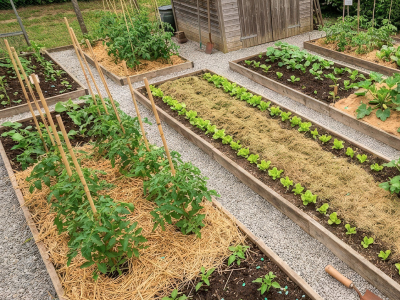
Which mulch to choose for your vegetable garden, crop by crop
Mulching has become an almost automatic reflex among experienced gardeners. Water savings, reduced weeding, protection against temperature fluctuations: its benefits are well known and widely documented. But what most guides fail to mention is that a poorly chosen or poorly applied mulch can also harm a harvest rather than help it. The goal here is not to extol the virtues of mulching in general, but to help you choose the right material for each family of vegetables, looking the real drawbacks squarely in the face. For ornamental beds and the precise calculation of the volume of wood chips needed, a dedicated guide already exists on the blog; let us focus here on the vegetable garden.
🌱 WHAT GUIDES DON'T TELL YOU: THE REAL DRAWBACKS OF MULCHING
The first pitfall, often downplayed, is nitrogen hunger. When you spread a highly carbonaceous material — straw, wood chip mulch (BRF), fresh wood shavings — the micro-organisms in the soil get to work breaking it down. This process mobilises available nitrogen in the soil, temporarily to the detriment of your crops. For leafy vegetables such as lettuce or spinach, which are among the most nitrogen-hungry, a poorly dosed carbonaceous mulch can result in yellowing leaves and slowed growth. It is not dramatic and it is reversible, but it is real, and many gardeners do not make the connection between their mulch and their ailing plant.
The second real drawback: slugs love mulch. A carpet of moist, compact organic matter is exactly the ideal habitat for these gastropods. In spring, when young plants are at the seedling stage and therefore most vulnerable, a thick mulch applied too early is an open invitation. It is not a matter of giving up mulching, but of understanding that certain materials — particularly fine, airy straw or hemp — are far less attractive than compact, moist mulches such as fresh grass clippings or chopped wet leaves.
The third trap is chronological: mulching too early in spring delays soil warming. An insulating layer placed on soil that is still cold in March does not allow it time to absorb the sun's heat. For crops that require a truly warm soil — tomatoes, courgettes, aubergines, peppers — this is a disadvantage from the start that can delay the first harvest by several weeks. The rule is simple: let the soil warm up first, then mulch once the temperature has stabilised.
Finally, collar rot is a risk that many discover too late. If the layer of mulch is too thick, poorly aerated, or worse if it directly touches the plant stem, the stagnant moisture creates ideal conditions for pathogenic fungi. The golden rule: always leave a clear space of a few centimetres around the base of each plant. These four drawbacks are not reasons to do without mulch; they are reasons to choose the right material, thickness and timing of application carefully.
🥬 ADAPTING YOUR MULCH TO EACH VEGETABLE FAMILY
The differentiated logic starts with a simple question: what does this vegetable need from the soil? Fruiting vegetables — tomatoes, courgettes, squash, aubergines, peppers — like a deep, rich, and above all warm soil. For them, mulching is ideal in the height of summer to retain moisture and prevent soil splashing onto the foliage, which encourages fungal diseases. The best materials are hay, hemp, or a mixture of coarse compost and fine BRF spread after planting, once the soil has fully absorbed the warmth of June. Mulching in April on a freshly planted tomato bed is a classic mistake that is paid for in delayed growth.
Leafy vegetables — lettuces, spinach, chard, rocket — are the most sensitive to nitrogen hunger. For them, the right option is well-matured compost spread on the surface, or dried grass, or relatively young hay. These materials have a balanced carbon-to-nitrogen ratio that does not cause nitrogen competition. If you only have straw on hand, spread only a thin layer (3 to 4 cm maximum) and supplement with a nitrogen input, such as compost tea or a cut green manure. The organic green manure range at Multitanks offers several blends suitable for this use as a complement to living mulch.
Root vegetables require more nuanced thinking. Carrots, parsnips, beetroot and radishes need a loose, aerated soil to develop properly. A thick mulch applied too early, before germination, prevents fine seeds from reaching the light and ruins the sowing. The right approach is to wait until the seedlings are well established, then mulch between the rows with a fine, lightweight material. Notable exception: the potato, which tolerates a thick mulch very well after planting. The latter can even replace traditional earthing-up while considerably simplifying harvesting, with the tubers remaining accessible under the layer of mulch without requiring a spade.
The table below summarises these recommendations by vegetable family for quick reference:
| Vegetable family | Recommended mulches | Indicative depth | Key watchpoint |
|---|---|---|---|
| Fruiting vegetables (tomatoes, courgettes, aubergines…) | Hay, hemp, coarse compost, hay/fine BRF blend | 7 to 10 cm | Only mulch after the soil has warmed up (June) |
| Leafy vegetables (lettuces, spinach, chard…) | Mature compost, dried grass, young hay | 3 to 5 cm | Risk of nitrogen hunger with straw or BRF |
| Root vegetables (carrots, parsnips, beetroot, radishes) | Fine compost, light hay between rows after germination | 3 to 4 cm between rows only | Never mulch before fine seeds have germinated |
| Potato (special case) | Abundant straw, hay, coarse BRF | 15 to 20 cm (replaces earthing-up) | Press the mulch down firmly to prevent light reaching the tubers |
🌾 MATERIALS BEYOND STRAW: WHAT YOU NEED TO KNOW
Straw and hay remain the most accessible references: lightweight and easy to spread, they offer decent protection against drought and surface frost. Hay, which is richer in nitrogen than straw, is preferable for crops sensitive to nitrogen deficiency. Their shared drawback remains their attraction for slugs, especially in wet weather, and the need to spread a reasonable volume to achieve a truly effective layer.
Dried grass clippings are a free and underrated resource. Rich in nitrogen, they decompose quickly — in two to four months — returning their nutrients directly to the soil. Be careful, however: never mulch with fresh clippings. Applied green and in a thick layer, they ferment, heat up and can scorch the roots of neighbouring plants while creating an impermeable crust. They must be left to dry for several days in the shade before use.
BRF — ramial chipped wood — is excellent for stimulating the fungal life of the soil and is perfectly suited to perennial plantings: fruit trees, shrubs, hedges. However, its use on annual vegetables should be handled with caution. BRF that is too fresh, used less than three months after chipping, considerably accentuates nitrogen hunger. Pre-composted BRF or BRF spread at the end of the season to act over winter before the next planting limits this problem. Visit the gardening section of the Multitanks website to discover available materials.
Hemp is an alternative increasingly adopted by demanding gardeners. Its water absorption capacity is remarkable, and its gradual release maintains stable moisture around the roots. Its lifespan extends from eighteen to twenty-five months depending on conditions, it does not cause significant nitrogen hunger, and its airy texture is unappealing to slugs. Its only drawback is its price, which is higher than straw. Its slower decomposition is, however, an economic advantage in the long term.
Living mulch fits into a permaculture logic that is increasingly widespread: a green manure is sown as ground cover between crops, cut before it goes to seed, and spread in place as mulch. The organic green manure blends available at Multitanks are particularly well suited to this use: they combine nitrogen fixation, soil loosening and the supply of fresh organic matter. Finally, for those seeking absolute simplicity over an entire crop, the mulching film remains the zero-maintenance solution: woven or thermal film, it durably blocks weeds and warms the soil, at the cost of a less living soil beneath the layer.
Straw, hay, dried clippings, hemp and pre-composted BRF gradually nourish the soil as they decompose. They encourage beneficial fauna, improve clay-silt structure and reduce runoff. Their effectiveness depends on the choice of material in relation to the crop, the season and the depth applied.
The mulching film is the ideal solution for field crops or dense rows of lettuces. It completely eliminates weeding, retains moisture and warms the soil. It does not feed the soil but remains a valuable tool alongside a rotation that includes green manures.
Sowing a green manure between crops, cutting it before flowering and spreading it as mulch in place is the technique that best closes the nutrient cycle. It returns nitrogen, organic matter and structure in a single operation, with no external input. Suited to productive permaculture, it requires good planning of crop rotations.
🐌 SLUGS AND MULCHING: THE RIGHT REFLEXES, THE FALSE SOLUTIONS
The question of slugs in a mulched vegetable garden is one of the first questions asked by gardeners who are new to this technique. And it is a legitimate question: moist mulch offers shelter, a food source and protection from predators. But the answer is not to remove the mulch — it is to adapt your behaviour and understand that certain materials cause fewer problems than others. Hemp and fine dry straw are far less attractive than green clippings or compact, moist dead leaves.
The guiding principle is simple: young plants are vulnerable at the time of transplanting, when they do not yet have reserve leaves and the slightest attack can destroy the plant. It is during this critical period that you need to be most vigilant. Once the plant is well established, its woody stems and leaf reserves allow it to tolerate a few bites without compromising the harvest. Here are the practical steps to take:
A word of caution is warranted regarding beer traps, often presented as the miracle solution. In reality, they work in the opposite way to what most people believe: by diffusing their scent over several metres, they attract slugs from the entire surrounding area and concentrate the population around the crops, without addressing the cause. In a natural and sustainable gardening approach, beer traps are a false good solution to be avoided. The real answer to slugs is a more diverse ecosystem with predators (hedgehogs, ground beetles, frogs) and a well-chosen mulch rather than a chemical campaign or a trap that backfires on the gardener.
🌿 THE PHILOSOPHY OF GOOD MULCHING: ADAPT RATHER THAN REPLICATE
The right mulch for your vegetable garden is not the most famous or the most attractive: it is the one that matches the crop in place, the season, and the balance already present in your garden. The same bed can receive surface compost in spring, a hemp mulch in summer, then a covering of dead leaves in autumn. Mulching is not a product to be applied once and for all; it is a practice to be adjusted continuously. As you observe your crops, your soils and your balances, you develop the intuition for what each bed needs. The essential thing is to remain curious and never apply the same recipe everywhere without thinking.
To go further, explore the green spaces section of Multitanks as well as the resources available in the gardening category, which offer materials, mulching films and green manure seeds suited to all vegetable garden configurations.
💡 Multitanks expert tip — carrots and fine-seeded sowings: before mulching a bed of fine-seeded root vegetables such as carrots, resist the temptation to spread your mulch immediately. Carrot seeds are tiny and their germination force is weak: a layer of mulch, even a light one, can be enough to smother them before they reach the light. Wait until the seedlings have reached 5 to 8 cm in height, then mulch exclusively between the rows with a fine, non-compacting material. This patience will save you from having to re-sow an entire bed because of a hasty step.
Share this content