



 IBC 1000 L accessories
 Heating jackets
 Fittings
 Drums, jerrycans & fittings

 Seeds
Seeds 





 Plant protection & biocides


 Garden


 Green spaces & municipal

 Barbecue, fire pit & fireplace
 Cleaning & care
 Refrigerants & air conditioning


 Watering

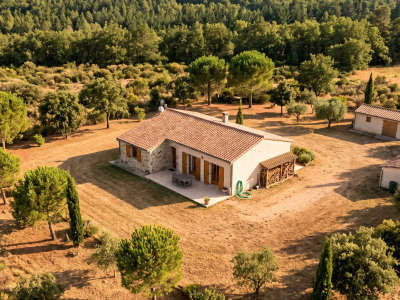
Mandatory brush clearing (OLD): protecting your home from wildfire risk
France is experiencing in this July 2026 its third heatwave episode in two months. Fifty-four departments are on high to very high fire danger alert — a level described as unprecedented by prevention services — while active wildfires are already devastating several regions. In this context, two figures are worth stating upfront: nine out of ten fire outbreaks are of human origin, and eighty percent of them start within fifty metres of homes. Yet nine out of ten houses destroyed in wildfires were not, or were poorly, cleared of brush. Brush clearing is therefore not an administrative formality: it is, concretely, the action that makes the difference between a house that survives and one that burns.
🔥 WHAT BRUSH CLEARING ACTUALLY IS
Many property owners confuse brush clearing, clear-cutting and deforestation. These are three fundamentally different operations, and this confusion leads to improper fulfilment of the legal obligation. Deforestation removes the forest designation of land: it is subject to authorisation and has nothing to do with what is required here. Clear-cutting, on the other hand, removes all vegetation: it is neither necessary nor desirable, and can even weaken the soil. Brush clearing, in the sense of the mandatory brush clearing obligation (OLD), is a far more precise operation: it involves reducing the quantity of combustible vegetation and, above all, creating discontinuities that break the path of fire.
These discontinuities are of two kinds. Vertical discontinuity separates low vegetation — grasses, scrub, shrubs — from the crowns of trees, so that a fire running along the ground cannot climb directly into the canopies and become a crown fire, which is far more violent and fast-moving. Horizontal discontinuity, meanwhile, spaces trees sufficiently apart so that a flame cannot jump directly from one to another. It is this logic of breaking propagation pathways, rather than stripping the land bare, that lies at the heart of the entire technical approach. Understanding this means understanding why well-executed brush clearing can leave mature, well-pruned and spaced adult trees on the plot while remaining fully compliant.
🔥 THE LEGAL BASIS AND DISTANCES TO OBSERVE
The mandatory brush clearing obligation is governed by articles L.131-1 to L.136-1 of the French Forestry Code. It applies in territories classified as fire risk areas, whenever a dwelling, building, construction site or installation is located within or less than 200 metres from a forest, moorland, maquis or garrigue. This 200-metre threshold is the key trigger of the obligation: if your home lies outside this buffer zone, you are in principle not affected. Otherwise, the obligation applies by law, regardless of the size of the plot.
The number of departments actually concerned is often cited as between 43 and 52 depending on sources and boundaries used: this figure changes regularly, particularly as wildfire risk extends northward under the effects of climate change. It is therefore essential to verify your individual situation rather than relying on a general list: the national map of OLD information zoning is freely available on Géoportail (IGN) and on Géorisques.gouv.fr. If in doubt, the local town hall or prefecture can confirm your plot's situation.
The distances to observe vary according to the configuration of the land and local decisions. The table below summarises the main rules applicable at national level, noting that prefectoral or municipal orders may be more stringent in your area.
| Situation | Required distance or perimeter | Authority empowered to adjust |
|---|---|---|
| Dwelling or building in a risk zone | Minimum 50 metres around the building (may extend onto neighbouring plot) | Mayor or prefect |
| Very high-risk zone (specific order) | Up to 100 metres around the building | Mayor or prefect |
| Private access routes (road, path, private track) | 10 metres on each side (maximum depth set by the prefect) | Prefect |
| Plot located in zone U (urbanised) of a local urban plan (PLU) | Entire plot, without distance limit | Local urban planning regulations |
One point that is frequently misunderstood must be emphasised: the 50-metre zone is measured from the building, not from the boundary of your property. If your house is close to a plot boundary, this zone may extend onto a neighbour's land — and the law has provided for this, as we will see below.
🔥 THE CONCRETE TECHNICAL ACTIONS
Carrying out brush clearing correctly requires mastering a few basic technical rules, which may vary slightly depending on the departmental orders in force. It is therefore always useful to consult your prefecture or town hall website for the exact local requirements before starting work.
In broad terms, the operation covers several types of complementary interventions. The first priority concerns the immediate surroundings of the building: any tree or branch located less than 3 metres from a facade or roof must be removed or cut back, as it forms a direct bridge between the vegetation and the roof structure. Dead or dying trees must also be eliminated as a priority: they are particularly flammable and can fall under the effect of heat or wind. Here are the technical actions commonly expected within the 50-metre zone:
These actions, carried out together, create an environment where a ground-level fire loses energy before reaching the house, finds no fuel to climb into the canopies, and cannot spread rapidly from one tree to another. It is this slowing of the fire that gives firefighters time to intervene, or allows occupants to evacuate safely. Brush clearing residues (cut wood, leaves, dry grass) must be removed or chipped and not left on site: a pile of dry scrub at the foot of a tree immediately undoes all the work done. Also consider consulting the resources available in the gardening category or in the green spaces and urban planning section for tools suited to this type of work.
🔥 WHO IS RESPONSIBLE, AND HOW TO HANDLE NEIGHBOURING PROPERTIES
The law is clear on this point: it is the owner of the building who is legally responsible for carrying out the OLD, in accordance with article L.134-8 of the Forestry Code. Neither the neighbouring forest owner nor the operator of the adjacent woodland bears this obligation on your behalf. If you are a tenant, be aware that you may only act on the land in this capacity if your lease explicitly provides for it: in all cases, this never exempts the landlord from their own criminal liability. The owner cannot shift responsibility onto a tenant to justify non-compliance with the OLD before the authorities.
The most delicate situation arises when the 50-metre zone extends onto a neighbour's plot. The law has anticipated this: you are authorised to work on the neighbouring land, but subject to conditions. You must send the owner concerned a recorded delivery letter with acknowledgement of receipt, informing them of the work you intend to carry out on their plot as part of your OLD. In the event of refusal or no response within one month, liability for the portion concerned may, under certain conditions, be transferred to them. This mechanism remains dependent on the precise situation of the neighbouring plot: in the event of a dispute or uncertainty, it is strongly advised to contact your town hall to find out the exact procedure applicable locally.
Whether they occupy or rent out the property, the owner of the building remains the sole legal party responsible for the OLD. No private agreement — lease, neighbourly arrangement — can relieve them of their criminal liability towards the authorities.
A recorded delivery letter with acknowledgement of receipt is sufficient to authorise you to work on the neighbouring plot. In the absence of a response within one month, liability for that portion may be transferred. Consult your town hall for the exact local procedure.
In the urbanised zone of a local urban plan, the obligation covers the entire plot, without any distance limit. Check with your town hall or on Géorisques to find out your exact zoning.
🔥 PENALTIES, INSURANCE AND PRACTICAL CONSEQUENCES
Failure to comply with the OLD is not without financial and legal consequences. The process typically begins with a formal notice from the mayor, which may be accompanied by a daily penalty of up to 100 € per day of delay until the work has been carried out. If the owner does not comply, the municipality may have the work carried out directly and charge the full cost to the owner. On the administrative side, a fine of up to 50 € per uncleared square metre may be imposed, which can amount to very significant sums for a plot of average size. A criminal fine of up to 1,500 € may be added depending on the classification applied.
The impact on insurance is an aspect that is often overlooked, yet particularly concrete for the property owner. In the event of a fire on a property that was not compliant with the OLD, the insurer is entitled to apply an excess increase of up to 5,000 €. In other words, on top of the potentially catastrophic loss caused by the fire, the non-compliant owner bears a significantly higher share of the damage. In the most serious scenario — where non-compliance with the OLD contributed to the spread of a fire that destroyed property or endangered lives — heavy criminal proceedings, including imprisonment and fines of several thousand euros, are conceivable. This scenario remains extreme, but it illustrates that the mandatory brush clearing obligation falls squarely under criminal law, not merely administrative law.
🔥 THE 2025 CHANGES AND PROPERTY TRANSACTIONS
Since 1 January 2025, the regulatory framework has been tightened on a point that directly affects property transactions. Any seller or landlord of a property subject to an OLD is now required to inform the buyer or tenant from the moment of the property listing, via the state of risks and pollution document (ERP). This information can no longer be provided at the signing of the preliminary contract: it must appear in the listing itself. This development reflects a deeper trend: wildfire risk is becoming a property valuation criterion in its own right, and the OLD is gradually entering housing culture, in the same way as energy performance certificates or asbestos surveys.
For the buyer, this information is valuable: it allows them to factor in the work from the outset of price negotiations, and to assess the annual cost of regular land maintenance. For the seller, complying with this disclosure obligation is also a legal protection: in the event of a fire after the sale, they cannot be accused of having failed to alert the buyer.
🔥 CHECKING YOUR SITUATION AND CHOOSING THE RIGHT TIME TO ACT
Checking whether your land is subject to the OLD is a simple and free process. The national map is directly accessible on Géoportail (geoportail.gouv.fr), the IGN portal, where you simply need to activate the "OLD information zoning" layer. The Géorisques.gouv.fr portal also provides a summary of risks by address, including forest fire risk. If any doubt persists, or if your situation is borderline (a house 190 m from a wood, for example), the town hall and prefecture remain the most reliable contacts for official confirmation.
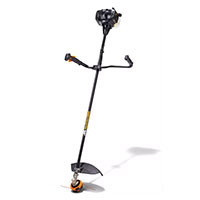
Finally, one essential practical note: if you are reading this article during a peak heatwave and wondering whether you need to act immediately, be aware that mechanised work — petrol brush cutters, chainsaws — is often prohibited during summer drought periods by prefectoral order. The reason is straightforward: these machines can themselves cause a spark on dry grass. The right time to clear brush is autumn, winter or early spring. If you have not yet acted and the season is already advanced, note the deadline in your diary for September-October, and check with your prefecture whether manual methods (hand trimming, non-motorised tools) remain permitted in the meantime.
For the equipment needed to maintain your land, browse the gardening and green spaces & urban planning sections of Multitanks. If you are also planning your water management during restriction periods, our irrigation category can help you optimise your setup. Finally, if the topic of summer safety and fire-related risks interests you, also discover our advice on barbecues and fire pits during drought periods, a subject directly linked to fire prevention around the home.
🔥 The Multitanks expert tip
Brush clearing is only effective if it is maintained over time. Land cleared once and then left unattended quickly returns to its original state: regrowth of herbaceous plants can reach 1 metre in height in a single favourable season. It is therefore better to carry out light, regular maintenance — two or three passes per year, adapted to the vigour of local vegetation — than a large one-off project quickly overtaken by nature. Schedule brush clearing in your annual calendar, just like boiler servicing or chimney sweeping: it is a maintenance task, not an exceptional event.
Share this content