



 Accessoires IBC 1000 litres
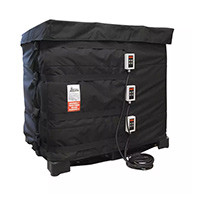
 Couvertures Chauffantes
 Raccords Plomberie
 Bidons / Futs et raccords
 Semences





 Produits Phyto


 Jardin


 Espaces Verts
 Barbecue - Braséro - Cheminée
 Entretien
 Fluides & Climatisation
 Arrosage
Garden wintering: Expert guide to protect valves and fittings from frost
- 1. Why do some materials break faster than others?
- 2. The golden rule of the expert: Complete emptying
- 3. The critical case of ball valves
- 4. Protect specific equipment
- 5. Insulation: A backup, not a guarantee
- 6. The Ultimate Tip: The Self-Draining Antifreeze Valve
- Conclusion: Your winterization checklist
- Confirmed technical information:
Garden wintering: The expert guide to protect your fittings, valves and networks from frost
Winter is the worst enemy of outdoor water installations. Every year, thousands of garden, swimming pool or agricultural facility owners face the same unpleasant surprise in the spring: split valve bodies, burst brass fittings or deformed PE pipes.
The culprit? A simple but devastating physical law: the expansion of water during its crystallization. When freezing, the volume of water increases by about 9%. If this water is enclosed in a rigid space (a closed valve, a brass elbow, a pump body), the pressure exerted exceeds the breaking limit of the material.
As experts in connection solutions, we have designed this guide to give you the keys to professional winterization. Here's how to secure your installation for zero damage at the end of winter.
1. Why do some materials break faster than others?
Understanding the strength of materials is the first step to successful wintering.
Brass is a robust alloy, but it is not very elastic. When a brass fitting or ball valve is full of water and experiences intense freezing, the metal cannot deform to absorb the expansion of the ice. The result: the metal splits cleanly. It is often invisible to the naked eye in winter, but the leak becomes spectacular as soon as it is refilled.
PE pipe (blue or black stripe) has a certain elasticity. It can withstand moderate frost because its structure can expand slightly. However, the danger does not come from the hose itself, but from the compression fittings (whether plastic or brass) which are not extendable.
PVC becomes extremely brittle at low temperatures. A shock to a frozen PVC tube can shatter it like glass. In addition, the bonds are subject to enormous stress if the water freezes inside the fittings.
2. The golden rule of the expert: Complete emptying
The only 100% reliable protection against frost is not insulation, but the absence of water. An empty pipe never freezes.
Close the overhead valve: Turn off the general power supply to your outdoor network (usually located in your cellar or protected manhole).
Open all the drawing points: Open all your garden faucets and secondary valves to let air in and water drain out.
Using the Bleed Valve: If your installation is done well, you have a bleed valve at the lowest point of the network. Open it until the flow stops.
Expert advice Multitanks : Don't just turn on the taps. If your network has "low points" (parts of pipes that form a basin), water will remain trapped in them by gravity. In this case, the use of an air compressor is recommended to flush out the residual water.
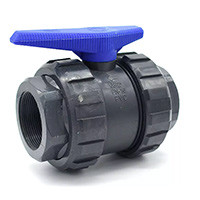
3. The critical case of ball valves
This is where the error is most frequent. A closed valve can explode even if the pipe is empty.
What for? When a ball valve is in the closed position, a small amount of water remains trapped inside the ball. When freezing, this water expands and causes the valve body to burst.
The pro method: * After emptying the network, leave your valves in the semi-open position (at 45°).
This allows water trapped in the sphere to escape and air to circulate. A valve that is fully open or completely closed is at risk.
4. Protect specific equipment
Surface or well pump
A pump is the most expensive part of your installation. A cast iron or stainless steel pump housing is never frost-resistant.
Draining: Unscrew the drain plug located at the bottom of the pump housing.
Storage: If possible, disconnect the pump (using 3-piece union connections) and store it in a frost-free place (garage, cellar). Take the opportunity to check the pressure of the pressure booster.
The internal membranes and solenoids of the controllers are extremely fragile.
Squeeze-out: Systematically disassemble your tap nose controllers.
Interview: Remove the batteries (to prevent oxidation due to condensation) and store the device in a dry place inside the house.
A full 1000 litre tank that freezes is not likely to explode (the plastic bag is flexible), but the outlet valve and the S60x6 fittings are in the front line.
Tip: Leave the tank valve slightly open and make sure that any accessories mounted on it (faucets, adapters) are drained or removed. If the tank is full, protect the valve with serious thermal insulation or a protective cover IBC.
5. Insulation: A backup, not a guarantee
Insulating a pipe with polyethylene foam or rock wool does not create heat, it simply slows down the temperature drop.
In a buried look: The floor gives off natural heat. To protect a meter or splitter, do not fill the manhole with sand. Instead, use extruded polystyrene sheets on the walls and above the equipment.
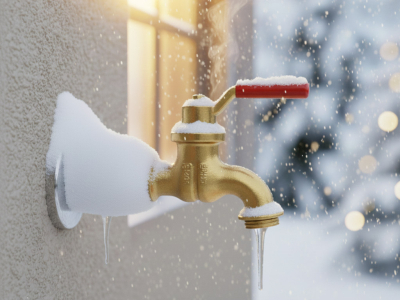
Outdoor faucets: If you can't turn off the water from a tap, use professional insulated thermal covers. They are much more effective than simple cloths which, once wet, accelerate frost.
6. The Ultimate Tip: The Self-Draining Antifreeze Valve
If you're tired of manually draining every year, technology can help.
The automatic purge valve: Installed at the low point, it opens on its own as soon as the pressure drops or the temperature drops.
The anti-freeze façade tap: Thanks to an elongated rod system, the water is cut off inside the house (in the heated area) while the control remains outside. It is the most profitable investment for total peace of mind.
Conclusion: Your winterization checklist
To make sure you don't forget anything before the first frost:
Close the outdoor standby supply valve.
Open all faucets and flush the network.
Place all valves at 45° (semi-open).
Bring in the controllers and surface pumps.
Drain filter housings and sprinkler manifolds.
By following these expert tips, you can extend the life of your equipment and avoid costly and stressful repairs in the spring.
Need a bleed fitting, a replacement valve or an insulating cover? Find our entire professional selection on Multitanks.com. Our advisors are here to help you choose the right solution for your setup.
Confirmed technical information:
Water dilation: +9% by volume at 0°C.
CW617N brass breaking pressure: greatly exceeded by the crystallization force of the ice.
Safety position of the valves: 45° to free up the space between seats.
Share this content