



 Accessoires IBC 1000 litres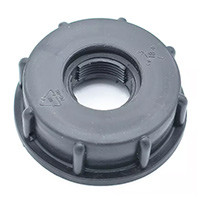
 Couvertures Chauffantes
 Raccords Plomberie
 Bidons / Futs et raccords
 Semences





 Produits Phyto



 Jardin




 Espaces Verts

 Barbecue - Braséro - Cheminée
 Entretien

 Fluides & Climatisation
 Arrosage
Complete Guide Plumbing Threads: Matching Inches to mm
The Ultimate Guide to Plumbing Threads: BSP, Gas, Inches and Millimeters
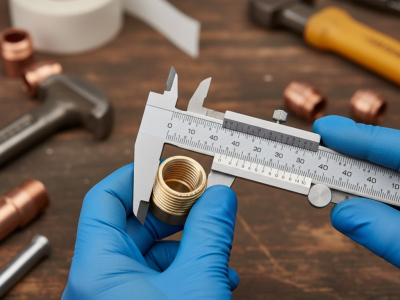
"I measured my fitting with a caliper, it's 26 mm in diameter, why are you telling me it's 3/4 inch when 3/4 inch should be about 19 mm?".
The experts at Multitanks experts hear it every day. It's a perfect illustration of the gap between real physical measurement and plumbing trade names. If you're feeling lost between millimeters, inches, Gaz pitch and BSP or NPT standards, this guide is for you. By understanding the (sometimes confusing) logic of threading, you'll avoid ordering errors, assembly leaks and tedious rework.
1. The historical legacy: Why does nothing seem logical?
To understand why a graduated ruler isn't enough to identify a fitting, we need to go back to the 19th century, to the time of the British Industrial Revolution.
Originally, plumbing dimensions referred to the inside diameter of wrought-iron tubes. A one-inch (1") tube actually had a water passage of 25.4 mm. However, threading these tubes required sufficient wall thickness. The outside diameter of the tube was therefore much larger.
Over time, and with advances in metallurgy, we learned to manufacture tubes that were much thinner, but just as strong. The inside diameter was therefore enlarged, but to maintain compatibility with older fittings already installed around the world, the outside thread diameters remained fixed.
Today, the designation "1 inch" is no more than a nominal label. It no longer corresponds to any simple physical measurement on the fitting. This is known as the BSP (British Standard Pipe) system.
2. The Correspondence Table: Your technical compass
This is the central element of this article. Before ordering on Multitanks, take a caliper (or, failing that, a ruler) and measure the outside diameter of the threads if you have a male fitting, or the inside diameter if you have a female fitting.
Conversion table millimeters / inches (Gas pitch / BSP)
| Appellation Inches | Gas pitch (mm) | Outside diameter Male (mm) | Inside Diameter Female (mm) | Frequent use |
| 1/8" | 5 x 10 | 9.7 mm | 8.6 mm | Pressure gauges, small sensors |
| 1/4" | 8 x 13 | 13.1 mm | 11.4 mm | Compressed air, drains |
| 3/8" | 12 x 17 | 16.7 mm | 15.0 mm | Valve hoses |
| 1/2" | 15 x 21 | 21.0 mm | 18.6 mm | Garden and shower outlets |
| 3/4" | 20 x 27 | 26.4 mm | 24.1 mm | Water inlets, washing machine |
| 1" | 26 x 34 | 33.2 mm | 30.3 mm | Pumping, manifolds |
| 1" 1/4 | 33 x 42 | 41.9 mm | 39.0 mm | Drains, water columns |
| 1" 1/2 | 40 x 49 | 47.8 mm | 44.8 mm | Pool filtration, pumps |
| 2" | 50 x 60 | 59.6 mm | 56.7 mm | Industrial piping, tanks |
Note: Measurements may vary from 0.1 to 0.3 mm depending on fitting wear or manufacturing precision.
3. BSPP vs. BSPT: The subtleties that make all the difference when it comes to sealing
Not all BSP threads are alike. In Europe, we use two main variants that should not be confused.
- BSPP (Cylindrical)
The thread is "straight" and parallel. The diameter is the same at the beginning and end of the thread.
Where to find it? On most brass fittings, garden and household valves.
How do you make the seal? The seal is not made in the thread itself. Instead, we use a flat gasket (rubber or fiber) or an O-ring which is pressed into the bottom of the female part.
- BSPT (tapered)
The thread is slightly "pointed" towards the end. It widens as you screw.
Where is it found? In industry and on certain high-pressure fittings.
How is the seal made? Here, the seal is made in the thread. When screwing, the male and female threads wedge into each other. It's essential to use Teflon tape or oakum to fill the micro-gaps.
4. The NPT trap: The rebellious American cousin
This is the fatal error when buying online on non-specialized sites. NPT (National Pipe Thread) is the American standard.
To the naked eye, a 1/2" NPT fitting looks exactly like a 1/2" BSP fitting. However, the thread pitch (the angle of the teeth and the distance between them) is different. If you try to screw one into the other :
You'll only be able to make 2 or 3 turns.
If you force the wrench, you'll destroy the threads for good.
You'll never get a perfect seal.
Always check that your material conforms to the European BSP standard before ordering.
5. Special cases: Tank outlets IBC 1000 liters
At Multitanks, we specialize in IBC tanks. These tanks often have threads that are totally outside conventional plumbing standards.
The most common is S60x6:
S stands for "Saw" (the thread profile resembles a saw tooth).
60 refers to the outside diameter (60 mm).
6 stands for "pitch" (the distance between two thread crests is 6 mm).
It's impossible to screw a standard plumbing fitting directly onto a tank without a special adapter. This is where our combination fittings come into play, transforming this "large section" outlet into a standard 3/4" or 1" thread that can be used with your sprinkler system.
6. Practical guide: How to identify your fitting in 3 steps?
Step 1: Thread direction
Is it male (the teeth are on the outside, like a screw) or female (the teeth are on the inside, like a nut)?
Step 2: Precise measurement
Use a caliper. Measure on the widest part of the threads. If you only have a ruler, be extremely careful: the difference between 1/2" and 3/8" is only a few millimeters.
Step 3: Thread profile
Check whether the fitting is cylindrical (straight) or conical. If you see a shoulder at the bottom of the female fitting to accommodate a gasket, you're almost certainly on cylindrical (BSPP).
7. Expert advice from Multitanks for successful assembly
Once you've identified the right fitting, you need to install it correctly.
Don't use too much Teflon: too much tape can prevent the fitting from going all the way, and paradoxically, can lead to leaks or cracks in plastic fittings.
Winding direction: Always wind your Teflon or thread in a clockwise direction (the direction of screwing). Otherwise, screwing will undo all your sealing work.
Mixing materials: When screwing brass into plastic, be careful. Because brass is harder, it can easily "re-cut" a new, crooked thread in plastic if you're not properly aligned.
Conclusion: Precision is the key to durability
Understanding threads is the key to ensuring that your sprinkler system, pumping system or home network will be reliable right from the start. The BSP system may be a hundred years old and sometimes confusing, but it's still incredibly effective when you have the right correspondence table.
At Multitankswe stock hundreds of references in all these dimensions. If, after reading this guide, you still have any doubts, don't hesitate to contact our technical department. A photo of your measurement next to a ruler is often enough for us to identify your needs in a matter of seconds.
Ready to equip your network?
Share this content