IBC 1000 L accessories


 Heating jackets


 Fittings

 Drums, jerrycans & fittings

 Seeds
Seeds 


 Plant protection & biocides

 Garden


 Green spaces & municipal



 Barbecue, fire pit & fireplace


 Cleaning & care

 Refrigerants & air conditioning


 Watering

Biochar and Permaculture: Regenerate Your Dead Soil Quickly
- Biochar in Permaculture: advanced strategies for regenerating dead soil in a single season
- Understanding the "death" of soil: breaking the carbon cycle
- Microbiology at the heart of regeneration: the microbial habitat
- Biochar in mound and lasagne cultivation
- Regenerating from below: the clay-humus complex
- An ecological gesture: the sustainable carbon sink
- Conclusion: Autonomy starts with a living soil
- Diagnosis: Which biochar for your land?
Biochar in Permaculture: advanced strategies for regenerating dead soil in a single season
In Permaculture, the saying goes: "You don't feed the plant, you tend the soil". But what do you do when that soil is literally on its last legs? Whether you're faced with fill soil concreted over by a building site, a vegetable garden exhausted by decades of monoculture or a wasteland whose structure has been washed away, the challenge is immense. In nature, it can take up to 500 years to create a centimetre of stable humus. As a gardener or market gardener, you don't have that kind of time. As we explored in our first installment on drought management with biochar, this material is a gas pedal of natural processes. Here, it becomes the catalyst for express regeneration: from desert to abundance in a single growing season.
Understanding the "death" of soil: breaking the carbon cycle
Soil is considered "dead" when it no longer contains sufficient oxygen, water and organic matter to support active microbial life. This is often the result of excessive compaction that has crushed the soil's pores, or intensive use of chemicals that have sterilized the subterranean biology. Without micro-organisms, nutrients remain trapped in an unassimilable mineral form. As explained in our article on combining biochar and fertilizers, soil without structure is a budgetary and agronomic sieve.
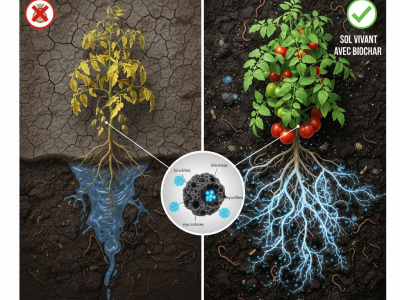
Professional biochar Terra Fertilis acts here as a "structural prosthesis". Composed of over 80% stable carbon (which does not decompose), it immediately reinjects the structure that degraded soils lack. It doesn't just amend the soil, it physically repairs it by creating circulation spaces for air and water.
Microbiology at the heart of regeneration: the microbial habitat
For soil to come back to life, it must be teeming with life. But bacteria and mycorrhizal fungi need a refuge from predators and thermal shock. Think of biochar as a "microscopic city": its different-sized pores (micro, meso and macropores) offer specific shelters for each type of micro-organism. In one gram of biochar, the internal surface can be the size of a soccer pitch!
This gigantic surface area enables immediate, massive colonization. To accelerate this awakening, the wise permaculturist will use nettle manure to "charge" the biochar before application. The manure provides the necessary lactic ferments and bacteria, while the biochar gives them a permanent home. In just one season, this invisible explosion of life can turn compact, grey soil into lumpy, humus-rich black earth.
Biochar in mound and lasagne cultivation
Permaculture often uses self-fertilizing mounds to maximize soil surface area and richness. However, a poorly managed mound can quickly become depleted or compacted. Introducing biochar into the structure of the mound itself (when assembling the layers of wood and compost) stabilizes the system over the long term. Biochar captures excess water from your collection tank, preventing valuable compost juices from leaching into the deeper layers of the soil.
During summer production peaks, mineral requirements are immense. Instead of watering to waste, market gardeners can use a liquid organic fertilizer coupled with biochar. The biochar will fix the fertilizing molecules and release them "on demand", depending on root activity. This virtuous circle results in nutrient-dense, disease-resistant vegetables.
| Permaculture technique | Role of Biochar | Immediate benefit |
|---|---|---|
| Mound cultivation | Nutrient sponge between layers of wood. | Prevents nitrogen starvation and prolongs humidity. |
| Market gardening on living soil | Colonization support for mycorrhizae. | Radical increase in emergence speed. |
| Forest-garden | Deep reservoir at the foot of trees. | Reduces mortality of young fruit trees. |
Regenerating from below: the clay-humus complex
The ultimate goal of any gardener is to stabilize the "clay-humus complex" (CAH). This is the chemical marriage between minerals (clay) and decomposed matter (humus), sealed by the action of earthworms. In dead soil, this complex is broken down. The structure of biochar acts as a "bridge", facilitating the creation of this complex. It holds the clay and humus particles together, creating a lumpy soil that is resistant to wind and heavy rain.
To optimize this natural alchemy, precision watering plays a crucial role. Soil that's too dry kills microbiology, while drowned soil suffocates it. Biochar regulates these extremes. By maintaining a constant level of humidity, it enables earthworms to remain active longer into the season, accelerating the transformation of grass clippings and straw into fertile soil right on the spot.
An ecological gesture: the sustainable carbon sink
Finally, adopting biochar in permaculture is a powerful act for the climate. Every kilo of biochar spread is equivalent to around 2.5 to 3 kg of CO2 removed from the atmosphere for hundreds of years. Unlike mulches, which release their carbon as they decompose, biochar remains inert and fertile. By caring for your vegetable garden, you're playing a direct part in the fight against global warming.
Conclusion: Autonomy starts with a living soil
Going from dead soil to a nurturing jungle isn't a miracle, it's a question of strategy. By using biochar as a structural base, you offer nature the means to rebuild itself at record speed. You secure your production, save your resources and build a fertile legacy for future generations. Abundance is at hand, you just have to give the earth the foundation it deserves.
Diagnosis: Which biochar for your land?
Answer these 3 questions to find out which regeneration strategy is right for your soil.
1. What is the dominant aspect of your soil?
Share this content