IBC 1000 L accessories
 Heating jackets
 Fittings
 Drums, jerrycans & fittings
 Seeds






 Plant protection & biocides



 Garden



 Green spaces & municipal
 Barbecue, fire pit & fireplace
 Cleaning & care

 Refrigerants & air conditioning
 Watering
1000L IBC Tank Overflow: Step-by-Step Fitting
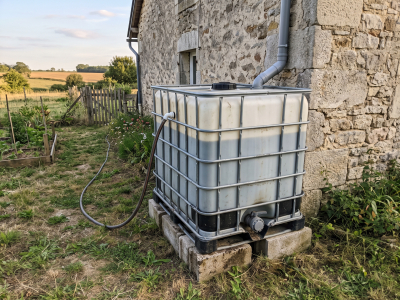
A 1000-litre tank placed under a downpipe fills up much faster than you might think. The day it is full, water keeps coming in and spills out through the lid, runs down the side of the tank and spreads out at the foot of the wall. The overflow is the part that decides for you where this excess water goes. It costs a few euros, takes an hour to fit, and yet it is the accessory most often forgotten on an IBC tank.
🌧️ WHY A 1000 L TANK NEEDS AN OVERFLOW
The calculation is simple: one millimetre of rain falling on one square metre of roof gives one litre of water. A 50 m² roof under a 30 mm per hour storm therefore sends around 1,500 litres per hour down the downpipe. At that rate, a 1000-litre tank that is already half full overflows in twenty minutes. This is not an extreme case, it is an ordinary summer storm.
Without an overflow, the water escapes through the highest and least intended point: the filler cap. It streams down the tank wall, soaks the ground at the foot of the tank and often ends up against a façade or a foundation. On a tank standing on breeze blocks or a light slab, the ground softening under one side can even make the whole thing tilt, when a full tank weighs more than a tonne.
The overflow solves the problem by setting a maximum level. As soon as the water reaches it, it drains away through a pipe you have chosen, to a place you have chosen. The tank stays full, but it no longer overflows.
🔍 DO YOU REALLY NEED AN OVERFLOW?
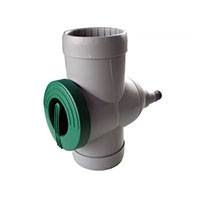
It all depends on how your tank is filled. If the water comes in through a rainwater filter collector fitted on the downpipe, the question is already largely settled: this type of collector has a built-in automatic overflow that sends the water back into the gutter when the tank is full. The excess water simply returns to the original drainage system.
On the other hand, if the downpipe is cut and empties straight into the tank, or if you fill the tank with a hose, nothing stops the water once the maximum level is reached. In both cases, an overflow is not optional. Nor is it as soon as you connect several tanks together, or when the tank is installed near a wall, a cellar or a walkway.
🧰 CHOOSING YOUR OVERFLOW: THREE TYPES
Our overflows range brings together three types that differ mainly in what you connect behind them. So before choosing a model, look at the pipe that will carry the water away: that is what decides.
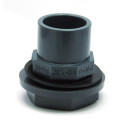
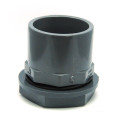
For drainage through rigid PVC pipe. The kit includes a smooth female PVC fitting, a flat gasket and a locking nut. The female PVC overflows come in 32/40, 40x50, 50x63 and 63x75: the pipe is bonded directly into the fitting. The 32/40 is the most popular.
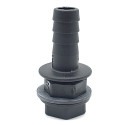
For a flexible hose, held by a hose clamp. It is the simplest solution when the water needs to go to a flower bed or a second tank. The straight hose tails range from 19 mm, for a 16 to 20 mm hose, up to 50 mm.
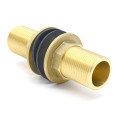
For a solid, durable wall pass-through. The screw-in brass overflow comes with a 10 cm threaded tube, nuts and two flat gaskets, which are tightened on either side of the wall.
One rule avoids most mistakes: the overflow must drain at least as much water as comes in. Otherwise, in heavy rain, it drains more slowly than the tank fills, and the water ends up coming out through the lid anyway. A 19 mm hose tail overflow is suitable for a tank filled with a garden hose. For a cut downpipe that empties straight into the tank, take the largest diameter, the 63x75 PVC overflow. And if the downpipe is 80 or 100 mm, the rainwater filter collector, which sends the excess water back into the gutter, remains the safest solution.
| Type | Drainage connected behind | Diameters in the catalogue | Intended use |
|---|---|---|---|
| Female PVC | Rigid PVC pipe, solvent-welded | 32/40, 40x50, 50x63, 63x75 | Connection to a downpipe or an inspection chamber |
| Hose tail | Flexible hose and hose clamp | 19, 25, 32, 38 and 50 mm | Drainage to the garden or a second tank |
| Screw-in brass | 10 cm threaded tube | One model | Robust wall pass-through |
📍 WHERE TO DRILL: THE RIGHT HEIGHT
The height of the overflow sets the maximum level of your storage: anything above the hole is never stored. On an IBC tank, whose 1000 litres are spread over about one metre of height, each centimetre of tank corresponds to around ten litres. An overflow drilled ten centimetres too low therefore costs you around a hundred litres of storage every time the tank fills.
Place it high on the wall, at around 80 to 90 % of the tank's height. This margin below the filler cap absorbs the surges of a storm while the overflow drains. Choose a flat area, between two bars of the metal cage, away from the tank's reinforcing ribs: a flat gasket only seals properly on a smooth surface.
Think about the side too. The overflow is best placed on the face closest to where the water needs to go, and close enough to the filling opening that you can reach inside and hold the part while tightening.
🔨 STEP-BY-STEP FITTING
Fitting requires a drill, a hole saw, a file or sandpaper and a spanner. Allow an hour, including glue drying time if you are draining through PVC.
Drilling is the step that makes or breaks the seal. A hole that is too large cannot be put right: the gasket then only grips on one side and a leak is guaranteed. If the size you need falls between two hole saw sizes, take the smaller one and enlarge the hole with the file until the part fits without play. For rigid PVC drainage, the rules of leak-free PVC solvent welding apply here as anywhere else: roughened surfaces, cleaner, glue, and no water before the drying time is up.
↪️ WHERE TO SEND THE OVERFLOW WATER
An overflow only moves the water: it still has to end up in the right place. The safest option is to send it back to the downpipe downstream of the tank, or to a rainwater inspection chamber, with a PVC pipe on a steady slope. Failing that, a flexible hose can carry it to a flower bed, a hedge or a soakaway, always well away from foundations.
The third solution is to keep it: the overflow of the first tank feeds a second tank. This one only starts to fill once the first is full, which doubles your storage without altering the downpipe. In that case, fit an overflow on the last tank in the chain, and a pipe of sufficient diameter between the two. To empty these tanks, each one keeps its valve and its IBC tank fittings and accessories as usual.
❄️ MAINTENANCE AND WINTER
An overflow needs almost nothing, provided it stays clear. Leaves, moss and roof debris eventually build up at the overflow inlet and in the drain pipe. A check in autumn, when the leaves fall, is enough to stop it clogging just when it is needed. Take the opportunity to check the condition of the gasket and the tightness of the nut.
In winter, standing water in a flat drain pipe can freeze and burst it. Give it a continuous slope so that it empties by itself, and for the tank valve, follow the precautions in our guide to winterising valves and fittings.
Multitanks Expert Tip
Don't wait for the first storm to find out whether your overflow works. Once the glue is dry, fill the tank with a garden hose until water comes out of the overflow, and let it run for a few minutes. In one go, you check the gasket seal, the slope of the drain and exactly where the water ends up. It is also the right time to make sure the overflow drains at least as fast as the water comes in.
⛈️ Overflow calculator
Estimate how long your 1000L tank takes to fill in the rain
Share this content