



 IBC 1000 L accessories
 Heating jackets
 Fittings
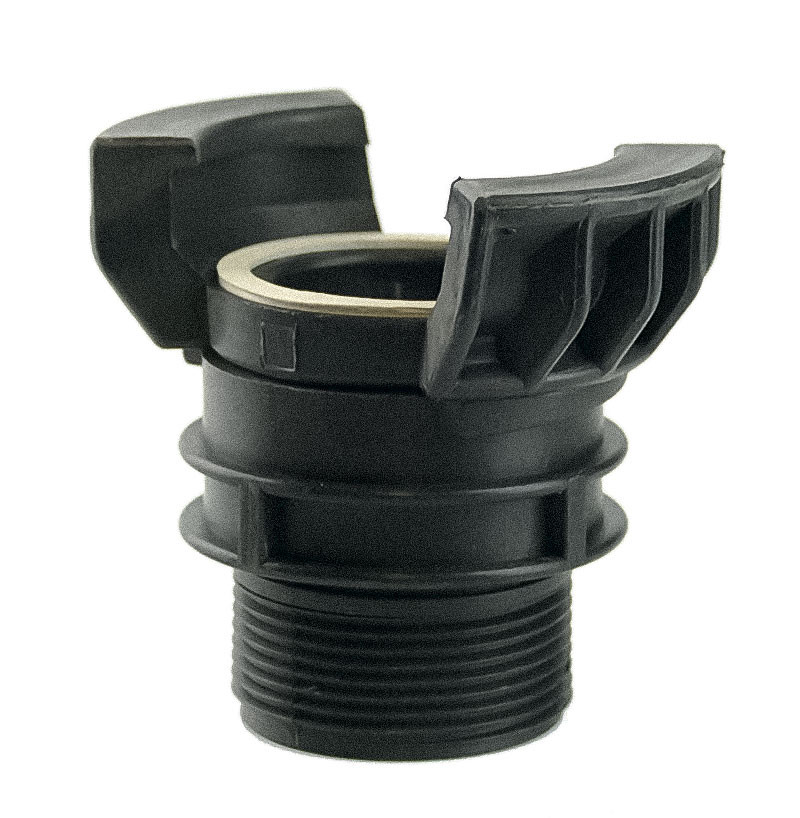
 Drums, jerrycans & fittings
 Seeds



 Plant protection & biocides


 Garden



 Green spaces & municipal

 Barbecue, fire pit & fireplace
 Cleaning & care

 Refrigerants & air conditioning
 Watering
Tap for a 1,000-litre IBC tank: which one to choose and how to fit it
Your tank tap is leaking, or you finally want to connect a garden hose to your 1,000-litre IBC tank — but the search results mix up taps, valves and fittings as if they were all the same thing, so it is hard to know what to order. This article gives you the keys to understand what you are really looking for, choose the right part for your use, and fit it without mistakes.
💧 The S60x6 standard: the linchpin nobody tells you about
Any purchase of a tap for an IBC tank starts with one piece of information most sellers forget to mention : the outlet thread on your tank is very probably an S60x6. This standard describes a 60 mm diameter thread with a 6 mm pitch — it is the thread fitted to the outlet of the vast majority of 1,000-litre IBC tanks on the market, whatever the manufacturer or the origin of the tank.
Precisely because this reference remains little known to the general public, confusion sets in. When someone types « 1000L tank tap » into a search engine, they usually have no idea they are actually looking for an S60x6-compatible part. Without that information, they risk ordering a tap whose thread does not match their tank, and finding themselves stuck when it comes to fitting it. Identifying this standard from the outset avoids the vast majority of ordering mistakes. You will find the full range of accessories for 1,000-litre IBC tanks compatible with S60x6 on the Multitanks site, designed to fit this standard directly.
💧 Tap, valve, fitting: three words, three different parts
Confusing these three terms is the leading source of ordering errors. Tap, valve and fitting describe distinct parts, with precise roles and locations in your installation — even though in everyday language they are often used as synonyms.
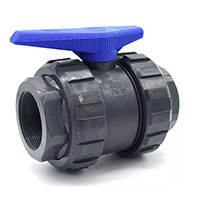
The valve is the shut-off device built into the tank. It is generally already there on delivery, mounted directly at the tank outlet : it is what opens or closes the flow of water from inside the container. If your tank no longer has a working valve — because it has been damaged, is leaking from the body, or no longer turns — then it is an S60x6 valve you need to replace, not just a tap. Multitanks offers S60x6 valves suited to this replacement.
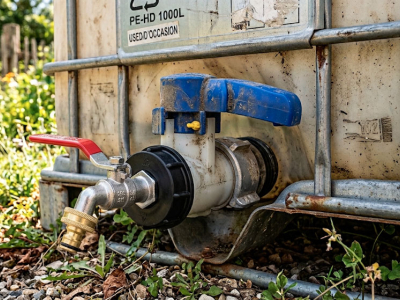
The tap, on the other hand, is the spout added downstream of that valve to draw water easily day to day. It is typically a garden-tap type spout, letting you connect a hose or fill a watering can without operating the main valve each time. If your valve works but you simply want to add a convenient draw-off point, a tap is what you need — not a complete valve. Browse the S60x6 taps and fittings available at Multitanks to complete your installation.
The fitting, finally, is the generic term covering any connecting part between two elements : adaptor, reducer, threaded spout. It is the word most people use by default, even when they are actually looking for a specific tap or valve. One tank can therefore take, in sequence : the original valve, then a transition fitting if needed, then the final tap for everyday use.
| Part | Role | Typical location |
|---|---|---|
| Valve | Opens / closes the flow of water from the tank | Native tank outlet (often already fitted) |
| Tap | Lets you draw water easily (hose, watering can) | Downstream of the valve, at the point of use |
| Fitting | Connects two parts together | Between the tank, the valve, the tap or a hose |
💧 Brass or polypropylene: choosing the right material
Once you know which part you are looking for, the choice of material is the second decision to make. Two options dominate the S60x6 tap market, each with its advantages depending on the intended use.
The brass tap is the preferred choice for regular, intensive use. Its mechanical strength lets it withstand frequent handling and pressure variations without deforming. It is particularly suited to permanently installed set-ups, to tanks used in farming or trade production, and to any context where the long service life of the part matters more than its initial cost.
The polypropylene tap is light, inexpensive and offers excellent chemical resistance, which makes it a sound alternative for tanks holding liquids other than clean water — liquid fertilisers, diluted plant-protection products, or any fluid liable to attack metals. It is also valued for temporary or seasonal installations, where ease of replacement counts as much as durability.
💧 The outlet thread: do not guess, measure
Beyond the S60x6 on the tank side, the tap itself often connects to a more conventional outlet thread, expressed as a BSP size. Sizes such as 1/2" or 3/4" correspond to the gas threads commonly used in plumbing — and that is where many people get lost, because these designations are not intuitive for anyone outside the trade.
It is tempting to guess the thread by eye, or to rely on the apparent size of the part. Yet that is the most frequent cause of ordering errors on this type of fitting : two threads can look identical and still be incompatible. The most reliable habit is to measure the existing part rather than guess. For this, Multitanks provides a thread calculator that lets you identify your thread precisely from your measurements, with no prior technical knowledge needed. If you do not know your thread, start there before ordering anything.
💧 Step-by-step fitting: installing your tap without mistakes
Fitting a tap to an IBC tank is a manageable job, provided you follow the steps in order and do not neglect the sealing. Here is the procedure, from the initial check through to the final test.
💡 Multitanks expert tip — Check before you order. The most frequent cause of ordering errors on IBC tank taps and fittings is having estimated the thread by eye instead of measuring it. Before placing your order, take two minutes to identify the part in place precisely — either by measuring it with a vernier caliper, or by using the thread calculator available on the site. This simple check saves you a parcel round trip and makes sure you receive exactly the right part first time. For accessories specific to IBC tanks, see also the fittings, valves and accessories for 1,000-litre IBC tanks category at Multitanks.
💧 Completing your installation: the accessories to plan for
Once the tap is in place, it is worth considering the additional accessories that will make your installation genuinely practical day to day. A transition fitting may prove necessary if the outlet thread of your tap does not directly match the diameter of your garden hose. Likewise, if your tank is used for garden watering, plan for a quick coupling or a suitable hose connector to make frequent connecting and disconnecting easier.
For more elaborate set-ups — particularly as part of laying out a gardening area or a rainwater storage zone — the essential thing is to plan the whole connection chain before ordering the first part, to avoid incompatibilities during assembly.
Finally, think about the cap : it is the part everyone forgets, and yet the S60x6 outlet of an IBC tank should never be left open to the air. An S60x6 female cap screwed straight onto the neck protects the thread from dust and knocks through the winter, and a male cap on your tap's thread prevents dripping when the hose is disconnected. The two common sizes are 3/4" and 1" : our guide to S60x6 female caps sets out which one matches your installation.
- Identifying the thread on your 1,000 L IBC tank — how to measure, before buying anything.
- Choosing your IBC tank valve — if it is the complete valve, and not the tap, that needs replacing.
- S60x6 female caps: 3/4" or 1" ? — the complete guide to both sizes.
Share this content