IBC 1000 L accessories
 Heating jackets

 Fittings
 Drums, jerrycans & fittings
 Seeds
 Plant protection & biocides

 Garden
 Green spaces & municipal
 Barbecue, fire pit & fireplace
 Cleaning & care
 Refrigerants & air conditioning
 Watering

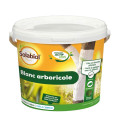
Solabiol Tree Whitening: Protecting Your Fruit Trees in 2026
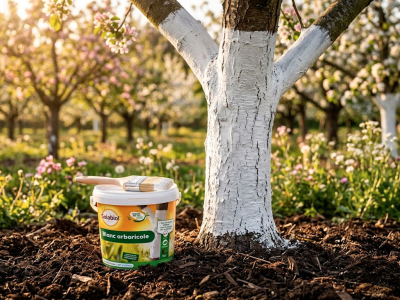
The orchard is an investment of patience and care. Whether it's an old apple tree inherited from your grandparents or a young cherry tree planted last year, the trunk is the most vulnerable part of the tree. It's through this that nutrients pass, but it's also where pests hide and where dreaded cankers establish themselves. In 2026, facing unstable winters and increasingly early springs, trunk whitening becomes an essential protective barrier. The Solabiol Tree Whitening 3L is not just simple paint: it's an antiseptic and physical treatment that acts like a second skin for the bark. Discover why this ancestral practice returns to the heart of modern ecological concerns.
THE CHEMICAL AND PHYSICAL ACTION OF TREE WHITENING
Tree whitening, often called "lime milk", relies on a very specific mineral formulation. Its composition based on aerial lime has an extremely high pH ($pH \approx 12.5$). This alkalinity is fatal for most pathogenic microorganisms. By applying this product, you perform a natural "chemical" cleaning of the trunk: it destroys the spores of fungi responsible for scab, powdery mildew and especially canker, this wood disease that can condemn a tree in two seasons.
Beyond the sanitary aspect, it's a thermal shield. The white color reflects solar albedo. During sunny days in March, the dark bark of trees can heat up more than 15°C compared to ambient air. When night falls and frost returns, thermal shock causes insolation cracks. The white maintains the wood at a stable temperature, avoiding these gaping wounds that serve as entry points for pests. It's one of the most effective alternative methods to reduce the use of chemical fungicides in the orchard.
THE 3 MISSIONS OF SOLABIOL WHITE FOR YOUR FRUIT TREES
It suffocates aphid larvae and codling moths that overwinter under bark scales, drastically reducing spring attacks.
By limiting day/night temperature variations on the trunk, it prevents bark from cracking under the effect of spring frost.
Moss sanitation: Mosses and lichens are not direct parasites, but they constitute real moisture sponges where bacteria proliferate. The application of Solabiol white naturally detaches these unwanted vegetation, leaving the trunk to breathe and stay dry, even during the rainy springs of 2026.
HOW TO APPLY TREE WHITENING LIKE A PRO?
For the Solabiol Tree Whitening to adhere perfectly, surface preparation is key. You wouldn't paint a dirty wall; the same goes for your cherry or apple tree. Here's the technical procedure to follow this March:
STRENGTHENING TREE HEALTH THROUGH SOIL
Whitening is an external treatment, but the tree's vigor depends on its internal energy. A tree with a protected trunk tires less from healing, but it needs nutrients to produce its flowers and fruits. We advise you to take advantage of this intervention to enrich the soil at the base of your fruit trees.
Spread a 5cm layer of Or Brun universal potting soil on the circle corresponding to the crown projection of the tree. This potting soil will provide the microorganisms necessary for soil life. Finally, don't forget that fruit trees are heavy water consumers during fruit set (fruit formation). Installing micro-irrigation at the base of protected trees will guarantee optimal fruit size and avoid water stress that weakens the bark.
Did you know? Solabiol tree whitening is ready to use. Its creamy texture allows easy application without the risks associated with handling raw quicklime. A 3L bucket can protect approximately 10 to 15 young trees or 5 adult trees with large trunks.
CONCLUSION
Protecting your fruit trees with Solabiol Tree Whitening is a visionary gardening act. In 2026, with increasing climate hazards, returning to this physical barrier is an agronomic evidence. Simple to apply, economical and 100% natural, whitening offers your orchard a visible health treatment. Don't let pests and thermal shocks dictate the life of your trees: act now to enjoy healthy fruits throughout the year. At Multitanks, we commit to providing you with the best solutions for gardening that respects living beings while ensuring your success.
Does your fruit tree need immediate protection?
1. Does the bark show cracks or crevices?
2. Is the trunk covered with moss or lichen?
Share this content