



 IBC 1000 L accessories
 Heating jackets
 Fittings
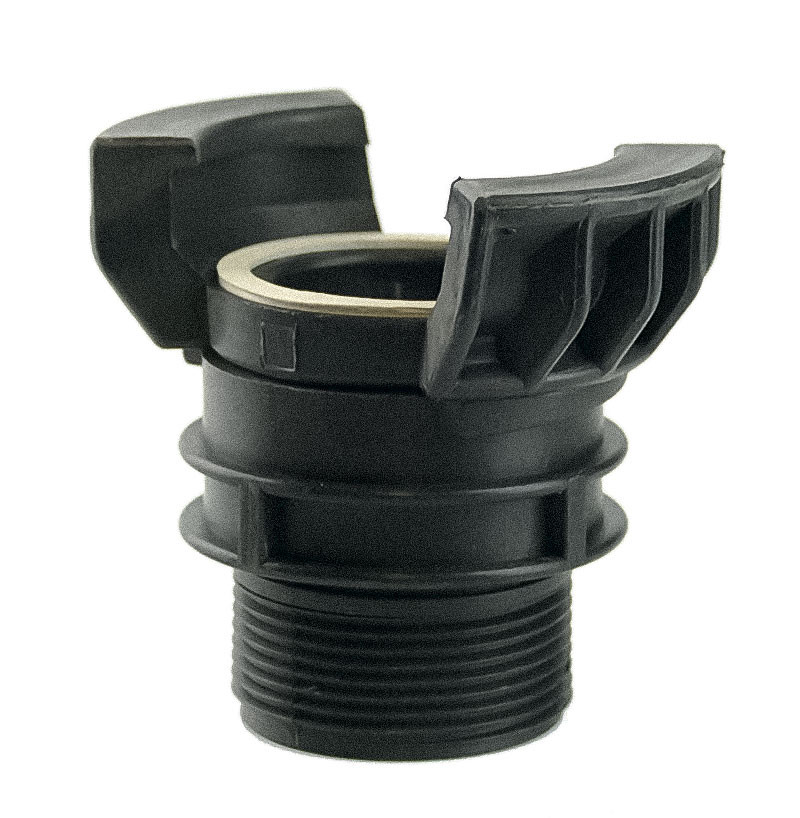
 Drums, jerrycans & fittings
 Seeds






 Plant protection & biocides




 Garden






 Green spaces & municipal

 Barbecue, fire pit & fireplace

 Cleaning & care


 Refrigerants & air conditioning

 Watering
Thread Fittings Guide: No More Confusion Between BSP, NPT and Gas
Our tool finds the fitting that goes with it — IBC tank, plumbing, garden — in 3 clicks, with live prices and stock.
The nightmare of threads: Understanding industrial logic
If there is one area that generates frustration among DIY enthusiasts as well as pool and irrigation professionals, it is that of threads. You have measured your fitting with a ruler, you have ordered a 25mm part, and when it arrives, nothing fits. This scenario is the daily reality of many customers. The reason is simple: in the world of plumbing and industry, nominal dimensions almost never correspond to the actual physical measurements taken with calipers.
This confusion comes from a deep historical legacy. Originally, in the 19th century, pipe dimensions referred to the useful internal diameter of the steel tube. With the evolution of manufacturing techniques, wall thickness decreased for the same strength, but commercial names remained fixed. Confusing BSP, NPT or Gas standards is not just a logistical error that delays your construction site; it is also a major technical risk to the integrity of your system.
To avoid these disappointments, it is essential to equip yourself with certified PN16 PVC threaded fittings, guaranteeing compatibility with European standards. Attempting to force an American thread onto a European fitting will irreparably destroy the threads of the PVC or polyethylene plastic, as the thread angles and pitches differ in minute but critical ways.
The BSP and Gas standard: The European norm explained
In France and Europe, the dominant standard is BSP (British Standard Pipe), also called Gas Thread. Despite its name, it is used universally for water, air and oil. What you need to remember is that the Gas thread comes in two fundamental variants: BSPP (Parallel) and BSPT (Tapered). In the majority of your residential pool installations, you will encounter BSPP. The threads are straight and sealing is generally done by a flat gasket or an O-ring compressed at the bottom of the fitting.
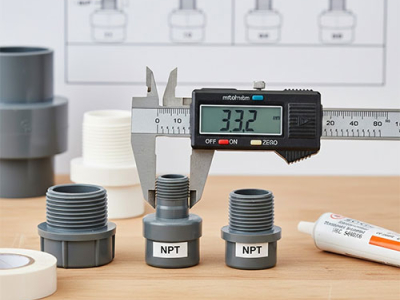
The classic trap lies in the inch designation. For example, a so-called 1 inch (1") fitting does not measure exactly 25.4 mm in external diameter. In reality, a 1" BSP male thread measures approximately 33.2 mm. This difference is explained because the 1" corresponds to the theoretical internal diameter of the pipe of that era. To avoid mistakes, you must forget your intuitive measuring reflexes and refer to a strict correspondence table before choosing your PVC valves for solvent welding and threading.
| Name (Inches) | Common designation (mm) | Male External Ø (Measured) | Female Internal Ø (Measured) |
|---|---|---|---|
| 1/4" | 8 x 13 | ~ 13.1 mm | ~ 11.4 mm |
| 3/8" | 12 x 17 | ~ 16.6 mm | ~ 14.9 mm |
| 1/2" | 15 x 21 | ~ 20.9 mm | ~ 18.6 mm |
| 3/4" | 20 x 27 | ~ 26.4 mm | ~ 24.1 mm |
| 1" | 26 x 34 | ~ 33.2 mm | ~ 30.3 mm |
| 1" 1/4 | 33 x 42 | ~ 41.9 mm | ~ 39.0 mm |
| 1" 1/2 | 40 x 49 | ~ 47.8 mm | ~ 44.8 mm |
| 2" | 50 x 60 | ~ 59.6 mm | ~ 56.6 mm |
Thread anatomy: Parallel vs Tapered pitch
This is where the most complex subtlety lies for a non-initiate. A parallel thread (like BSPP) has a constant diameter along its entire length. If you measure the beginning and end of the thread with your calipers, you will get exactly the same value. In this system, the threads only serve to mechanically hold the two parts together under pressure. Sealing does not occur in the thread itself, but by crushing a flat gasket between the base of the male thread and the bottom of the female fitting.
Conversely, a tapered thread (BSPT or NPT) sees its diameter gradually increase towards the base. It resembles an extremely elongated cone. Here, the sealing is said to be in the thread. When screwing, the male and female threads end up jamming into each other by mechanical interference, creating a tight physical barrier. To perfect this union, the use of Teflon tape or hemp is mandatory. A tapered pitch is recognized visually: if you place a ruler on the side of the thread, you will observe a slight angle. A tapered fitting never screws all the way in; it locks by the force of the slope.
The NPT standard: The intruder from America
NPT (National Pipe Thread) is the North American standard. Unlike the European BSPP which is straight, NPT is always tapered. The fatal error is thinking that a 1/2" NPT thread and a 1/2" Gas thread are compatible because their diameters seem close. Yet, the thread pitch (the number of threads per linear inch) is different, as is the thread angle: 60° for NPT versus 55° for BSP.
This 5-degree difference, although invisible to the naked eye, prevents the thread crests from fitting together. If you force an NPT fitting into a Gas fitting, you will create internal tensions in the PVC polymer. Under the effect of pump pressure or temperature variations, the female fitting will eventually split longitudinally. Always check the nameplate of your imported equipment (American brand pumps in particular) before ordering.
The specific case of the IBC tank (S60X6)
For rainwater collection, 1000-liter tanks use a totally different standard. The outlet thread of the valve is S60X6. This code means an external diameter of 60 mm with a huge pitch of 6 mm between each thread. This is an artillery type thread, extremely robust to support the weight of water.
Trying to screw a standard 2" plumbing fitting (which also measures about 60 mm) onto an IBC tank is mistake number 1. Although the diameter is close, the Gas thread pitch is much too fine. You will irreversibly destroy the threads of your IBC valve. For these installations, use exclusively suitable S60X6 fittings.
Mastering sealing: Teflon, Gasket or Glue?
On BSPP plastic threads, sealing should never rely on brute force. If you use Teflon tape, limit yourself to a maximum of 5 or 6 turns. PVC is a material that undergoes the phenomenon of creep: too strong and permanent tension will eventually deform the part. For optimal safety, favor solutions from our sealing range, such as EPDM gaskets or anaerobic adhesives for plastics.
The infallible Multitanks measurement method
To never make a mistake again, follow this rigorous protocol:
1. Measure with calipers: Take the measurement on the thread crest (external diameter for a male).
2. Identify the profile: Straight or tapered? If the measurement varies between the beginning and the end, it's tapered.
3. Check the pitch: Count the number of threads over 1 cm. Gas is fine, S60X6 is very wide.
4. Use the table: Don't try to round off. A measurement of 33.2 mm is a 1 inch, period.
By mastering these technical basics, you guarantee the durability of your installation. A correct thread is the assurance of easy maintenance, winterization without leaks and a professional system. If any doubt persists, our technical team is at your disposal to analyze your photos and measurements.
Selection aid tool: Which fitting to order?
Enter the measurement you took with your calipers (in mm) to find the standard correspondence.
Share this content