IBC 1000 L accessories
 Heating jackets
 Fittings
 Drums, jerrycans & fittings
 Seeds

 Plant protection & biocides


 Garden

 Green spaces & municipal
 Barbecue, fire pit & fireplace
 Cleaning & care
 Refrigerants & air conditioning

 Watering
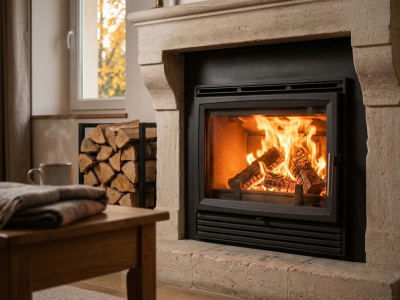
Chimney Sweep Log: What It Does and What It Doesn't
The first chilly days of mid-October make you want to light the first fire of the season. Before you strike the match, though, spare a thought for the flue: it has sat unused all summer, with last winter's soot and tar still stuck to its walls. The chimney sweep log promises to bring them down in a single burn. It keeps part of that promise, not all of it. Here is what it really does, what it does not replace, and how to keep a stove insert glass clean all winter.
🔥 WHAT BUILDS UP IN A CHIMNEY FLUE
Wood never burns completely. Part of what goes up in the smoke settles on the walls of the flue: a dry, crumbly soot when the fire burns hot, and a black, sticky tar, creosote, when the fire smoulders or the wood is damp. Layer after layer, these deposits narrow the passage for the smoke and the draught weakens.
The real danger lies elsewhere: soot and tar burn. A fire hotter than usual, a flame that reaches up into the flue, and it is these deposits that catch light. That is a chimney fire, the very thing sweeping is there to prevent.
A few signs are unmistakable: a smell of soot that lingers in the room, flakes of soot falling into the hearth, a fire that is hard to get going or draws less well than before. They all say the same thing: the flue needs looking after.
⚖️ SWEEPING IS STILL A LEGAL REQUIREMENT
Since the French decree of 20 July 2023, the national rule is clear: flues and their connecting pipes must be swept at least once every twelve months. Prefectoral or municipal orders can require more, and many départements' health regulations call for two sweeps a year. Your town hall can tell you what applies where you live.
For wood, an order issued the same day recommends two sweeps a year, one of them during the heating season, as soon as you burn more than 6 stacked cubic metres of logs or 2.5 tonnes of pellets a year. It also advises sweeping before any long period without use.
Sweeping is carried out by a qualified professional, who gives you a certificate within fifteen working days. In a single-occupancy home, it is up to the occupant to have it done, tenants included, unless the lease says otherwise. Keep this certificate: if there is a fire, it is what your insurer will ask you for.
This is where the chimney sweep log reaches its limit. Some, like the Diablotin log, come with a document intended for your insurance. It is a commercial guarantee from the manufacturer: it binds the manufacturer, on its own terms, but it does not bind your home insurer. It replaces neither the compulsory sweep nor the sweep's certificate. Read its terms and file it with the certificate: the log is burnt in addition to the chimney sweep, never instead of one.
🪵 WHAT A CHIMNEY SWEEP LOG REALLY DOES
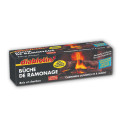
A chimney sweep log looks like an ordinary compressed log. It is made of sawdust mixed with oxidising and catalytic active ingredients. As it burns, it releases these agents into the flue. They dry out the soot and tar stuck to the walls, make them brittle and gradually turn them into a fine dust, which falls away or which the sweep removes with ease.
Its strength is that it works wherever the smoke goes, including the bends and upper sections of the flue that a brush struggles to reach. Its effect does not stop with the flame: it carries on for around a fortnight. The Diablotin chimney sweep log is suitable for open fireplaces, inserts, wood and pellet stoves, and wood or coal boilers.
Burnt eight to fifteen days before the visit, the log loosens the deposits. The mechanical sweep that follows is all the more effective for it.
With a fire lit every day, one log every two months of the heating season keeps the flue in good order between two sweeps.
Smell of soot, soot dropping into the hearth, a weakening draught: burn one, then have the sweep come round.
So remember the two roles: the log prepares and maintains, the sweep cleans and certifies. One without the other leaves a flue only half looked after.
📋 HOW TO USE IT: BURNING YOUR CHIMNEY SWEEP LOG
The job takes one evening and makes use of an ordinary fire. The log's agents only work properly in a flue that is already hot: so it is never placed in a cold hearth.
An old or heavily clogged installation needs a more thorough treatment: two logs fifteen days apart for the first treatment, before the sweep's visit. The kit of 3 chimney sweep logs with 24 firelighter cubes covers this first treatment and the next log. For a flue that is already well maintained, one log is enough.
| Situation | How many logs | When |
|---|---|---|
| Fire every day | One every two months | Throughout the heating season |
| Occasional fire | Two to four a year | Depending on use, including one before the sweep |
| Old or clogged flue | Two, fifteen days apart | For the first treatment |
| Before sweeping | One | Eight to fifteen days before the visit |
🪟 A CLEAN STOVE INSERT GLASS WITHOUT SCRUBBING
On an insert or a stove, soot does not only settle in the flue: it also clouds the glass. A light grey haze after a long burn is nothing to worry about. Glass that turns black in a single evening, on the other hand, points to damp wood or a fire starved of air, and it is the same deposit that clogs the flue.
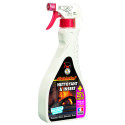
To clean it, forget scouring pads and steel wool, which scratch the glass. The Diablotin insert cleaner is a soda-based foam that dissolves greasy soot and tar without scrubbing. It also works on glass oven doors and boiler windows.
🌲 DRY WOOD, THE FIRST MAINTENANCE PRODUCT
No chimney sweep log can make up for badly chosen wood. Damp wood burns poorly, gives off little heat and produces smoke laden with tar: it is what creates creosote in the flue and the black haze on the glass. Burn dry wood, with a moisture content below 20 %, well split, and stored out of the rain but in the open air.
Also steer clear of anything that is not firewood: painted or treated pallet wood, printed cardboard, rubbish. They clog the flue just as they do the glass.
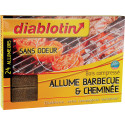
To light a fire without newspaper, compressed wood firelighters soaked in paraffin wax get the fire going cleanly and without smell. You will find the whole range in our barbecue, braziers and fireplaces section.
Multitanks Expert Tip
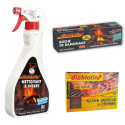
Make the most of mid-October to set your schedule. Burn a chimney sweep log during one of the first fires, book the sweep within the following fortnight, and file the certificate with your insurance papers. Our complete Diablotin package brings together the chimney sweep log, the insert cleaner and the firelighters for the season.
🗓️ Your chimney maintenance schedule
How many chimney sweep logs to burn this season, and when to book the sweep
Share this content