IBC 1000 L accessories
 Heating jackets
 Fittings
 Drums, jerrycans & fittings
 Seeds





 Plant protection & biocides


 Garden





 Green spaces & municipal

 Barbecue, fire pit & fireplace


 Cleaning & care

 Refrigerants & air conditioning
 Watering
How to successfully bond PVC PN16 without leakage? The Complete Guide
Complete guide: How to successfully bond PVC PN16 without leakage?
In the world of high-pressure plumbing, bonding is not just adhesion: it is a cold chemical weld. For a swimming pool technical room, an irrigation network or an industrial installation, the reliability of the circuit depends entirely on the quality of this junction.
However, many leaks occur not because of the equipment, but because of poor preparation. Whether you are a professional looking to optimize your sites or a demanding individual, here is the rigorous method to guarantee a perfect seal under 16 bars of pressure.
1. Understanding chemistry: Why do we talk about welding?
Unlike a conventional adhesive that remains on the surface, PVC pressure adhesive contains solvents that soften the surface layer of the pipe and fitting. As they evaporate, the two pieces merge to form a single block of material.
Careful: Never use PVC drain glue (classic grey tube) over PVC pressure (PN16). The mechanical stresses are radically different and you risk the fitting bursting.
2. The 5 crucial steps for a professional collage
Step 1: Cutting and deburring (The Forgotten Step)
A straight cut is the basis. Use a pipe cutter or fine-toothed saw with a miter box.
The pro's secret: Make a chamfer (a bevel) at the end of the tube. If the edge remains sharp, it will "scrape" the glue at the bottom of the fitting during the interlocking, creating an internal bead and an area of weakness on the wall.
Step 2: Stripping (The role of PVC stripper)
This is the most important step. PVC stripper is not only used to clean dust. Its chemical role is to "prepare" the surface by opening the pores of the PVC-U.
Run a clean cloth soaked in stripper over the tube and inside the fitting. The surface should become matte. If it remains shiny, the glue will not adhere deeply.
Step 3: Strategic Bonding
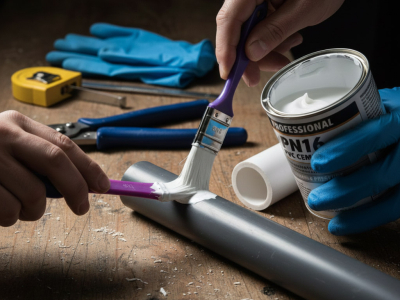
Apply the glue longitudinally (from the edge inwards).
The golden rule: Apply a thin layer to the inside of the fitting and a more generous layer to the tube. What for? Because when interlocking, the excess glue on the tube will be pushed outwards (creating a visible seal), while the excess in the fitting will be pushed inwards, risking clogging the duct.
Step 4: Quick interlocking
Snap the two pieces together in a firm, straight motion.
Mistake to avoid: Never turn the pieces on top of each other while nesting. Turning breaks the molecular chains of the glue in the process of setting and creates micro-channels, sources of future leaks.
Step 5: Drying time (Patience pays off)
Wipe off the excess glue on the outside with a cloth.
Meet deadlines: For PN16 pressure, wait at least 24 hours before full pressure. Premature refilling is the No. 1 cause of damage to new installations.
3. The essential tools of the gluing kit
For clean work, your toolbox should contain:
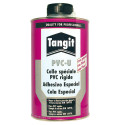
A certified PVC pressure adhesive (with integrated brush for large diameters).
A professional PVC stripper.
A deburr or a soft file.
Clean, lint-free cloths.
4. Classic mistakes that cost a lot
Working in rainy or high humidity weather: Water is the enemy of PVC glue. It instantly stops the chemical reaction.
Using too much glue: Excess glue inside can structurally soften the tube and cause pressure breakage.
Neglecting stripping: Without a stripper, the glue is just a surface film that will eventually peel off with the vibrations of the pump.
Conclusion: Safety first
A successful bonding is a guarantee of peace of mind for decades. By strictly adhering to the Cut/Deburr/Strip/Glue protocol, you transform your fittings into a monolithic structure that can defy time and pressure.
At Multitankswe don't just supply the tubes and fittings, we offer you the consumables (glues and strippers) tested and approved for the most demanding installations.
This advice is given as an indication according to the rules of the art. Always follow the specific instructions for use of adhesive and fitting manufacturers
Share this content