IBC 1000 L accessories
 Heating jackets
 Fittings
 Drums, jerrycans & fittings
 Seeds

 Plant protection & biocides


 Garden



 Green spaces & municipal



 Barbecue, fire pit & fireplace

 Cleaning & care

 Refrigerants & air conditioning

 Watering


Biochar: The Natural Solution Against Garden Drought
Biochar: Your natural shield against drought and water restrictions
Every year, the scenario repeats and intensifies: as soon as the first heat waves arrive, groundwater levels show alarming levels, and prefectures trigger water restriction orders. For gardeners, market gardeners, or landscapers, it's heartbreaking to see their plantings wither under the sun, unable to water them sufficiently. Faced with this new climate reality, it's no longer enough to water "better" - you must change the soil's capacity to conserve this precious resource. This is where biochar comes in, an ancestral technology brought up to date to become the ultimate shield for your soils.
Biochar is not a fertilizer; it's a radical soil conditioner. Its primary mission in a water stress context is to transform your soil into a true sponge capable of storing rainwater or irrigation water and releasing it drop by drop during heatwave periods. By investing in high-quality biochar, you're not just feeding your plants - you're permanently modifying your soil's architecture to make it autonomous and resistant.
The sponge physics: How does biochar store water?
To understand biochar's effectiveness against drought, you need to dive into its microscopic structure. During the pyrolysis process, organic matter is stripped of its gases and moisture, leaving behind an incredibly porous pure carbon skeleton. A single gram of biochar can have a specific surface area of several hundred square meters. Imagine millions of micro-cavities acting as miniature reservoirs.
When you water or it rains, these pores fill by capillarity. In conventional soil, especially sandy soil, water quickly infiltrates to the depths, out of reach of roots. With biochar, this water is literally trapped and maintained in the root zone. Plants can then draw from these reserves according to their needs, drastically reducing losses through evaporation and leaching. It's the essential complement to smart management via an above-ground water storage tank: the water you collect is finally used 100% by your plants, without waste.
Comparison: Water retention and soil behavior
Biochar's impact is particularly spectacular on so-called "difficult" soils. Whether you have soil that's too light and retains nothing or soil that's too heavy and suffocates roots, biochar rebalances the water balance. Here's a comparative table to visualize the performance gain according to substrate:
| Soil Type | Without Biochar (Behavior) | With Biochar (Impact) | Water Retention Gain |
|---|---|---|---|
| Sandy Soil | Too rapid drainage, immediate water stress. | Water fixation at surface, useful storage. | + 40% to 60% |
| Clay Soil | Compaction, stagnation then cracks in summer. | Pore aeration, better infiltration. | + 15% to 25% |
| Potting Soil / Containers | Rapid drying of clumps in full sun. | Buffer effect, maintaining stable humidity. | + 30% |
Reducing watering frequency: Time and money savings
Using biochar also means rethinking your garden organization. By increasing your soil's Water Holding Capacity (WHC), you can space out your watering sessions. Where a conventional vegetable garden requires daily watering during intense heat, soil enriched with biochar can last 48 to 72 hours without signs of wilting.
This autonomy is crucial because it allows you to effectively combine soil amendment with reasoned watering systems. By installing an automatic or drip irrigation kit, you deliver water precisely where biochar expects it. This synergy between surface technology and deep amendment is the only sustainable response to maintain vegetable production or a lush ornamental garden despite prefectural restrictions. Less water used also means reduced bills and environmental resource preservation.
Mycorrhizal biochar: Extending the root network
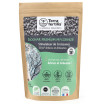
At Multitanks, we particularly recommend versions enriched with mycorrhizae. Why? Because while biochar stores water, mycorrhizae (symbiotic fungi) are responsible for bringing it to the roots. These fungi create a network of filaments (mycelium) that extends far beyond the natural reach of plant roots.
During drought periods, mycorrhizae will draw water from the finest pores of biochar, where roots alone could never access. This alliance creates an ultra-resistant plant, capable of surviving intense water stress episodes. It's life insurance for your plantings. If you're preparing your containers or planters, don't hesitate to mix your biochar with quality potting soil to create an environment conducive to this symbiosis from the start.
The importance of mulching as biochar complement
For your anti-drought shield to be complete, biochar must be combined with surface protection. While biochar retains water in the soil, mulching prevents the sun from "stealing" it through direct evaporation. This "water sandwich" technique is formidable: biochar stores below, mulch protects above.
By keeping the soil shaded and cool, you also favor the microbial life that has colonized your biochar. Soil that stays moist is soil that stays alive. Without this residual moisture, microorganisms go dormant and fertility drops. Biochar ensures this water continuity necessary for soil biology, even when the sky remains desperately blue for weeks.
Investing in biochar: A profitable long-term choice
Unlike chemical fertilizers or even compost that disappear after one season, biochar is eternal on a human lifetime scale. Once incorporated into your soil, it doesn't decompose. Its water retention and microbial support action lasts for decades. It's a one-time investment that continues to pay dividends every summer in the form of water savings and vigorous plants.
In a world where water is becoming a rare and expensive commodity, adapting your soil is the only viable strategy. Biochar is no longer a luxury for permaculture enthusiasts; it's an essential technical management tool for anyone who wants to maintain green space, a vegetable garden, or agricultural operation in the years to come. By modifying your soil's physical structure, you regain control over climate and guarantee the survival of your ecosystems.
Simulator: Estimate your water savings with Biochar
Discover how many liters of water you could preserve in your soil this season.
Share this content