IBC 1000 L accessories
 Heating jackets
 Fittings
 Drums, jerrycans & fittings
 Seeds

 Plant protection & biocides
 Garden
 Green spaces & municipal
 Barbecue, fire pit & fireplace
 Cleaning & care
 Refrigerants & air conditioning
 Watering
Pantry moths or clothes moths: how to get rid of moths
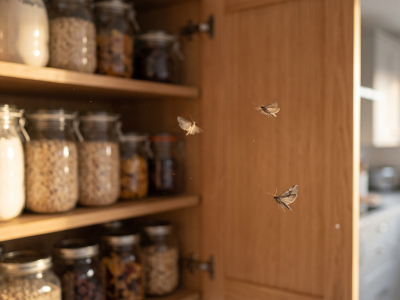
Beige moths fluttering around the cereal cupboard in the evening, or small, neat holes that have appeared on a jumper stored away since winter: both get called "moths", and yet they are neither the same insect nor the same treatment. Getting it wrong wastes time and lets the damage take hold: you end up scenting the wardrobe when the infestation started in a bag of flour. Our flying insect control range draws a clear line between the two families; this guide helps you work out which one you are dealing with, and what to do next.
🔍 Pantry moths or clothes moths?
Pantry moths, also called food moths, attack stored dry goods, while clothes moths go for the natural fibres of your clothing: these are two distinct groups of moth, which do not live in the same room and are not fought with the same product. So the first useful reflex is not to buy a moth killer, but to look at where the problem is: kitchen and larder on one side, wardrobe and dressing room on the other.
The confusion comes from how alike the adults look. In both cases you see a small, inconspicuous moth, dull in colour, a poor flier that readily settles on a wall or a ceiling. But the adult eats nothing: it breeds. It is the larvae that cause the damage, and they stay hidden inside what they are eating — a bag of dried fruit, the fold of a coat. That is why a treatment that merely drives off the visible adults lets the infestation start up again a few weeks later.
These are the Indian meal moth and the flour and cocoa moths. They colonise kitchen cupboards and storage areas: flour, cereals, dried fruit, chocolate, spices. They prefer dark, poorly ventilated places, which is exactly what a closed cupboard is. A product used there has to be compatible with the presence of food.
This is the common clothes moth, Tineola bisselliella, which attacks natural fibres: wool, silk, cotton and blends. It targets the items left hanging for a long time without being worn — jumpers, coats, suits, winter clothes put aside for the warmer months. Here the product works by repelling, so that the female does not come to lay her eggs.
⚠️ The signs that give it away
Before treating, you need to confirm the species, and that can be done with the naked eye in a few minutes. The clues are not the same from one insect to the other, and they also tell you what stage you are at: a few stray adults, or an established population.
A word on names, because they regularly lead people astray. The word "moth" also covers a garden pest that has nothing to do with your cupboards: the box tree moth, which eats away at hedges and is treated with Bacillus thuringiensis. If your box leaves are being stripped, you do not have a pantry moth problem, and no cupboard trap will help you.
🪤 Pantry moths: detect first, catch second
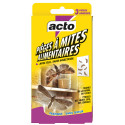
In a kitchen, constraint number one is the presence of food, which rules out any treatment that releases an active substance above the food itself. That is precisely the role of the ACTO pantry moth traps: they catch the adults on an adhesive surface, with no smell and no insecticide, which makes them usable around food without interfering with its aromas. They target the Indian meal moth and the flour and cocoa moths.
Their first benefit is in fact detection. A trap placed in a cupboard tells you within a few days whether you have a real problem or just a passing moth, and it then goes on catching the adults, which breaks the breeding cycle. That double action is what prevents reinfestation: as long as females are laying, replacing the food only feeds the next generation.
When positioning them, aim for the at-risk areas rather than the middle of the room: the flour cupboard, the cereal boxes, the dried fruit or spice store, favouring dark, poorly ventilated places. Allow one trap every two to three linear metres of shelving, or one per affected cupboard, and increase the density temporarily where an infestation is confirmed. Replace the trap as soon as it is saturated with catches.
The trap does not do away with the cleaning, it completes it. From the very first catch, check all your stores, isolate and throw away the contaminated packets, clean containers and shelves thoroughly, then restock in airtight boxes with regular rotation. It is that combination that settles the problem, not the trap on its own.
👔 Clothes moths: a scent barrier in the wardrobe
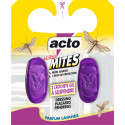
Against clothes moths, the aim is not to catch the adults but to deter the female from coming to lay in the fibres. The ACTO Special Clothes Moths gel hooks work on that principle. Each hook contains a gel based on lavandin essential oil, Lavandula x intermedia, released gradually to create a repellent barrier — with, along the way, a smell that most people find pleasant in a cupboard.
The pack contains six hooks, each covering a volume of around half a cubic metre, which is one standard wardrobe section. Allow one hook per section of about eighty centimetres wide, and in a large dressing room spread them out, leaving sixty to eighty centimetres between units. The stated effectiveness is three months per hook, the intensity of the smell fading gradually without the repellent properties disappearing with it.
Fitting them takes three steps. You detach the hooks along the pre-cut lines, remove the protective aluminium film just before use, and hang the hook on the rail, in a central position so that the molecules can circulate. Avoid direct contact with delicate items and go for a high position. Two conditions to keep an eye on: a temperature between fifteen and twenty-five degrees is optimal, and humidity above seventy per cent degrades the gel while also favouring the pests. A dressing room set up in a damp cellar will therefore need work on the ventilation first.
🧹 How to get rid of moths, room by room
Treating a moth infestation always follows the same order: confirm the species, remove the source, clean, fit the right solution, then keep it up. The most common mistake is to start with the product: putting a trap or a hook on an established infestation, without having removed the source, only slows the process down. The table below sets the two situations side by side, step by step.
| Step | Pantry moths | Clothes moths |
|---|---|---|
| Confirm | Silky threads or grains stuck together in a dry packet | Clustered holes in wool, silky cases on the fabric |
| Remove the source | Throw away the contaminated packets, check the whole store | Take out and wash or dry-clean the affected items |
| Clean | Containers, shelves, cupboard grooves and seals | Vacuum the wardrobe, the skirting boards and the corners |
| Fit | One glue trap per cupboard, or every two to three metres of shelving | One hook per wardrobe section of about eighty centimetres |
| Keep it up | Replace the trap as soon as it is saturated, store in airtight boxes | Check the gel level every month, renew every three months |
That leaves the case of widespread infestations, when the moths are moving through several rooms and treating the source is no longer enough. An all-purpose insecticide fogger then treats the volume of a whole room, moths included. Two essential precautions: this type of product is never used where food is present, which must be taken out or hermetically sealed, and it does not replace the glue trap in a kitchen cupboard, where the absence of insecticide is precisely the point of the solution. Follow the manufacturer's instructions, in particular the guidance on ventilation and on going back into the room.
📅 The protection calendar
Pantry moths and clothes moths do not follow the same calendar, and that changes when you need to act. On the food side, activity is at its highest in warm weather, in spring and summer: that is when it is better to put the traps in place before you see the first moths rather than after. On the textile side, the two critical moments are early autumn and late winter, which is precisely when one seasonal wardrobe is put away and another comes out.
This calendar has one simple practical consequence: the hooks go in before the clothes are put away, not after. A wardrobe in which the protection is fitted two weeks before the woollens are shut in for six months is in a far better position than a wardrobe treated the following spring, when the damage is done.
💡 Multitanks expert tip
Never treat a wardrobe and a kitchen with the same product. The insecticide-free glue trap is made to live alongside food and acts as your indicator: if it fills up, you still have an untreated source somewhere. The lavandin hook, on the other hand, catches nothing and will therefore never tell you where you stand — it is preventive protection, to be renewed on a calendar rather than when the symptoms show up.
Share this content