IBC 1000 L accessories
 Heating jackets
 Fittings
 Drums, jerrycans & fittings
 Seeds

 Plant protection & biocides


 Garden
 Green spaces & municipal
 Barbecue, fire pit & fireplace
 Cleaning & care
 Refrigerants & air conditioning

 Watering
Wasp Nest in the Ground: What to Do and How to Destroy It
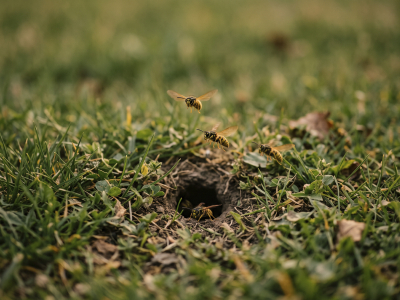
Wasps flying in and out just above the lawn, always at the same spot, then vanishing into a hole in the ground: you have an underground nest. It is often found by chance, while mowing or walking barefoot, and that is exactly when it becomes dangerous, because the colony defends its entrance. Here is how to recognise it, decide whether it needs destroying, pick the right moment and treat it without taking chances.
🔎 GROUND WASPS: WHAT ARE WE TALKING ABOUT?
There is no species called the “ground wasp”. The term covers the ordinary social wasps of our gardens that have built their nest in the soil rather than under a roof. To found her colony, the queen looks for a dark, sheltered cavity: an old rodent burrow, a hollow beneath a tree stump or a paving slab, a crack in a bank. There she builds a papery nest from chewed wood fibre, which grows all summer along with the colony.
Hornets nest in the ground less often, but it does happen, the Asian hornet included. The approach is the same, with extra caution: the colony is larger and more defensive. For the Asian hornet, trapping queens in spring helps limit the number of nests in summer, as we explain in our guide to the Asian hornet trap.
👀 HOW TO SPOT A NEST IN THE LAWN
From a distance, nothing gives away an underground nest: no grey ball hanging from a beam, just a hole in the grass, at the foot of a hedge or in a bank. What betrays it is the traffic. Wasps come and go constantly through the same opening, flying low along an almost straight line.
⏳ DOES IT REALLY NEED DESTROYING?
Not always. A wasp colony lasts a single year: it dies off in autumn, and only the young mated queens survive the winter, hidden elsewhere. In spring, each one starts a new nest; the old one is abandoned and will never be used again. An underground nest at the far end of the garden, well away from where people walk, can therefore be left alone until the first cold spell.
You should act, on the other hand, when the nest lies near a patio, a door, a path, a vegetable plot or a play area, and as soon as someone in the household is allergic to stings. If wasps mainly bother you at mealtimes, with no nest nearby, the answer is different: see our article on wasps on the patio.
| Situation | What to do |
|---|---|
| Underground nest well away from any path | Leave it: the colony will die off in autumn |
| Underground nest near a path or a patio | Treat it with powder, at dusk |
| Hornet nest in the ground | Treat it at dusk, with a larger dose |
| Nest hanging under a roof or in a hedge | A dedicated nest aerosol, not powder |
| Very large nest, play area, allergic person | Call in a professional |
| Nest found in winter | Nothing: it is empty and will not be reused |
🌙 THE RIGHT MOMENT: AT NIGHTFALL
When you treat matters as much as what you use. During the day, many of the workers are out foraging: treating the entrance then reaches only part of the colony, and the rest come back agitated. At nightfall or at dawn, activity is close to zero and the whole colony is gathered inside the nest. That is when a treatment stands the best chance of reaching all of it, and when you are least likely to be stung.
Find the entrance from a distance, mark it, and have the product and a torch ready to hand.
Once the comings and goings have stopped, approach calmly, treat the entrance and walk away without running.
Keep children and pets away for the 12 to 48 hours the product needs to work.
🧪 WHY POWDER FOR AN UNDERGROUND NEST
An underground nest extends through narrow, winding tunnels that you cannot see. Powder has one decisive advantage: it settles at the entrance and along the walls of the passage, and the wasps themselves carry it inside as they come and go. In doing so they contaminate the rest of the colony, right down to the larvae.
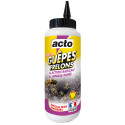
Our ACTO powder for underground nests combines two active substances, cypermethrin (0.4 %) and d-tetramethrin (0.05 %): the second acts quickly on contact, while the first extends the effect for up to 4 weeks. The nest is usually eliminated within 12 to 48 hours. It comes in a 400 g puffer bottle, which blows the powder in without any contact with the insects.
For a nest hanging under a roof, in a hedge or in roof timbers, powder is not the right answer: a wasp nest aerosol reaches the nest from a distance. You will find the full range of solutions in our section on flying insect control.
🚫 COSTLY MISTAKES TO AVOID
Faced with a nest in the ground, improvised remedies spread fast. Some are dangerous, others simply do not work, and most of them stir up the colony instead of getting rid of it.
🐶 CHILDREN, PETS AND THE GARDEN: PRECAUTIONS
An insecticide designed to destroy a nest is still a biocidal product and must be handled with care. For the 12 to 48 hours after treatment, keep children and pets out of the area: a dog sniffing at the nest entrance is exposed both to stings and to the product. The powder is very toxic to aquatic life: never use it near a pond, a water feature or a ditch, and do not release it into the environment.
A ground wasp sting is no different from any other wasp sting. It is painful and rarely serious, but it can be for someone who is allergic or in the case of multiple stings: if so, call 112 (or 999 in the UK) straight away.
Use biocides with care. Before use, read the label and product information.
Multitanks Expert Tip
After treatment, leave everything as it is. Check the entrance the next day and the day after, always from a distance: activity should stop within 12 to 48 hours. Do not block the hole or clean up the powder: it keeps working for 4 weeks on any wasps returning late. And if you find the nest in late autumn, rest assured it does not have long left: the colony will not survive the winter.
🧮 How much powder for your nests?
Enter the number of underground nests to treat
Share this content