IBC 1000 L accessories
 Heating jackets
 Fittings
 Drums, jerrycans & fittings
 Seeds

 Plant protection & biocides


 Garden

 Green spaces & municipal
 Barbecue, fire pit & fireplace
 Cleaning & care
 Refrigerants & air conditioning
 Watering
Food-grade plastic drum: how to recognise it and choose the right one
A drum is never neutral towards what it holds. The wrong plastic can release dyes or additives into food, and make a harvest, a juice or an oil stored for months unfit for consumption. The words « food grade » are therefore not a marketing claim : they are a tested guarantee, and one you can check yourself. Here is how to recognise it, what it actually covers, and how to choose the right drum for what you store.
Food grade: what the wording really guarantees
A drum described as food grade is a container recognised as suitable for lasting contact with foodstuffs. It has been tested to confirm that it releases no harmful substance : no dangerous dye, no recycled plastic loaded with chemical residues. That verification is what allows grain, food liquids or bulk preparations to be stored in an environment sealed against air and insects.
Not every plastic drum qualifies, and the distinction deserves to be stated plainly, because two expressions circulate and they do not mean the same thing.
The material — usually high-density polyethylene — can come into contact with food or water without immediate danger. That is a property of the material, not a guarantee over time.
The container has additionally been tested to prove the absence of dyes and chemicals liable to migrate into food. That is the wording which covers long-term storage.
In other words : « food safe » does not necessarily mean suitable for prolonged storage. If you are keeping a harvest, an oil or a juice for several months, food grade is what you should insist on.
Checking a drum yourself
The check takes seconds and needs no tool. Turn the drum over and look for the recycling number moulded into the base, inside a triangle.
💡 The second-hand drum trap. A drum that has held an industrial product does not become food grade again after washing : HDPE is porous and retains molecules from its previous contents. For food, start from a new drum whose history is known. If you are repurposing a drum for something else, our article 5 ideas for reusing a full open head drum suggests uses with no health risk.
Sealed, airtight, vacuum: what a drum can actually do
This is a common confusion, and it leads to disappointment. A properly closed food-grade drum is sealed : it keeps out water, damp air, insects and rodents. For grain, flour, dry goods or water, that is already the essential part.
It is not, however, a vacuum container : the air shut in with the product at closing time stays there. For goods sensitive to oxidation — oil, wholemeal flour, coffee — that residual air eventually takes its toll. Two simple measures address it :
The quality of the seal makes all the difference. On a full open head drum, the lid gasket must be supple and clean : a dry or deformed gasket no longer compresses. On a bung drum, the screw cap provides superior tightness, which makes it the default choice as soon as liquid is involved.
Why HDPE became the standard
High-density polyethylene combines four properties which explain its presence in almost every food container on the market, from milk bottles to 220-litre drums.
| Property | What it changes in use |
|---|---|
| Chemical resistance | Compatible with a wide range of foods, drinks and cleaning products without degrading. |
| Resistance to extreme pH | Tomatoes, gherkins, vinegar : highly acidic foods cause no migration of components. |
| High purity | Controlled manufacturing, with no cross-contamination from recycled material. |
| 100 % recyclable | The drum is recycled at end of life, limiting its environmental impact. |
One limitation is worth knowing : HDPE does not like ultraviolet light. A drum left in the sun all year eventually becomes brittle and chalky on the surface. Outdoors, place it in the shade or under a cover ; the opaque blue of our drums already limits light transmission considerably, which also protects the contents.
UN certification: when is it required?
The United Nations defines the rules applying to the transport of dangerous goods. Any drum used to ship regulated materials must carry a UN packaging code printed on its body, certifying the tests it has passed : drop, leakproofness, internal pressure, stacking.
For domestic use — storing water, a harvest, grain, animal feed — this certification is not required. It becomes essential as soon as the drum travels with a classified dangerous good : fuel, solvent, concentrated plant protection product. Our ADR/RID certified drums carry this marking.
Full open head or bung: the decisive choice
This is the question that determines everything else, and it is settled on a single criterion : the nature of what you are storing.
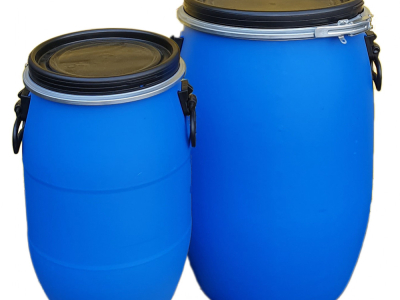
The lid comes off entirely, the opening matches the drum diameter. Essential for solids, powders and pastes, and for anything that has to be filled, emptied by hand then cleaned. Closed by a lever locking ring with gasket.
→ See the full open head drums, 30 to 220 litres
The top is closed, pierced by one or two screw caps. Tightness is superior, which makes it the container for liquids and viscous products intended for long storage or transport.
→ See the bung drums, 5 to 220 litres
Both ranges are in food-grade HDPE, in blue, from the 5-litre jerrycan to the 220-litre drum. If you are still hesitating, our guide to choosing between full open head and bung covers both uses point by point, and the effect of the opening on preservation explains why this choice weighs on storage life.
Which size for which use?
Size is chosen less on the quantity to store than on your ability to handle the drum once full. A 60-litre drum of water weighs 60 kg : it can no longer be moved by hand.
| Size | Common use | Handling |
|---|---|---|
| 5 to 20 L | Transport, dosing, back-up reserve, food-grade jerrycan | By hand, full |
| 30 to 60 L | Storing harvests, grain, animal feed | Two people, or partly emptied |
| 120 to 220 L | Fixed storage, water reserve, fermentation | Sack truck or pallet truck : to be installed permanently |
💡 Multitanks tip. Two 60-litre drums are often better than a single 120 : you move them alone, you can open one without exposing the other to air, and you keep two products apart. The price per litre is slightly higher, the flexibility far greater.
Looking after a food-grade drum
A well-maintained drum lasts for years. Three rules are enough.
The gasket is the wearing part. Check it at every filling : if it is hardened, cracked or flattened, it no longer compresses and tightness is lost. It can be replaced — the drum does not need throwing away.
In short
A food-grade drum is recognised by three signs : a recycling number 1, 2, 4 or 5 in the base, a glass-and-fork pictogram, and an explicit « food grade » mention — the one that covers long-term storage, as opposed to a simple « food safe ». HDPE meets this through its chemical resistance, its tolerance of extreme pH and its manufacturing purity.
That leaves a single decision : full open head for solids and anything that needs cleaning, bung for liquids that must stay sealed. And a size you will still be able to move once it is full.
Share this content