



 IBC 1000 L accessories
 Heating jackets

 Fittings
 Drums, jerrycans & fittings
 Seeds
Seeds 
 Plant protection & biocides

 Garden


 Green spaces & municipal

 Barbecue, fire pit & fireplace
 Cleaning & care
 Refrigerants & air conditioning
 Watering
Saving your vegetable garden after a heatwave: the right reflexes
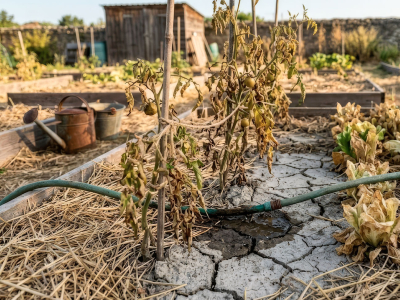
Many gardeners have opened the gate to their vegetable garden in recent days with a sinking feeling: leaves curled or outright scorched, a lawn turned straw-yellow, split tomatoes, soil as hard and cracked as a desert. The first reflex, entirely human, is to want to make up for lost time: water all at once, mow quickly, prune what appears dead. Yet it is precisely that reflex which can, without meaning to, make the damage worse. This article invites you to calmly assess the state of your garden, avoid the most common mistakes, and strengthen your crops before the new heat wave forecast for the first half of July.
🌱 Reading the stress signals without panicking
Before doing anything at all, the first thing to do is to observe your garden methodically and without rushing. A vegetable garden that has endured several consecutive days at 30, 35 or even 40 °C shows characteristic signs of water stress that it is important to know how to interpret before acting. These signals do not necessarily mean your plants are lost: they indicate that your garden has activated its defence mechanisms, and that it needs appropriate help, not vigorous intervention.
The most common signs after a heatwave are leaves that wilt or droop in the middle of the day, edges that brown or curl, soil that cracks on the surface, and roots that struggle to absorb water even when it is available. A plant that is wilted in the morning, when temperatures are still bearable, is a more serious signal than one that droops at 3 pm in full sun: in the latter case it is often a temporary reaction, and the plant generally recovers by evening. The gardener’s science after a heatwave is, above all, the science of patience and observation.
🌱 The counter-intuitive mistakes that make everything worse
The first major mistake after a heatwave concerns the yellowed lawn, and it is extremely widespread. Watching your grass turn straw-coloured is unpleasant, and the immediate reflex is to mow it short to “tidy things up” and water it abundantly to “save it”. Yet a yellowed lawn is not dying: it is going dormant, a natural and entirely reversible protective mechanism. It will turn green again spontaneously with the return of autumn rain, without any intervention whatsoever. Mowing short after a heatwave is, on the contrary, very harmful: it exposes bare soil to the sun, accelerates drying, and deprives the grass of the protection that taller blades naturally provide by shading the ground. It is far better to space out mowing sessions, raise the cutting height, and let time do its work.
The second mistake, perhaps the most damaging for the vegetable garden, is to resume watering all at once with a massive application, with the idea of “making up for lost time”. After prolonged water stress, the soil has compacted and its absorption capacity has decreased: a sudden heavy watering will simply run off the surface without reaching the roots. Worse still, this sudden water shock triggers violent physical reactions in already weakened plants: fruit — tomatoes above all — that stopped swelling during the drought gorge themselves with water too quickly and burst. Correct rehydration after a heatwave happens in successive stages: a first moderate application on day one, a second the next day, then a third the day after, progressively increasing the quantities. This rhythm gives the soil and roots time to restore their normal functioning.
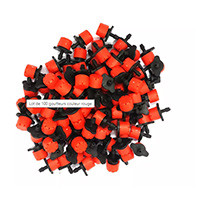
The third mistake is linked to how you water rather than how much: many people water quickly, hastily, spreading water over a wide area. Yet water deposited on the surface of hot, dry soil evaporates within minutes without ever reaching the deep roots. Effective watering after a heatwave is slow, directed at the base of the plants, aimed at penetrating 20 to 30 centimetres deep. This is exactly what micro-irrigation, drip, or oya systems allow: they deliver water slowly, in the right place, encouraging roots to grow downward rather than staying near the surface where they are exposed to heat. It is also an opportunity to rethink your irrigation system durably before the next wave.
Two other temptations must be absolutely avoided in the days following a heat peak. The first is to prune heavily plants that appear damaged: pruning creates open wounds, and an already weakened plant does not have the resources to heal properly. It is better to wait for a cooler period, ideally autumn, before working on the main framework. The second temptation to resist is fertilising to “give strength” to your garden: fertilisers stimulate vegetative growth, which mobilises energy the plant simply does not have right now. Fertilising a heat-stressed plant is like asking someone exhausted to run a sprint. The priority in the first few weeks is to stabilise before stimulating.
🌱 The right actions to revive your vegetable garden
Once the mistakes have been ruled out, it is time for genuinely effective actions. The first of these, and arguably the most powerful, is to reinforce mulching. If your soil is bare or lightly mulched, now is the moment to remedy that without delay. A layer of mulch at least 10 centimetres thick — straw, dried grass clippings, shredded ramial chipped wood (RCW) — applied after progressive watering, will lock in the moisture regained by the soil, dramatically reduce water requirements, and protect the microbial life of the soil. Without this shield, every watering session will be partly in vain, as evaporation regains the upper hand as soon as the sun returns. You will find suitable materials on the Multitanks gardening section to cover your paths and growing beds.
The second key action is the application of mature compost. Extreme heat damages the microbial life of the soil: the bacteria, fungi and micro-organisms that make nutrients available are affected. Applying a layer of well-decomposed compost on the surface, without incorporating it, restarts this essential biological activity. It is a gentle fertilisation, respectful of the pace of still-weakened plants, very different from a stimulating chemical fertiliser. This action also prepares your soil for late-summer sowings and autumn plantings.
Health vigilance is the third pillar of recovery. When moisture returns after a period of drought and heat, weakened plants are particularly vulnerable to downy mildew and powdery mildew. Regularly inspect the undersides of leaves on tomatoes, peppers, cucumbers and squash. If you water in the evening, be aware that moisture lingering all night on already weakened foliage is favourable ground for fungi: wherever possible, prefer watering early in the morning, before 8 am, so that leaves are dry before temperatures rise.
🌱 Potted plants, the forgotten victims of the heatwave
Container plants deserve particular attention after a heatwave episode, as they accumulate several vulnerabilities: a limited volume of soil, roots exposed to heat through the walls of the pot, and total dependence on human watering. Unlike plants in open ground that can draw moisture from depth, a plant in a pot only has access to what the gardener provides. During the heatwave, many containers saw their potting mix dry out completely, sometimes to the point where capillary action no longer works: water then passes around the root ball without penetrating it.
To correctly rehydrate a pot whose soil has completely shrunk away from the sides, the most effective technique is soaking: submerge the pot in a tub of water for 20 to 30 minutes to allow the root ball to gradually reabsorb moisture. For upcoming hot periods, place saucers filled with damp clay pebbles under your containers: they create a cool, humid microclimate around the roots without waterlogging the root system. Also move the most vulnerable pots to shade during the critical hours of 12 pm to 5 pm: even a few hours of shade is enough to significantly reduce heat stress.
After prolonged drought, never water all at once. Split watering over three consecutive days, increasing the quantities. Roots gradually regain their absorption capacity, and fruit avoids the sudden splitting caused by water shock.
10 cm of mulch after each deep watering is the most cost-effective action a gardener can take. It reduces evaporation, protects the soil, feeds earthworms and prepares the ground to withstand the next heat wave without extra effort.
Weakened plants are ideal targets for downy mildew and powdery mildew as soon as moisture returns. Inspect the undersides of leaves every two days, prefer morning watering to keep foliage dry at night, and act at the first signs.
🌱 Anticipating the next wave before it arrives
The year 2026 has confirmed this in a striking way: heatwaves are no longer content to be isolated events — they sometimes follow one another only weeks apart. A new heat wave is forecast for the first half of July, and this is valuable information: it gives you a few days to strengthen your garden’s defences rather than simply tending its wounds. The first anticipatory action is a deep, abundant watering — not the evening before the heatwave, but right now, to build a deep water reserve in the soil that plants can draw on when temperatures rise. The deeper the water in the soil profile, the more roots are encouraged to go down in search of coolness.
Mulching, already mentioned for recovery, also plays a decisive role in anticipation. A well-mulched soil before a heatwave retains its moisture for several days longer than bare soil, significantly reducing crop stress. For young plants, lettuces, basil and all soft-leaved plants, installing shade cloth filtering 30 to 50% of light allows them to get through the hottest hours without leaf scorch. These cloths are easily placed over hoops or stakes and removed as soon as temperatures return to normal.
Also think about your water supply. During drought episodes, pressure on water resources can lead to prefectural orders restricting usage. Having a storage tank or a rainwater harvesting system allows you to build an autonomous reserve that proves extremely valuable during these restrictions. 1000-litre IBC tanks and their accessories are particularly well suited for storing rainwater in significant quantities and supplying an irrigation system during restriction periods. Combined with a drip or micro-irrigation system, they durably transform the resilience of your garden in the face of increasingly hot summers.
🌱 The Multitanks expert tip: The best action when faced with a stressed garden is often the one you do not take in haste. A mowing avoided, a fertilisation postponed, a split watering rather than a massive one: these non-actions or half-actions save far more plants than vigorous but poorly calibrated intervention. Patience and observation are the two most powerful tools a gardener has after a heatwave. Plants have remarkable resilience as long as they are given the time and conditions to express their natural recovery capacity. To go further in equipping your garden, explore our product selection at Multitanks Gardening.
Share this content