IBC 1000 L accessories
 Heating jackets
 Fittings
 Drums, jerrycans & fittings
 Seeds


 Plant protection & biocides

 Garden


 Green spaces & municipal
 Barbecue, fire pit & fireplace

 Cleaning & care
 Refrigerants & air conditioning
 Watering
Why choose PVC-U PN16? Safety & Pressure | Multitanks
The choice of materials for a hydraulic network is a critical step. Whether for a swimming pool, a sprinkler system or an industrial network, the longevity of your installation depends on it. PVC-U (unplasticized polyvinyl chloride) has become the reference standard. But one question often comes up: what pressure class should you choose? The difference between PN10 and PN16 is more than just a number. Today, PN16 represents the choice of absolute safety. This article explains why this pressure class is strategic for your installations.
Understanding the notion of Nominal Pressure or PN
Before getting to the heart of the matter, let's define "PN". Nominal Pressure corresponds to the maximum pressure (in bars) that a pipe or fitting can withstand continuously at 20°C, over a service life of 50 years.
- PVC PN10: Designed for 10 bar constant pressure.
- PVC PN16 : Certified for 16 bars.
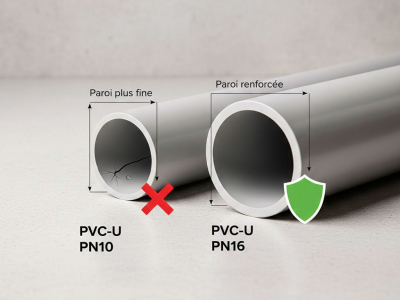
The 6-bar difference may seem pointless to a homeowner whose network is limited to 3 or 4 bars. However, PN should not be seen as a limit, but as an overall safety margin. PN16 has thicker walls. This extra thickness strengthens the mechanical structure in the face of impact and temperature variations.
Superior mechanical resistance to water hammer
The No. 1 enemy of a hydraulic system is water hammer. This phenomenon occurs when there is a sudden change in water velocity, such as the rapid closure of a manual valve, the sudden shutdown of a pump or the activation of a solenoid valve on a sprinkler system. This shock wave creates a momentary excess pressure. It can far exceed your network's normal pressure.
In a PN10 installation, a violent water hammer can approach the material's breaking point. This creates invisible micro-cracks that will eventually give way. Thanks to its thickness, PVC-U PN16 is much better at absorbing these stress peaks. It acts as a genuine structural shock absorber. For a pool where the pump is activated several times a day, this is an indispensable guarantee.

Greater protection against temperature variations
PVC is a thermoplastic material. Its properties change with temperature. In hot weather, PVC softens and its resistance to pressure decreases. In cold weather, plastic becomes more brittle. In summer, a pipe exposed to sunlight or heated pool water reduces the actual strength of a PN10 pipe.
If heat reduces your pipe's resistance by 40%, your safety margin becomes very slim. With PN16, even with a loss of resistance due to temperature, the base is so high that you always remain in a comfort zone. It's the assurance of a reliable network, whether you're in the middle of a heatwave or a harsh winter.

Why PN16 is a pool owner's best ally
Swimming pools are where PN16 is most indispensable. A swimming pool is not a static circuit. It's a system where large volumes of water circulate at high speed. The fittings are subjected to the vibrations of the filtration pump, the aggressiveness of the chemicals (chlorine, salt, bromine) and the frequent manipulation of the valves.
Using PN16 fittings in your technical room will prevent leaks at the bonding point. A PN16 fitting offers a more robust contact surface and rigidity that prevents the pipe from vibrating. A leak in a technical room can cause major electrical damage. Investing a few extra euros in PN16 protects equipment that costs thousands.
Resistance to chemicals and corrosion
PVC-U is renowned for its chemical resistance. It does not rust or oxidize. However, this resistance depends on the density of the material. PVC-U PN16, being denser, offers a more effective barrier against chemical permeation over the long term.
In agricultural (fertilizers) or industrial (cleaners) environments, walls are put to the test. Chemicals can weaken PVC's molecular structure over the years. A PN16 pipe will take much longer to lose its properties. This robustness guarantees that the water transported will not be contaminated by plastic degradation.
Easier installation and better bonding properties
The installation of a PVC network depends on the quality of the cold bond. PN16 products generally benefit from tighter manufacturing tolerances. The superior rigidity of PN16 also facilitates pipe insertion into the fitting. Because the tube does not ovalize under pressure or during cutting, the fit is perfect.
When it comes to preparation (deburring and sanding), having a thick wall means you can prepare the surface well without over-refining the material. Finally, a more rigid structure requires fewer clamps. Your network won't "belly up" under the weight of water. The visual appearance is straighter and more professional.
UV-resistant PN16: greater outdoor durability
Although treated against UV rays, PVC eventually ages under the effect of the sun. The surface layer becomes drier and sometimes discolored. On a thin PN10 pipe, this degradation represents a significant proportion of the total thickness. On a PN16 tube, the impact of UV rays remains localized on a tiny fraction of the structure.
This is crucial for surface sprinkler systems or exposed piping on facades. By choosing PN16, you give yourself a "wear margin". Even after 10 years of exposure, the deep structure will remain intact. This is an essential safeguard against the splintering of materials that have "baked" in the sun.
A profitable investment over the product life cycle
It's tempting to choose PN10 to save a little money. But if you look at the cost over 10 or 20 years, PN16 is the systematic winner. The cost of fittings is only a small part of a hydraulic project. The most expensive part is labor, earthworks and equipment replacement in the event of a leak.
Imagine having to dig up your garden again to replace a PN10 elbow that has cracked under the pressure of soil compaction. The cost of repair will be ten times greater than the initial savings. PN16 is insurance against the unexpected. Once installed, you'll have peace of mind for decades to come.
Case studies: when PN16 saves your installation
Example 1: Automatic watering. Solenoid valves close instantly, creating massive shocks. PN10 systems are often found to leak at the elbows after just 3 years. Upgrading to PN16 solves the problem once and for all.
Example 2: Unstable ground. Soil moves and settles according to humidity. These movements exert bending forces on buried pipes. The robustness of PN16 enables it to withstand these mechanical stresses far better than a thin, flexible product.
Conclusion: Choose excellence with PVC-U PN16
PN10 may suffice for unpressurized drainage. But when it comes to safety, PN16 is the obvious choice. It offers superior resistance to water hammer, better heat and UV resistance, and a more rigid, cleaner installation.
At Multitanks, we put quality first, because a hydraulic network is the heart of your installation. Choosing our PVC-U PN16 products means investing in professional equipment designed to last. Don't let a small saving compromise the safety of your pool or operation. Choose the robustness of PN16.
Hydraulic Safety Calculator
Answer these 4 questions to find out if your installation requires **PVC-U PN16** or if **PN10** is sufficient.
Share this content