IBC 1000 L accessories
 Heating jackets

 Fittings

 Drums, jerrycans & fittings

 Seeds

 Plant protection & biocides



 Garden



 Green spaces & municipal



 Barbecue, fire pit & fireplace

 Cleaning & care

 Refrigerants & air conditioning

 Watering



Drought resistant grass seed: sowing a lawn that lasts
Summers keep getting hotter and drier, hosepipe bans return year after year, then autumn and winter bring far too much rain: the lawn takes every hit, and many simply give up. Yellow by July, patchy by October, overrun with moss by spring. The good news is that a hard-wearing lawn is not only a matter of watering. Most of it is settled on sowing day, through the choice of grasses.
☀️ WHY LAWNS SCORCH IN SUMMER
A standard ornamental lawn has shallow roots. As long as the topsoil stays moist, all is well. During a drought, however, it is precisely those top few centimetres that dry out first: the roots have nothing left to draw on, and the blades turn yellow and then straw-coloured.
Three habits make things worse: mowing too short, which leaves the soil exposed to the sun; short, frequent watering, which keeps roots near the surface; and compacted soil or a thick thatch layer, where water runs off instead of soaking in. By contrast, a lawn with deep roots and longer blades gets through a dry summer far better, using much less water.
And once watering is no longer allowed, the matter is settled for you: during restrictions, lawn watering is among the first uses to be curbed, as we explain in our article on water restrictions. It makes sense, then, to sow a grass that needs very little of it.
🌾 A BLEND BUILT FOR AN UNPREDICTABLE CLIMATE
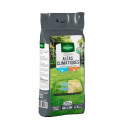
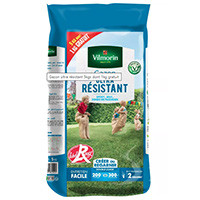
The Vilmorin Climate-Resilient Lawn Seed blend was selected for exactly these conditions: heatwaves and dry spells in summer, heavy rain and sudden swings for the rest of the year. It combines three grasses that each play a different part.
This is the key player against drought: its roots reach far deeper than those of an ornamental lawn. When the surface is parched, it can still tap into moisture held deep in the ground.
A variety carrying four sets of chromosomes (4N): seedlings that establish faster, grow thicker and stand up better to disease. Quick germination covers bare ground before weeds can move in.
The classic lawn grass: it brings fast establishment and a fine sward, rounding off the toughness of the other two.
The aim: a lawn that stays green for longer while others go brown, and fills back in without bare patches as soon as the rain returns. Once established, this grass gets by on light watering. Vilmorin does not disclose the exact ratio of the blend; it is made up of these three grasses, with no added fertiliser, as pure seed.
📅 WHEN TO SOW: AUTUMN, AN IDEAL WINDOW
This seed can go down at any time of year, provided you avoid frost and prolonged heatwaves. Autumn has every advantage: the ground still holds summer warmth, rain is back, and young plants have all winter and spring to root before the first hot spell. It is also the right moment to repair a lawn damaged over summer.
| Your situation | What to do | Amount |
|---|---|---|
| Scorched or thin lawn | Overseed after scarifying | 5 kg per 300 m² |
| Bare soil, new lawn | Sow on prepared ground | 5 kg per 200 m² |
| Dry ground, area prone to hosepipe bans | Swap gradually through repeated overseeding | 5 kg per 300 m² each time |
🛠️ HOW TO OVERSEED A DRY, SUMMER-DAMAGED LAWN
There is no need to dig everything up to get a new lawn. Overseeding works the new blend into the existing turf, which is slowly taken over by hardier grasses.
The first shoots come through in under 2 weeks in good conditions, and the lawn can take full use after 6 to 8 weeks. To get this key step right, see our guide why and how to scarify your lawn.
✂️ LAWN CARE THAT KEEPS IT GREEN
A tough grass performs at its best when you let it get on with the job. Rule number one: never scalp it. Grass cut too short becomes far more vulnerable to foot traffic and dry weather. Leave a few centimetres: the shade cast by the blades keeps the soil cool.
When it comes to water, the cheapest supply is still the one falling from the sky: a storage tank filled by autumn and winter rain holds a reserve for summer watering, even when mains water is restricted. Read our article on rainwater harvesting, and our full guide to lawn care.
🙋 YOUR QUESTIONS ABOUT DROUGHT TOLERANT LAWNS
Will this grass stay green without ever being watered?
No, and no lawn can. You need to water it regularly until it reaches 10 cm, while it takes root. Once established, it needs little water: it holds out much longer than an ordinary lawn, and if it yellows in a severe drought, it recovers with the first rain.
How much seed do I need per square metre?
One 5 kg bag covers 200 m² for a new lawn, which is 25 g per m², and 300 m² for overseeding, roughly 17 g per m². The calculator at the bottom of the page works it out for your area.
Can I sow in spring instead of autumn?
Yes. This blend can be sown all year round, as long as there is no frost and no ongoing heatwave. In spring, sow early enough for the grass to be well rooted before the first hot weather, and keep an eye on watering.
How soon can I walk on the lawn?
The first shoots appear in under 2 weeks in good conditions. Keep foot traffic to a minimum while it germinates: the lawn can take full use 6 to 8 weeks after sowing.
Multitanks Expert Tip
A lawn that has gone yellow in midsummer is not necessarily dead: many grasses go dormant to save water and bounce back with the autumn rain. Wait for that rain before assessing the damage, then overseed only the areas that fail to green up. Each round of overseeding with a hardier blend leaves your lawn a little better equipped for the following summer.
🌱 How much seed does your lawn need?
Enter the area and the type of job
Share this content